
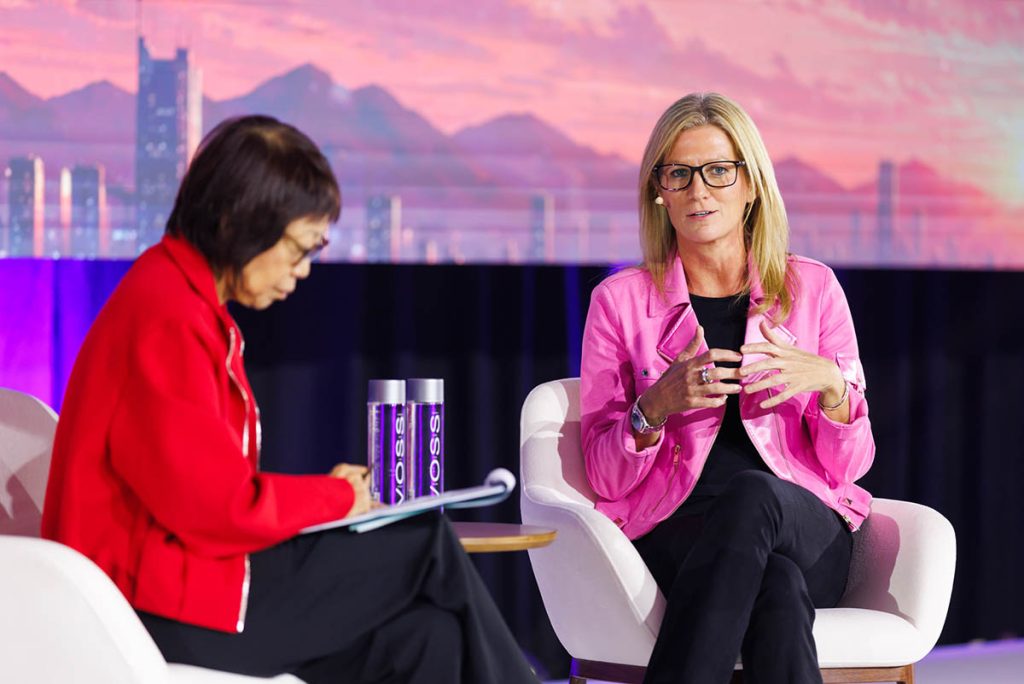
Every WiT Singapore 2026 speaker was asked to pick a song that captures a new beginning. Laura Houldsworth, Managing Director, Asia Pacific at Booking.com, chose Bon Jovi’s “It’s My Life.” A few times in her life, she said, she has had to make critical decisions, and the song speaks to those moments.
WiT is marking its 21st year in Asia. Does she feel the way she did at 21? “I feel as excited as I did when I was 21. A bit less naive, but otherwise the fear and the excitement are the same.”
Her job, in part, is to champion Asia inside an American company, and that has become easier. What has happened in Asia over the past 21 years is now plainly visible to the rest of the world. “I don’t need to spend too much time preaching about the opportunity size of Asia, because the size and scale are enormous. The future of travel is very much here.”
So what does she find herself having to champion and fight for these days? Localisation, she says.
Innovation lab or receiving end?
The numbers say Asia is ahead in customer adoption of AI. Booking.com’s own research found 64% of APAC travellers use AI to plan trips, and according to Google, seven of the world’s top 10 markets for AI usage are in the region.
So is APAC Booking’s innovation lab, she was asked?
“I’d love to say we are,” Houldsworth said. The region has a habit of skipping technology generations and going straight to what’s next, and hyper-personalisation plays to that.
That makes localisation, at speed, close to imperative, especially against rivals such as Trip.com and Agoda (a sister brand in the Booking Holdings family). For her, payments are where it starts. Asia isn’t one payment market. Travellers want to choose how they pay, including spreading the cost over time. “That is critical, and that is the space we’ve focused on.”

Booking Holdings CEO Glenn Fogel has long talked up AI. The group’s newest bet is Lola, an AI assistant built by Kayak co-founders Steve Hafner and Paul English. It doesn’t just plan and recommend. It books and executes on the traveller’s behalf, and works on a membership.model for now.
Then there’s the other newly launched Booking bet, Vayo, which CEO and co-founder Mike Fridgen describes as “not another planning tool, chatbot, or do-it-all agent.” It builds your trips from the confirmations in your inbox, catches price drops and refunds, and goes after the hard-to-get 7pm table. It’s backed by a planned $100M from Booking Holdings, and the beta is invite-only.
Houldsworth was asked, will a fully agentic model like that work in Asia, a region of super apps, digital wallets and local ecosystems? She thinks it scales well, because the model is about the individual, not the market. “We don’t need to make it specific for Singapore or Malaysia or Japan. It’s unique to you. It takes personalisation and localisation to a whole other level.”
The group’s advantage is that it can test AI across several brands at once, she said. “We don’t know what 21 years looks like. We don’t even know what 21 months looks like in this space.”
Travel starts with intent, not a destination
Asia is also intensely social, and social has become a key channel for winning customers. “Social is absolutely critical, and it has been for quite some time,” she said. What social drives is the visualisation, “the feeling, the realisation of travel well before it happens. People still need to see it. You need to feel it in advance.”
Her phrase for it: “Travel starts with intent, not a destination.”
Vitamins, not dessert
The session turned to the why of travel, and to happiness. Booking.com recently launched its first Travel Happiness Index in Asia Pacific, the only region where it has done so. It surveyed more than 10,000 travellers across 10 APAC markets.
Asked which traveller segment she would bet on over the next two years, Houldsworth picked necessity travel: trips people take for their wellbeing. The data backs her. According to the index, 84% of APAC travellers say travel helps them reset mentally and emotionally, and 98% associate travel with positive emotions.
So is travel a vitamin or a dessert? The audience poll leaned towards vitamins, “very much in line” with her research. Travel used to be dessert, she said: a sweet treat, something we work towards, earn and spoil ourselves with. Now it’s a vitamin, something people aren’t willing to give up.
That resilience shows up in another finding. When plans are disrupted, 90% of APAC travellers would rather adapt than abandon their trip.
The thing we keep forgetting
What does the industry keep forgetting, she was asked? Her answer – that a lot of travellers actually enjoy the planning, sometimes more than the trip.
The Happiness index found 60% of travellers enjoy planning. Houldsworth wants that number much higher, and she sees it as the industry’s job. “Planning should be much more fun.”
That is the real promise of AI for an OTA: not just faster bookings, but taking the stress out of the part of the journey that should be half the joy, she believes.
Watch the full session: