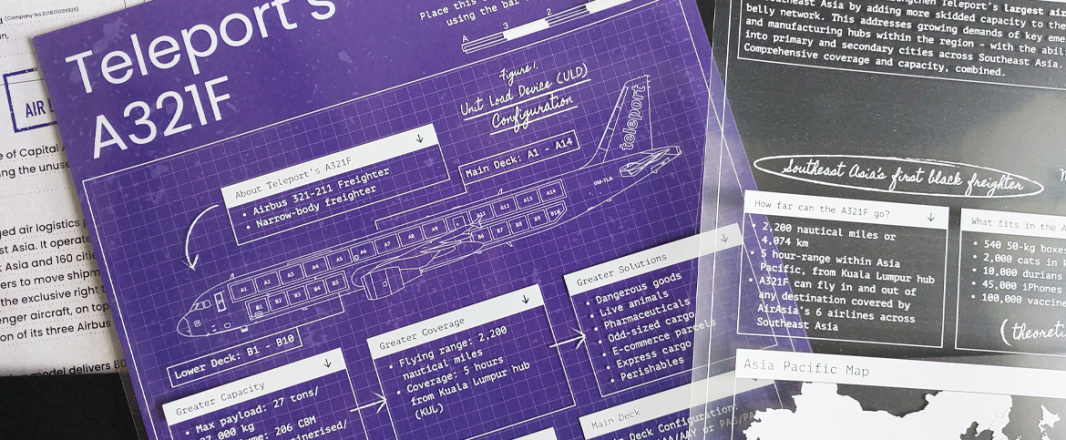
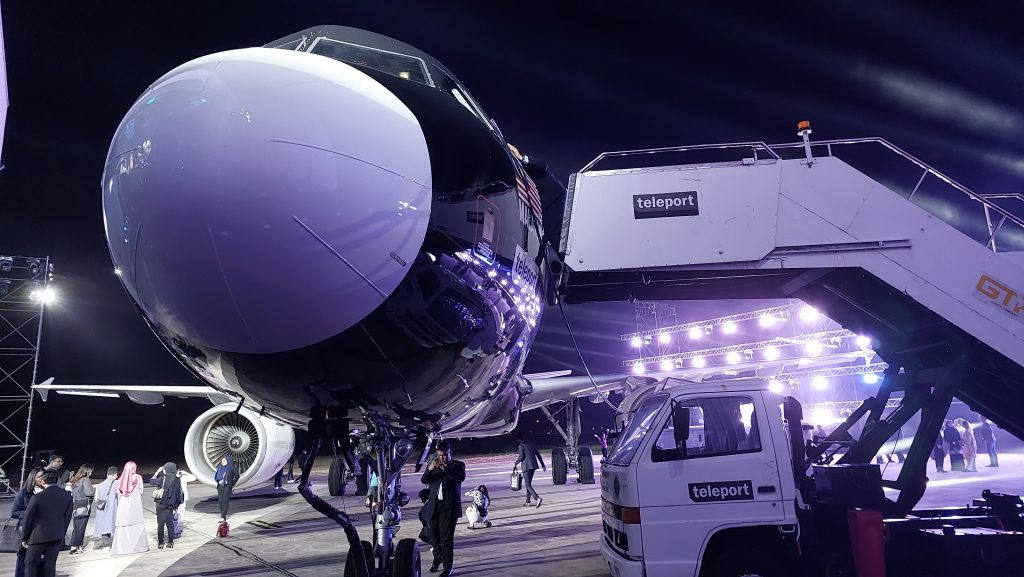
The Airbus 321 freighter (A321F), named Awan, turns Teleport into full-fledged air logistics provider.
When I got the invitation to attend the unveiling of Teleport’s first A321F aircraft, I didn’t know what to expect. I remember being at the launch of Malaysia Airlines’ first Airbus A380 when I was a teenager – it was a big event because, theoretically, this colossal vehicle would be accessible for the public to fly in.
Logistics is a different story.
The whole process is behind-the-scenes and doesn’t require your participation for the most part. It’s about measurements and weight-by-boxes, scales, packages and parcels. So, I was genuinely surprised at how cool the unveiling of the new A321F was.
“Dominate the Skies” was the theme of the evening. They had launch videos painted in future-retroism, a hangar converted into an event space, unveiling the plane to Daft Punk’s “Contact” (an insanely good track that closes off the Random Access Memories album) and a lightshow to go along with it. It was a whole production. Top marks for branding because that is Teleport’s main mission, is it not? To make regional logistics accessible and affordable to everyone.
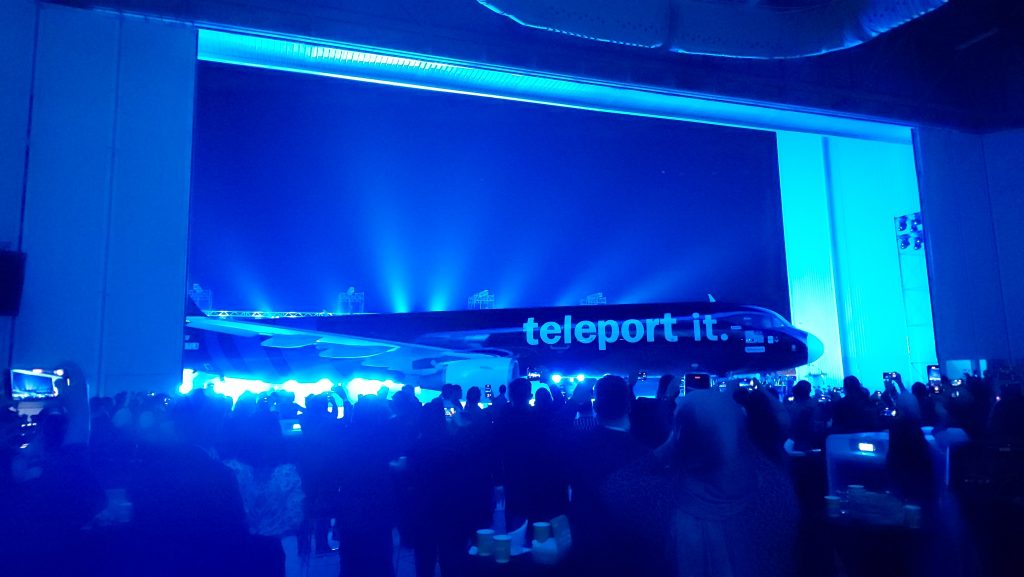
Yang di-Pertuan Agong Al-Sultan Abdullah Ri’ayatuddin Al-Mustafa Billah Shah graced the event, with Transport Minister Anthony Loke also in attendance.
Teleport is, of course, AirAsia’s logistics venture and I couldn’t help but notice the melding of ideologies between the two; they’re both fairly scrappy companies focused on mass accessibility. What interests me most is how both brands, under Tony Fernandes’ Capital A group, have doubled down on air logistics lately.
The induction of the A321F means Teleport is now a full-fledged air logistics provider. Previously, they only relied on the belly space of AirAsia’s passenger aircrafts.
Still, Pete Chareonwongsak, CEO of Teleport made it clear that the company isn’t moving to a freighter-only model. “Anyone who operates just a freighter is not going to win in this market, so you’ve got to have belly space and a freighter. This is our time.”
It’s not as “sexy” as low-cost airfare and passenger airlines, but the implications of Capital A’s strategy are far-reaching, as this development opens up new opportunities for small businesses to expand their reach and deliver products at affordable prices.
Founded five years ago, Teleport has evolved rapidly by consolidating unused passenger flight belly capacity of all AirAsia airlines into a single network. Underpinned by this infrastructure, Teleport has built Southeast Asia’s largest air logistics network, while tackling the growing demands of emerging production and manufacturing hubs in the region.
Teleport’s growth has been driven by three key factors. Firstly, its air logistics network, utilizing surplus belly space from 204 AirAsia passenger aircraft, has set it apart. Secondly, Teleport’s focus on digitization and data integration has enabled coordination of end-to-end e-commerce deliveries. Finally, the company’s ability to form relationships with third-party airlines has contributed significantly to its success.
Chareonwongsak emphasized that the addition of the A321F will allow Teleport to expand its reach in the Asia-Pacific region, while strengthening its position in Southeast Asia. The company anticipates acquiring three more A321Fs by the end of this year, with plans for a total of 10 freighters within the next 18 months. This is bolstered by Teleport’s profitability and its projected $200 million in annual revenues.
“Our number one route, by volume, in the whole region is in the Philippines,” said Chareonwongsak during the media conference. This was echoed by Tony Fernandes, CEO of Capital A, who emphasised, “Philippines is where we see Teleport being a very big operation. AirAsia Philippines is doing most of Teleport’s work right now through the belly space, they’re working with other airlines, but in the not-too-distant future the 10 aircrafts that we’re talking about… some of those will be destined for the Philippines.”
Chareonwongsak said the additional skidded capacity provided by these freighters expands Teleport’s air cargo network, enabling the company to carry more and serve a broader range of customer needs. Kuala Lumpur, as the hub for the first A321F, offers strategic advantages with its 5-hour flight range, granting access to over 80 destinations in Southeast Asia and an additional 80 key cities across the Asia Pacific.
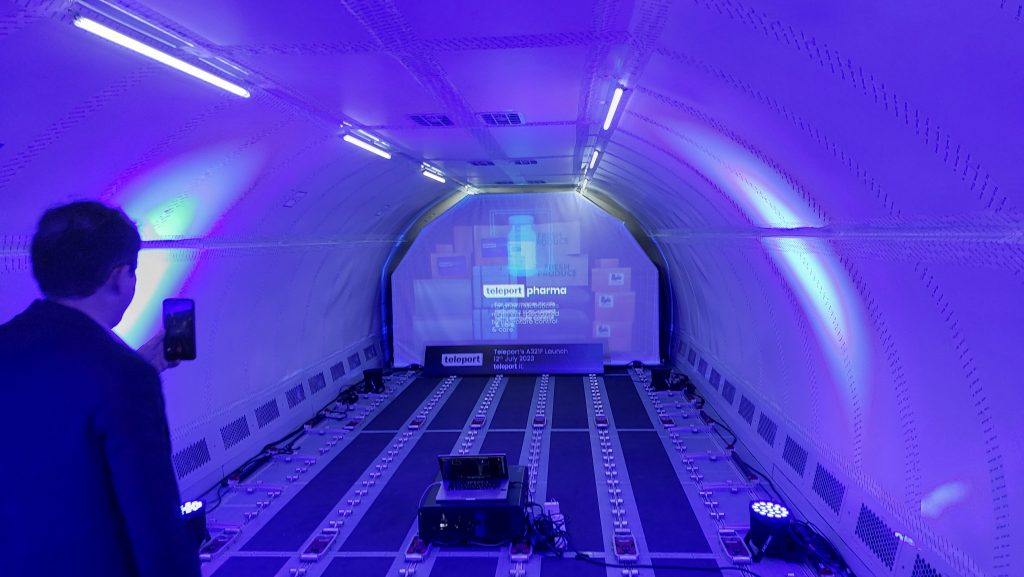
Teleport’s A321F is equipped with 24 containerized positions across the main and lower decks, enabling a maximum payload of 27 tons/27,000 kilograms. This capacity allows for the transportation of various cargo types, including e-commerce parcels, express deliveries, large volume shipments, and dangerous goods. The delivery of the second and third A321Fs will give Teleport the flexibility to be based in Kuala Lumpur, Bangkok, Jakarta, or Manila.
It wasn’t long before the question of further diversification was brought up to both Fernandes and Chareonwongsak. With so much growth, would Teleport venture into land and sea logistics as well? The short answer is no.
“The model that Teleport has built is a multimodal model,” said Fernandes to the press. “While we work on planes, there’s nothing to stop Teleport from working with rail operators, land operators, and sea. Obviously, sea is still the cheapest. There are so many e-commerce sellers, but they generally sell in their own town – because logistics is expensive. We see that as a huge disruption, and a huge opportunity, at providing small businesses a chance to expand their product. That could be a combination of sea, rail, road, and flight.”