
FCM Consulting’s Q2-2023 Global Trends Report highlights challenges and opportunities for corporate travel
The second quarter of 2023 was a period of halves in the global travel landscape, as detailed in the latest Global Trends Report by FCM Consulting. While the Northern Hemisphere witnesses a surge in travel demand during the summer, the rest of the world plateaued in travel patterns. The report, which encompasses data sourced from FCM and Flight Centre Travel Group corporate bookings, coupled with Cirium aviation schedule data as of August 8, 2023, reveals that business trip volumes are on the rise. Despite this, ongoing disruptions due to extreme weather events and shortages in airport staffing continue to reverberate across the industry.
FCM Consulting’s Q2-2023 Global Trends Report underscores the intricate dynamics shaping the corporate travel and accommodation sectors in Asia and beyond. While challenges such as disruptions persist, businesses can leverage strategic planning and technological integration to optimize travel budgets and navigate evolving trends. The report’s insights shed light on a diverse landscape characterized by fluctuations in airfare, accommodation costs, and evolving traveler preferences.
Bertrand Saillet, the Managing Director of FCM Asia, emphasized that even though airfares and hotel room rates have remained high in Asia, prudent planning and the integration of technology can empower businesses to optimize their travel budgets effectively.
Strategies for optimizing budgets in corporate travel
In the realm of corporate travel, managing budgets efficiently remains a priority. To this end, several strategies can be adopted:
- Advance Planning: Strategic planning well in advance remains a reliable approach to secure better value for travel expenses, a tactic that remains relevant in the current market.
- Leveraging Expertise: Partnering with Travel Management Consultants (TMCs) can assist in streamlining complex travel itineraries and optimizing supplier contracts.
- Technology Integration: Utilizing booking technology equipped with budget controls like price caps and filters can help maintain fiscal discipline.
- Exploring Supplier Contracts: Regularly evaluating and considering new supplier contract offers is vital, given the dynamic nature of commercial models.
Market dynamics and trends
Aviation Fuel and Pricing: The second quarter of 2023 witnessed fluctuations in jet fuel prices, increasing from $94 to $103 per barrel due to heightened summer demand in the Northern Hemisphere and strengthened travel activity in Asia. By early August 2023, prices had averaged at $119 per barrel, with projections indicating further hikes as travel demand in Asia continues to surge.
Environmental Considerations: Glenn Thorsen, FCM Consulting’s Sustainability Lead, has collaborated with CAPA (Centre for Aviation) and Envest Global to offer insights into air travel environmental plans. The partnership employs the latest market data to assist corporations in addressing sustainability within their travel practices.
Persistent Disruptions: As the latter half of 2023 unfolds, air travel disruptions remain a concern. Extreme weather conditions and shortages in airport staffing—particularly among air traffic controllers—continue to be the primary culprits disrupting air travel schedules. These disruptions are impacting a significant portion of flights daily, resulting in reduced schedules and capacity caps at airports.
The Era of Hybrid Work: The McKinsey Global Institute underscores the lasting influence of hybrid work models, with employees averaging three days a week in the office. While this trend remains dominant, future shifts in labor dynamics or productivity could influence its trajectory. Key facts related to post-COVID hybrid work include reduced office attendance by 30%, a 7% migration of individuals from cities to suburbs, and the demand for mixed-use areas in travel hubs to facilitate work on the go.
Policy Evolution: Adapting travel programs to align with contemporary internal and external influences necessitates ongoing policy and process reviews. Key updates in 2023 include a focus on traveler wellness, engagement in sustainability, travel with purpose, personal safety, security, smart budgeting, carbon management, total booking consolidation, and technology integration.
Domestic Air Travel and Pricing Trends
Strong Domestic Demand: The global air travel landscape is witnessing robust domestic travel demand, particularly in major markets such as China, where demand is merely 1% lower than in 2019. Japan and India have experienced notable increases of 20% and 13%, respectively. These trends are attributed to factors such as airline competition, staffing capabilities, economic climate, and supply and demand dynamics.
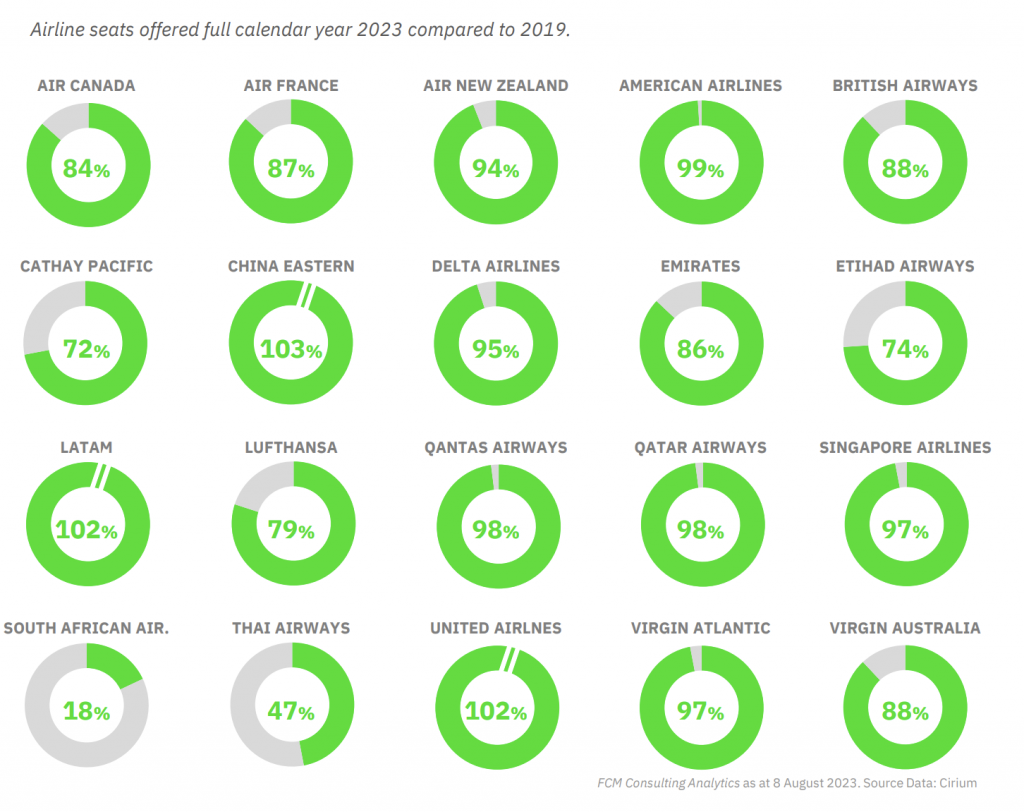
Recovery of Airline Seats: The forecast for domestic airline seats indicates a notable recovery, surpassing 2019 volumes by an anticipated 4.1%. While the Asia Pacific region has seen a 6.9% increase in domestic seats, international seat numbers remain 22.5% below 2019 levels. Among the 20 major airlines, forecasts indicate a 93% return of seats in 2023 relative to 2019. China Eastern leads with a projection of 103%, followed by LATAM, United Airlines, American Airlines, Qantas, and Qatar Airways.
Business Class Fares and Accommodation Trends
Business Class Fare Variations: Notable variations in business class fares have been observed across regions. The Middle East witnessed a 29% increase, followed by Australia and New Zealand at 27%, and Asia at 19%.
Hotel Room Rate Dynamics: The second quarter of 2023 saw diverse trends in average room rates. Europe experienced a 12% rise, North America saw a 5% increase, and Latin America observed a 3% uptick. Conversely, the Middle East and Africa witnessed a 19% reduction, while Asia and Australasia saw decreases of 2% and stability, respectively.
City-Specific Insights: Tokyo emerged as the costliest city to stay in Asia, with average rates of USD$286 per night, followed by Singapore at USD$260. Notably, Hong Kong overtook Seoul as the third most expensive hotel destination in Asia due to China’s border reopening.
China’s Hotel Market: In China, Beijing experienced a 12% increase in hotel room rates, reaching USD$175 per night, while Hong Kong and Shanghai saw rises of 10% and 5%, reaching USD$246 and USD$140 per night, respectively. Within India, Bangalore led with an average rate of USD$146, followed by Delhi at USD$120 and Chennai at USD$101 per night.
Occupancy Trends: As of June 2023, global occupancy rates stood at 63.3%, signaling a 96% recovery compared to 2019. Mumbai and New Delhi exhibited the highest occupancy rates in Asia, reaching 101% and 97% respectively, followed by Shanghai and Beijing at 95% and 93%.