
The effectiveness of Influencer Marketing in driving direct sales is not significant, but there’s still a lot of value in this vertical, says Milieu study
In the last decade or so, the undeniable growth of social media has given rise to a new breed of celebrities: the influencers. These individuals wield significant sway over their followers and have become a central component of marketing strategies. In Southeast Asia, where the online world thrives, a recent survey conducted by Milieu Insight sheds light on the interesting, and somewhat surprising, dynamics of influencer marketing, revealing both its strengths and its challenges.
Looking at Influencers through a South-east Asian lens
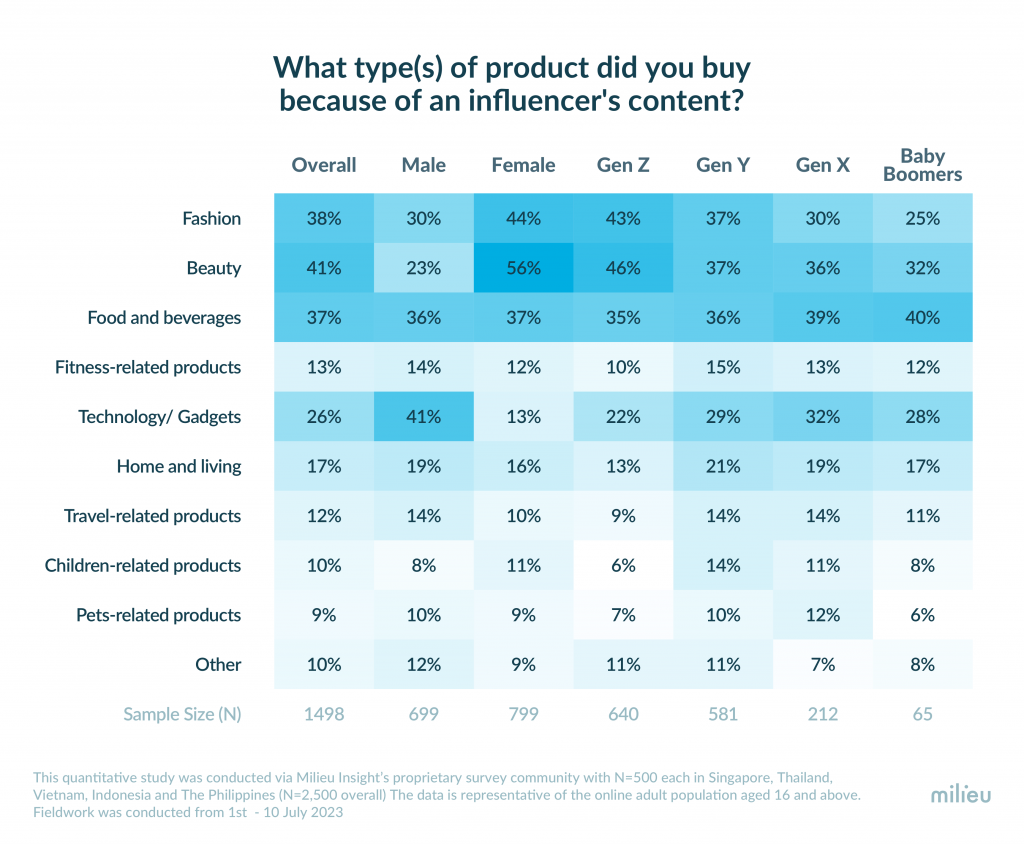
The role and impact of influencers vary across age groups. Approximately one-third of respondents state that influencers have expanded their knowledge of brands and products. The top three areas of purchase influenced by influencers are beauty (41%), fashion (38%), and food and beverages (37%). For males, tech/gadgets (41%), food and beverages (36%), and fashion (30%) are the most common products purchased.
Across Indonesia, the Philippines, Singapore, Thailand, and Vietnam, a substantial 56% of Southeast Asians actively follow influencers on various social media platforms. These digital role models have seamlessly integrated themselves into our daily feeds, transforming marketing tactics along the way. However, the extent of this phenomenon varies across countries.
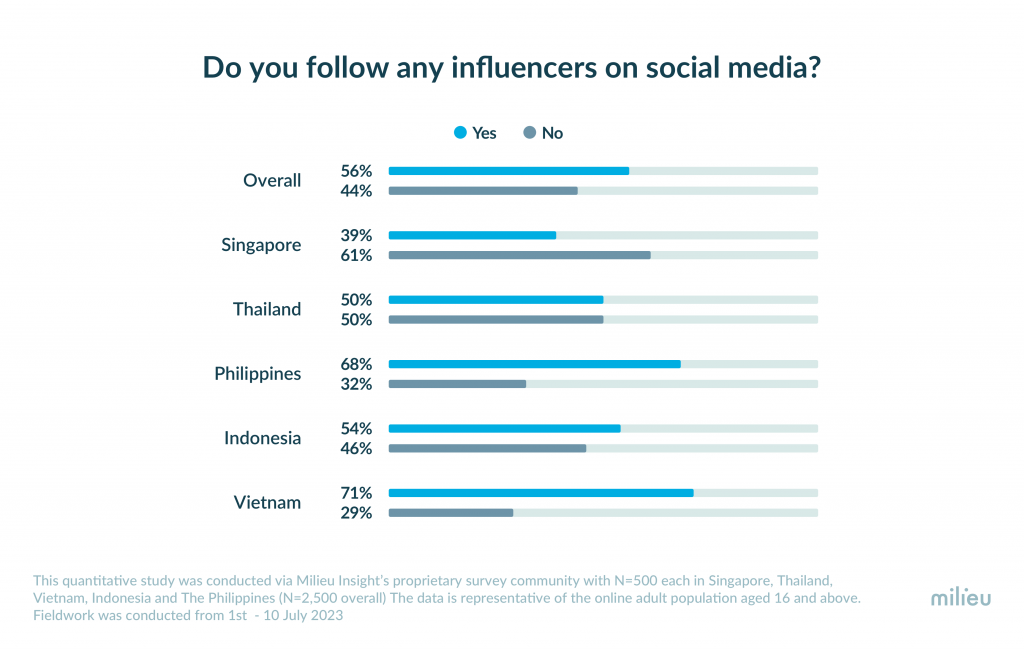
In Singapore, only 39% show interest in influencers, while in the Philippines and Vietnam, a significant 68% and 71%, respectively, actively follow these online celebrities.
The role and impact of influencers vary across age groups. Approximately one-third of respondents state that influencers have expanded their knowledge of brands and products. The top three areas of purchase influenced by influencers are beauty (41%), fashion (38%), and food and beverages (37%). For males, tech/gadgets (41%), food and beverages (36%), and fashion (30%) are the most common products purchased.
The preferred platforms and content
According to Milieu, in the South-east Asian landscape, YouTube takes the lead as the preferred platform for following influencers, with 72% of respondents choosing it. Instagram (60%) and Facebook (60%) are also popular choices. These preferences vary among generations, with Gen Z favouring Instagram and TikTok, while Millennials and Gen X lean toward Facebook and YouTube.
It’s also interesting to note that the slightly older demographics gravitate to relatively long-form content, while Gen Z and younger prefer quick, scroll-style content by-the-minute.
The content that influencers post plays a pivotal role in attracting followers. Lifestyle (54%), Entertainment/Comedy (52%), Food (48%), Fashion (41%), and Travel (40%) top the list of interests. However, gender differences are evident, with men gravitating toward Entertainment/Comedy (52%) and Technology and Gadgets (41%), while women show a strong interest in Food (55%) and Beauty (53%).
Based on these numbers, it’s obvious that influencers undeniably impact consumer purchases in Southeast Asia, with Beauty products emerging as the top-selling category, particularly among females (56%) and Gen Z (46%). Interestingly, Baby Boomers (above 59 years of age) are influenced by influencer content in the food and beverages category, with 4 in 10 making purchases based on these recommendations. Gen X consumers (ages 43 to 58) are most inclined to buy technology and gadget-related products (32%) due to influencer content.
The trust factor and the clout game
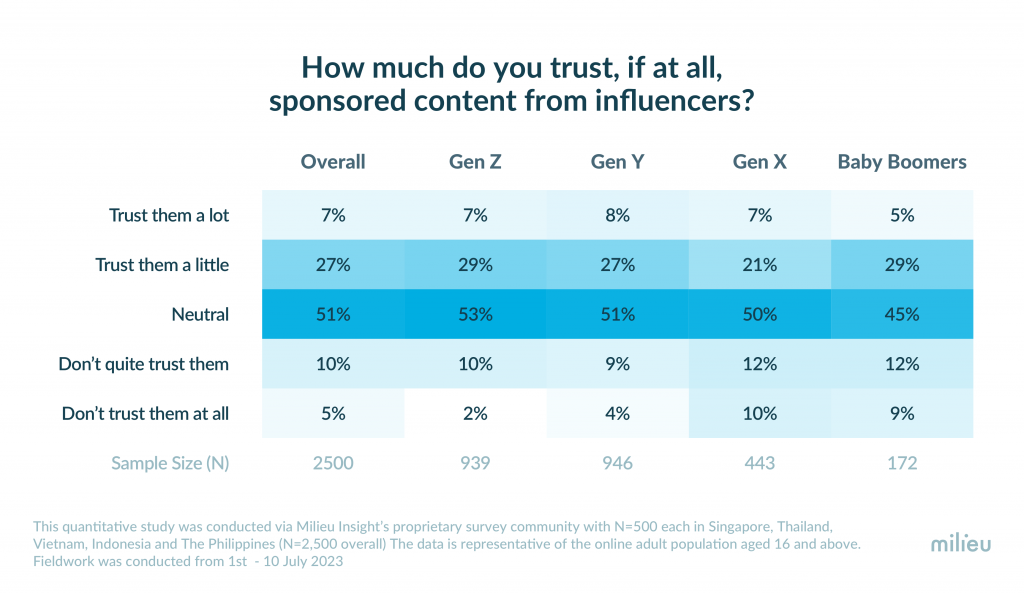
Milieu reports that trust is a crucial aspect of influencer marketing. Surprisingly, user reviews and review sites carry more weight than influencer endorsements in South-east Asia. Around 51% of respondents express neutrality regarding their trust in sponsored content from influencers, with the exception of Vietnam, where 60% have a positive impression. Only 5% of Baby Boomers trust influencers significantly, compared to an average of 7% for Gen Z and Gen X, and 8% for Gen Y.
It’s surprising that the gap between those numbers is extremely small, which says something about consumer trust in sponsored content.
The Milieu report adds that influencers who boast more than a million followers are the norm, with 36% of South-east Asians following them. This trend is consistent across the Philippines, Indonesia, and Vietnam. However, authenticity (51%), a sense of humor (49%), and expertise (42%) are valued attributes. Indonesian consumers prioritise consistency of recommendations, while Vietnamese consumers emphasize engagement with followers.
The rise of Deinfluencers
According to Milieu research, in response to criticism of influencers’ role in consumerism, a new wave of social media figures has emerged: the deinfluencers. These individuals advocate for mindful consumption and challenge consumerist tendencies. While awareness of deinfluencers is relatively low, with Vietnam leading the pack at 62%, they represent a growing movement questioning traditional influencer culture.
Despite its challenges, influencer marketing continues to be a valuable tool for raising brand awareness and providing information about products in Southeast Asia. Influencers create trust bridges between brands and consumers, offering valuable insights and real-life testimonials. However, with the emergence of deinfluencers and consumer skepticism, the industry may need to adapt and evolve to maintain its effectiveness.
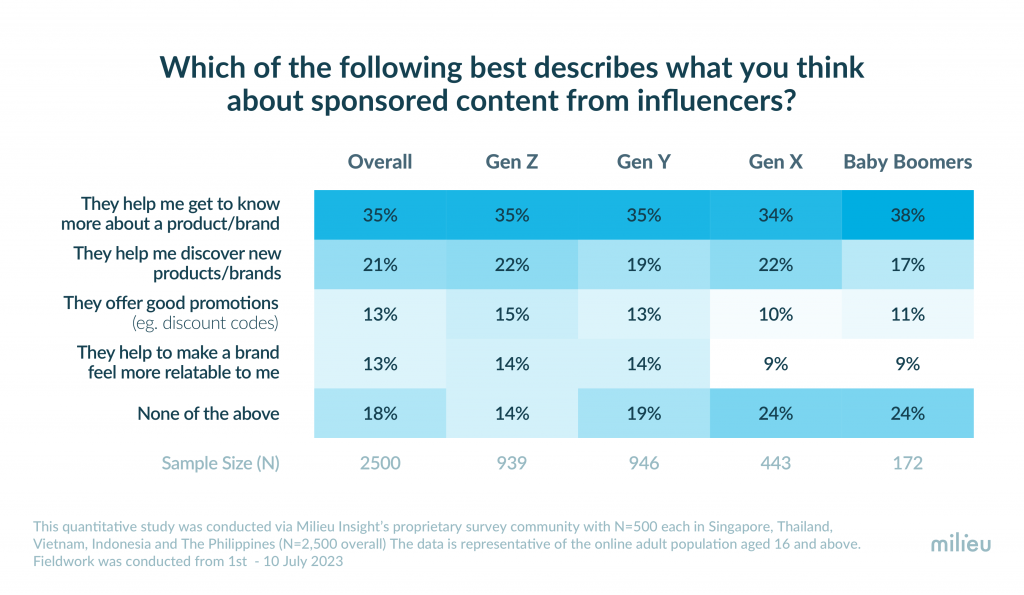
Based on a survey of 2,500 individuals in Southeast Asia in the Milieu project, the effectiveness of Influencer Marketing in driving direct sales is not significant, despite the rocket number of influencers and 56% of survey participants following influencers. The industries that benefit the most from influencer marketing are Fashion, Beauty, and Food and Beverages. This marketing method is most effective in increasing brand awareness and providing information about brands/products. However, 80% of surveyed consumers hold a neutral or low level of trust towards influencer content, posing a challenge to this advertising trend as the Deinfluencers movement is gradually emerging.
It’s safe to say that influencer marketing in Southeast Asia has transformed the advertising landscape. While it may not always directly drive sales, it significantly raises brand awareness and influences consumer decisions, especially in the fashion, beauty, and food and beverages sectors. As the marketing landscape evolves, understanding the dynamics of trust and the influence of deinfluencers will be key to staying ahead in this digital age.