One step closer to Korean Air-Asiana merger, Korean Air to launch NDC in 2024, new airlines Air Premia and T’way jostle for supremacy, Lufthansa and KLM Air France push on with NDC, agents anticipating disruption in distribution in traditional market
It felt like something out of a K-drama. After two straight days of board meetings, the directors of Asiana had failed to decide on the sale of the carrier’s cargo arm in order to secure merger approval from European Commission authorities, creating suspense as to whether the merger with Korean Air would fall apart.
Media reports suggested that Korean Air had offered the Asiana board an immediate payment of KRW150 billion (US$111 million) if they agreed to sell their cargo business, and a further KRW500 billion (US$370 million) in long-term loans, contingent on selling the cargo arm.
One board member had reportedly walked out of the heated board meetings, and another meeting had been scheduled for November 2, the day of our WiT Seoul conference. At 2pm, a decision was announced. Asiana’s board had agreed to the sale of its cargo business, paving the way for EC approval, after which it just needs to secure the green light from the US and Japanese authorities.
The merger, if and when it happens, will have major implications on the Korean aviation market. For Korean Air, it would remove its biggest competitor and three local low cost carriers have formally expressed interest in acquiring Asiana’s cargo business namely Air Premia, Eastar Jet, and cargo operator Air Incheon. It will also facilitate T’way’s entry into the European market, with the airline set to acquire five passenger-configured A330-200s from Korean Air, plus the necessary pilots and support services.
Speaking at WiT Seoul, Korean Air’s managing vice president Kwang-Ho Ko could not comment explicitly on the merger but observed that pre-pandemic, Korean Air’s cargo revenues were at KRW800 billion, which ballooned to KRW2.3 trillion, indicating the importance of cargo in the negotiations. He said he was positive about the proposed merger.
Air Premia maintains hybrid and longhaul strategy
In a later session, Air Premia’s CEO Yoo Myeongseob said that when the airline started in 2017, the merger was not on the table. If they do merge, he said it would open up opportunities for more longhaul routes especially to North America. On cargo, he said there was interest “to prepare for the future. We are interested in it”.
Air Premia chose the hybrid model because Yoo, who used to be CEO of Jeju Air, said “longhaul low cost has never succeeded and we had to offer a new approach on medium and longhaul routes”, which means more room and comfort with the B787 and a point-to-point strategy.

Air Premia’s CEO Yoo Myeongseob said a merger would open up opportunities for more long-haul routes especially to North America.
When it started flights to secondary airports, it wasn’t easy, he said but the most successful sector has been Los Angeles. “After people flew with us, they realised they could be comfortable and yet pay affordable fares.”
Vietnam was not a success, he said. At five hours, demand is driven by cost, not comfort and with Vietjet offering three flights a day, it was hard to compete, said Yoo, adding that it plans to maintain a longhaul strategy.
T’way poised to enter Europe, but will longhaul low cost model work?
Speaking on a panel, T’way’s strategy and marketing director of T’way, Steve Sukwan Kim, said the Asiana decision to sell of its cargo division was just one more step towards the merger – “we have many challenges to overcome first”.
For T’way, it would mean possible entry to the European market but a critical question would arise, can its longhaul low cost model compete effectively against traditional full service carriers such as Lufthansa and KLM Air France, to name a couple of competitors? Would it have to go hybrid like Air Premia?
As had been noted by Air Premia’s Yoo, the longhaul low cost model is still in question.
Nevertheless, T’way, which has launched flights to Singapore, Sydney, Bangkok and Ulaanbaatar, is managing to achieve healthy passenger numbers. According to this article in Naver quoting data from www.airportal.go.kr, T’way for the first time reached second place among Korean LCCs, beating Jin Air in terms of pax carried during January and September this year. It carried 9,062,664 pax, compared to Jin Air’s 7,302,808, followed by Air Busan (5,537,452), Air Seoul (1,685,991) and Eastar, 1,059,554.
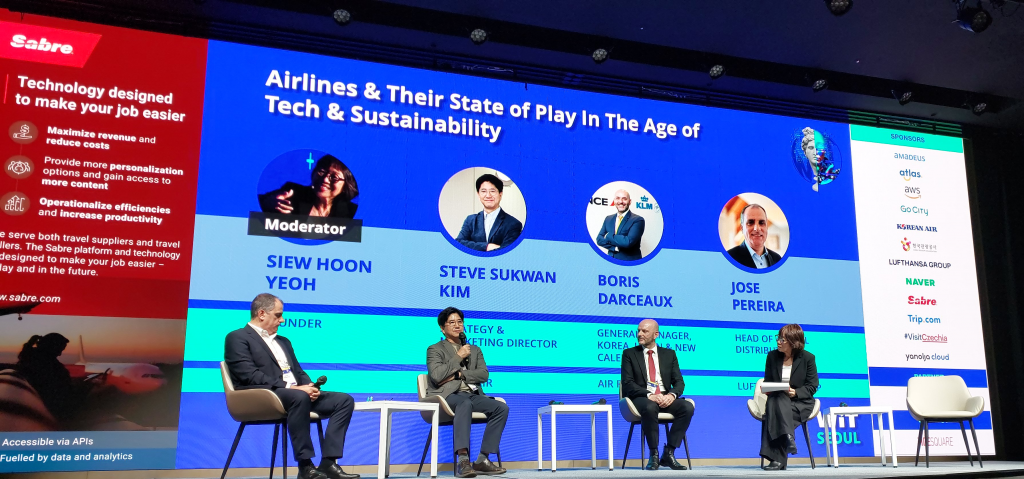
Steve Sukwan Kim (strategy and marketing director, T’way) wonders if its long-haul low-cost model can compete against full-service carriers like Lufthansa and KLM Air France.
Kim said it found that during longer flights, passengers wanted comfort over price and that it would have to find a balance between the two.
Foreign airlines are also watching the merger talks closely. On the same panel as Kim, Lufthansa’s head of global distribution, Jose Pereira, who took up the role in September, said consolidation is a fact of life these days and there would be more consolidation coming.
Boris Darceaux, general manager, Korea, Japan and New Caledonia, Air France KLM, gave a nod to its partnership with Korean Air with both airlines being part of the same SkyTeam Alliance. Asiana is part of the Star Alliance, along with Lufthansa.
Korean Air to roll out NDC second half of 2024, every third ticket on Lufthansa Group is NDC
Meanwhile, while the merger remains in the air, one thing is certain – NDC is coming to South Korea. Korean Air’s Ko said that it would be rolling out NDC distribution by the second half of next year, a move that will be welcomed by foreign carriers such as Lufthansa and KLM Air France which are already way ahead in NDC implementation.
Said Ko, “Next year, NDC will change the market. We are aware of travel agent concerns. NDC is one of the tools that will help airlines to personalise retailing – from the airline’s perspective, it is not to save costs but to diversify merchandise for consumers.”
He said being late to the party, it had analysed strengths and weaknesses of other airlines’ implementations in North America and Europe. “We want to minimize the complaints of retailers and consumers.”
Airport services and ancillaries can also be done through NDC, he said. “It would allow us to deliver real-time competitive services to consumers, for example, door-to-door services.”
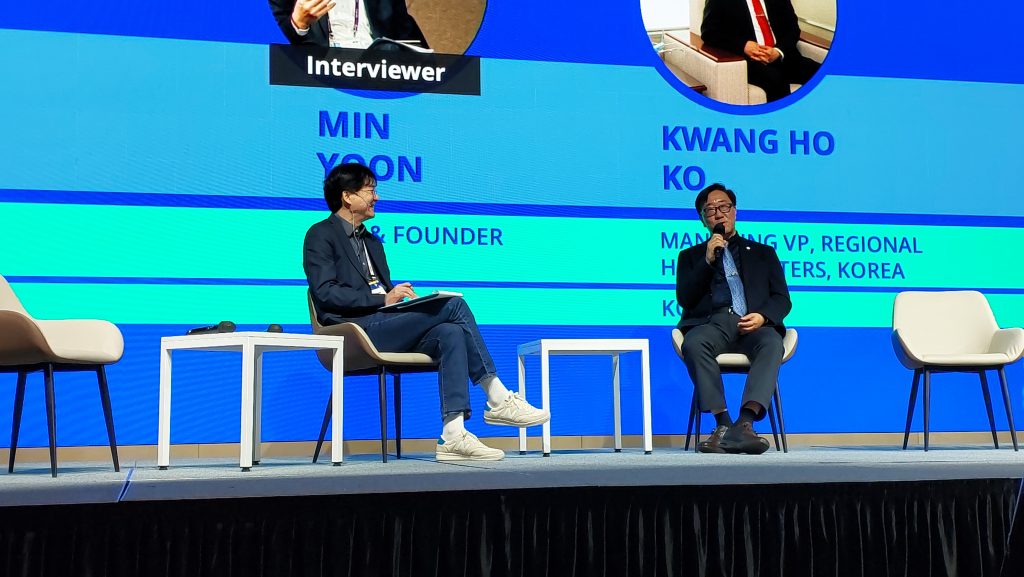
Korean Air’s Kwang Ho Ko said, “Next year, NDC will change the market. NDC is one of the tools that will help airlines to personalise retailing – from the airline’s perspective, it is not to save costs but to diversify merchandise for consumers.”
Lufthansa’s Pereira noted that when he started in distribution in 2017, the distribution group had 10 people, today it has more than 120 in total – covering payments, security, NDC deployment. “This is one of the main topics that I have in the future, coordinating with the markets on how far we can go with this (NDC) initiative.
“Every third ticket that we issue today for the whole group is an NDC ticket already – so it is a reality. We are also aware that not everything is working as it should be, therefore we are really engaged with all partners to enhance the standards in a way that it can be scalable.”
While Finnair has set a target of 2025 to go all-NDC, Pereira said Lufthansa Group was looking at 2030 to get to 100%.
Lufthansa is also rolling out continuous pricing for longhaul routes, following on from their successful implementation in Europe. “From our experience, we see cost savings on the consumer side,” said Pereira.
In a further push for NDC integration, Lufthansa Group has also invested in and partnered with Spotnana, the travel-as-a-service platform, for corporate travel. The group, which includes Lufthansa, Austrian Airlines, Brussels Airlines, Swiss, Air Dolomiti and Eurowings Discover, became an investor in Spotnana a year ago as part of the company’s $75 million Series B round.
Said Pereira, “The beauty of Spotnana and some others is that it is just one platform, one system to provide all capabilities for the corporates, and if corporates need to enhance a product, it takes them a couple of weeks, and they are done. This gives us the chance to further develop without having longer timelines and not knowing when it’s going to be available for the customer. That’s why we think this is a good solution going forward, and we are really motivated and looking into similar approaches.”
Air France KLM has also been active on the NDC front, increasing its GDS surcharge from the current $18.70 per one-way booking to $23.10 effective July. Darceaux said it was working on direct connectivity with agents in Korea, one of which was Tidesquare, to be completed by year end.
The future will be turbulent; how to find meaning in later life
Direct distribution by airlines is an inevitability – according to market research from T2RL, the share of airline direct sales, such as those booked through carriers’ own websites, mobile apps or call centers, comprised 61% of global passengers boarded last year – the highest airline-direct share documented by the airline IT and distribution advisory and research firm in 15 years of study.
In South Korea, things may be slightly different. T’way’s Kim said that even in its home market, direct channel sales accounted for only 20% of its mix, in contrast to other LCCs which, in their home markets, can command up to 70-80% direct share. “We focus on our own homepage but the power of travel agents is huge and we want to sell through everybody.”
How long this will remain is unsure. With the Korean Air-Asiana merger in the wings and NDC introduction into the market, and as more online travel startups emerge and global OTAs enter the market with new, aggressive models, one can only surmise the Korean air travel market is in for turbulent times and more K-drama moments.
Observed Pereira, “Lots of things are changing, challenging the well-established ways of working in the airline industry, starting from distribution to the whole value chain, and also airports. Especially at airports, we can do much more better – digitalisation will help a lot. AI, robots and the way we onboard customers, the way we lead them through immigration, there are some really nice biometric approaches out there. Topics like digital ID so that the customer has one touchpoint along the journey.”
If this is all too dramatic for your nerves, then take a piece of advice from Korean Air’s Ko who, when asked who he admired most, cited the 103-year-old Professor and Philosopher Kim Hyung-Seok. “He says up unto your mid-20s, you tend to be influenced by parents, from 20s onwards, you are governed by society – real life is designed after 65,” said Kwang. “Instead of taking a rest, one can decide to have a meaningful life in later years.”
One could also take lessons from KLM, which is just a year older than the professor. It turned 104 on October 7, 2023, while Air France turned 90 on the same day of October 7.
Said Darceaux, “If you look at the way airline business was done in the 20s, 40s and 90s, it has completely changed. That we are 104 is proof of innovation, proof of being able to adapt so we have a lot of pride in that. It also gives us some sense of responsibility for the future, and it means we need to adapt to the new challenges – whether it’s supply chain, price and the biggest one, sustainability.”