It’s been nearly two weeks since I left the majesty and scale of South Africa for the tiny dot of Singapore and here I am, in the even tinier (or as tiny) dot of Penang, Malaysia, where the evidence of global nomadism is in full play.
This is the island off the west coast of Malaysia that was recently voted the third best island to retire in, out of a list of 15, by International Living. The article says, “Here, the lifestyle is First World – it’s possible to trade-up. A couple can live well on a monthly budget of between $1,500 and $2,500 a month. It’s a luxury life on an affordable budget with all the comforts and conveniences of home.”
Incidentally, I happened to meet the writer who put that list together at a dinner in Penang – and yes, he’s eating his own words, he’s lived here for the past two decades.
In my apartment block in Penang, I meet Koreans, Japanese, Germans, Swedish, English, French, Spanish – it’s like a mini United Nations here – and I feel right at home in the world.
Penang is also top of the list among destinations in Malaysia for remote workers and digital nomads ever since Malaysia introduced its Digital Nomad programme under a scheme called DE-Rantau. It is Airbnb’s top selling Malaysian destination for short-term rentals (even though technically there is a ban on short-term rentals) and many of my friends are Airbnb hosts, making pretty decent incomes from their rentals.
It reminded me that no matter how far apart the Asia and Africa continents are, there are some trends that connect us.

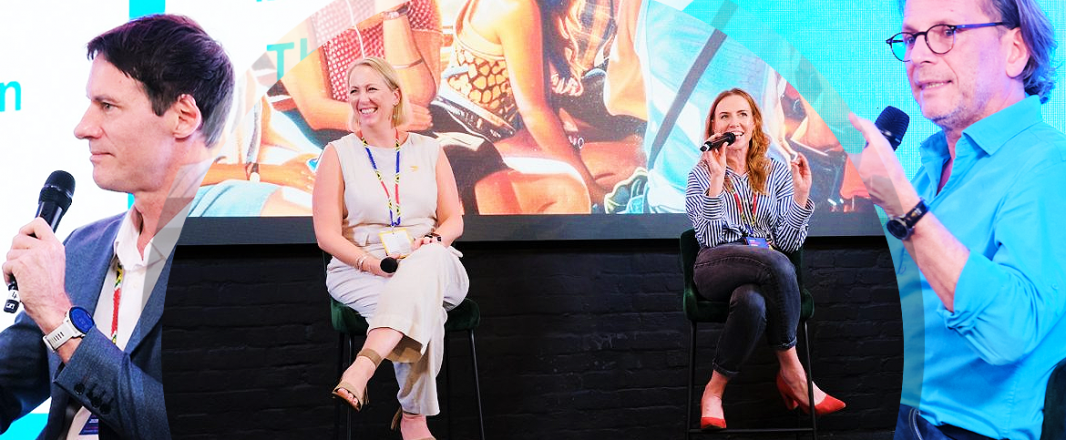
Airbnb’s Velma Corcoran (right) speaking up for “remote work” and its benefits to local economies; while Julie Cheetham of Weeva said headwinds are coming in sustainability and we face the risk of being cancelled if we don’t tackle it seriously.
Love it or leave it, LAWA’s here to stay for Airbnb
At WiT Africa in Cape Town, I heard Velma Corcoran, Airbnb’s regional lead for Africa Middle East, talk about how Airbnb’s growth in South Africa has been led by one, remote workers and two, domestic travel and how it is working with Cape Town Tourism on its “Live Anywhere Work Anywhere” (LAWA) programme.
Firstly, on remote work – even though many businesses are now questioning the merits of “remote work” vs “return to office”, Airbnb remains resolute in its path to LAWA.
Corcoran said, “We believe living and working anywhere is a durable trend. Over the past three years, we’ve seen new use cases emerge as guests across all regions and age groups use Airbnb for long-term stays. Since the pandemic, we have continued to see longer stays on Airbnb.
“Long-term stays made up 19% of gross nights booked in Q4, while roughly a quarter of nights booked for long-term stays were for trips of three months or longer. Nights booked for trips over three months increasing approximately 20% compared to Q4 2022
“While we know that some businesses have been encouraging workers to return to physical offices, LTS bookings indicate that many people still have flexibility with where they live and work.
“While the ability to travel and work remotely has been an important part of long-term stay growth, people are also extending their typical weekend stays by an extra night or two. For the past seven quarters, long weekend stays have been the fastest-growing trip type on Airbnb.”
Walking around Cape Town, I certainly see similarities between the types and profiles of “nomads” there and in Penang – a next generation “hippie” in search of an alternative lifestyle – and their hangouts – typically “shabby chic” cafes that look like they’ve been hastily put together but you know a lot of thought has gone into making them feel non-pretentious.
Corcoran said it worked with Cape Town Tourism to develop a Live and Work Anywhere one-stop-shop hub, enabling remote workers from across the globe to easily identify and choose Cape Town and South Africa as a destination for them to visit.
“We also developed guidelines for destinations who were thinking about developing remote worker visa categories.”
She cited an impact assessment report conducted by Airbnb in 2022 which found that “more than 50% of guest spending takes place in the listing’s local neighbourhood, contributing to the economic growth of local communities”.
“From a tourism perspective, remote worker visa regimes increase awareness and promotion of a destination. When remote workers live and work in a country for a few months, they may travel within the country, further contributing towards domestic tourism, especially smaller and unique destinations in a country.”
Indeed, she said, domestic tourism and smaller destinations were key to driving the strong tourism rebound seen by Airbnb in South Africa. “Domestic travel has been consistently higher than regional and international travel on the platform, and has boosted the geographic dispersion of travel with six out of the 10 fastest-growing cities on the platform in terms of growth of total stays between 2019 and 2022 being located outside of traditional tourist hotspots.
“In 2022, only one of the fastest growing destinations was in the WC (Witzenberg), and none in Gauteng, with significant growth in Mpumalanga and KZN.”
She said that in 2022, Airbnb contributed more than R23.5 billion to the economy, supporting almost 50,000 jobs, with the typical host earning around R32,500. That same year, nationwide host earnings totalled just over R4 billion ($218 million), a 25% increase from pre-COVID levels in 2019 of R3.2 billion ($174 million). The increase in tourism was driven by domestic travellers who accounted for more than 60% of the total nights spent on the platform.
Sustainability headwinds are coming – Booking removes Sustainable Travel Badge, the risk of being cancelled is real

Carlo Olejniczak, Booking.com, speaking at WiT Africa about the remove of the “Travel Sustainable Badge”.
When Carlo Olejniczak, vice president and managing director of Europe, Middle East and Africa (EMEA), Booking.com, mentioned at WiT Africa that the company was removing the “Travel Sustainable Badge”, everyone’s ears perked up. This was a programme that’s been years in the making and at one point saw up to 500,000 accommodation being listed with this badge.
He said Booking would remove the badge and would focus on certifications. “We already recognise more than 62 certifications and we will keep all the attributes on the hotel page so they will be displayed …” (Watch this clip)
According to this report in Phocuswire, the removal of the “Travel Sustainable Badge” follows pressure from the Netherlands Authority for Consumers and Markets (ACM), which objected to the scoring system, giving properties a score between 1 and 3+ depending on their efforts.
In a statement, Booking.com said it will now prioritize third-party certification systems. “Booking.com will now introduce a label to acknowledge when a property has achieved a third-party sustainability certification coupled with the ability to filter searches accordingly,” the company said. “To date, over 16,500 properties have a third-party sustainability certification displayed on the platform. Moving forward, the Travel Sustainable name, logo and levels will no longer be displayed.”
Julie Cheetham, managing director of Weeva, the business sustainability management platform for hospitality, said, “The business case is stronger than ever. Headwinds are coming at us.”
Green tariffs directives out of Europe, regulations, requirements for disclosures – “privately-owned tourism and hospitality businesses have to face up to this. And the fines are coming and are being imposed. We’re seeing the first cases of legislation through the Advertising Standards Authority in the UK.”
Cheetham, whose startup is South Africa-based, said “the risk of being cancelled is real”.
“You don’t want your business to be protested at by locals, because you have used all of the water and expect them to conserve water so that your guests can have water. You don’t want to be in the newspaper for writing seasonal contracts and not giving people a decent living wage with benefits. And this is definitely going to endure into the future; it’s not going to go away; and it’s a change that we’re better off embracing.”
Her words ring as true for destinations in Africa as they do everywhere. Just as the pandemic made governments and local populations hyper conscious of the importance of tourism to their economies, it also raised awareness around “what kind of tourism is right for my country?”
AI & the things it can do in travel

Ross Veitch: AI/ML capabilities will continue to develop at exponential rates and this is going to shock most people.
Another global trend is that of generative AI which will change the way travellers plan and book their travel. The distribution may not be equal, as sci-fi author William Gibson, famously said, but it’s coming, just at different paces.
Ross Veitch, CEO and co-founder of Wego, a passionate proponent of AI, in his talk, shared the various ways in which AI will change travel.
- AI/ML capabilities will continue to develop at exponential rates and this is going to shock most people
- AI driven product features will be widespread across the online travel industry, unlike today
- AI will unlock personalization across the travel industry
- Conversational agents will be good enough to be used widely for shopping and service
- Much coding, UI design, ad creative and content authoring will be done by AI systems or by humans assisted by AI tools
- Building online travel products will involve less ‘plumbing’ and more feature innovation
Fritz Demopoulos, CEO of Queen’s Road Capital, has another take on AI – as he says in this article, “Some argue AI is an amplification of our values. We as humans have a history of not being nice to each other. I’d be worried that AI embeds those negative values.”
It gives me some cause for optimism that when we asked our speakers what values they’d like to improve about themselves or what human quality is most needed in the age of generative AI, the most common answers were “Patience” and “Empathy”.
Clearly, in the “Human Revolution” unfolding from Africa to Asia, and next to the Middle East where we will hold our next event in Dubai on May 3, we must continue to amplify those positive values so that AI doesn’t get the better of us.