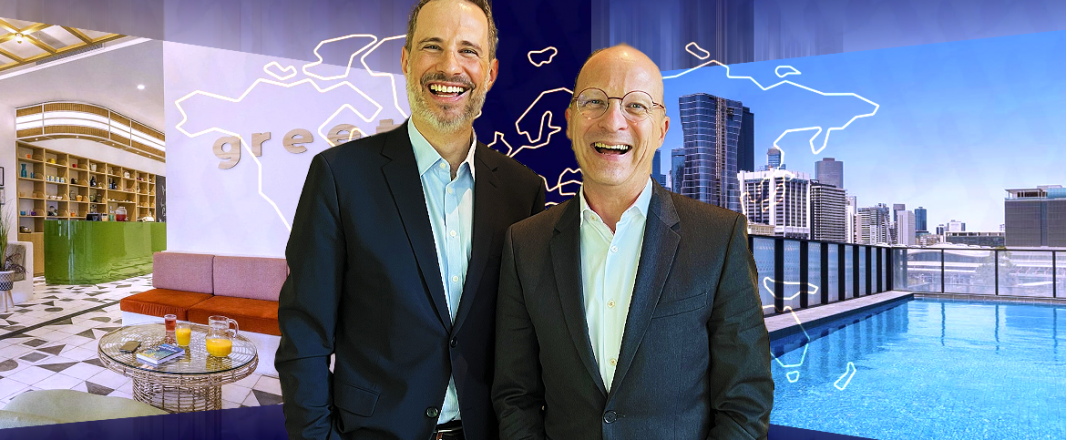
Former Estee Lauder and W veterans take reins to hone brand promise and differentiation
A day after their announcements as the new global brand presidents for Accor’s Premium Brands, Midscale & Economy Brands (PM&E), I caught up with Benoit Racle and Jean-Yves Minet in Bangkok where they were being introduced to the Middle East, Africa and Asia Pacific commercial teams.
It’s clearly been an intense time at the “MEA APAC Commercial Days” event at the Movenpick BDM Wellness Resort in Bangkok for Racle, who’s heading Premium (including Pullman, Swissotel, Movenpick, Angsana and Peppers), and Minet who’s heading Midscale & Economy (including Novotel, Mercure, TRIBE, Handwritten Collection, Ibis, Ibis Styles and ibis budget and greet. The PM&E division includes a total of 21 brands and 90 percent of the hotels in Accor’s portfolio.
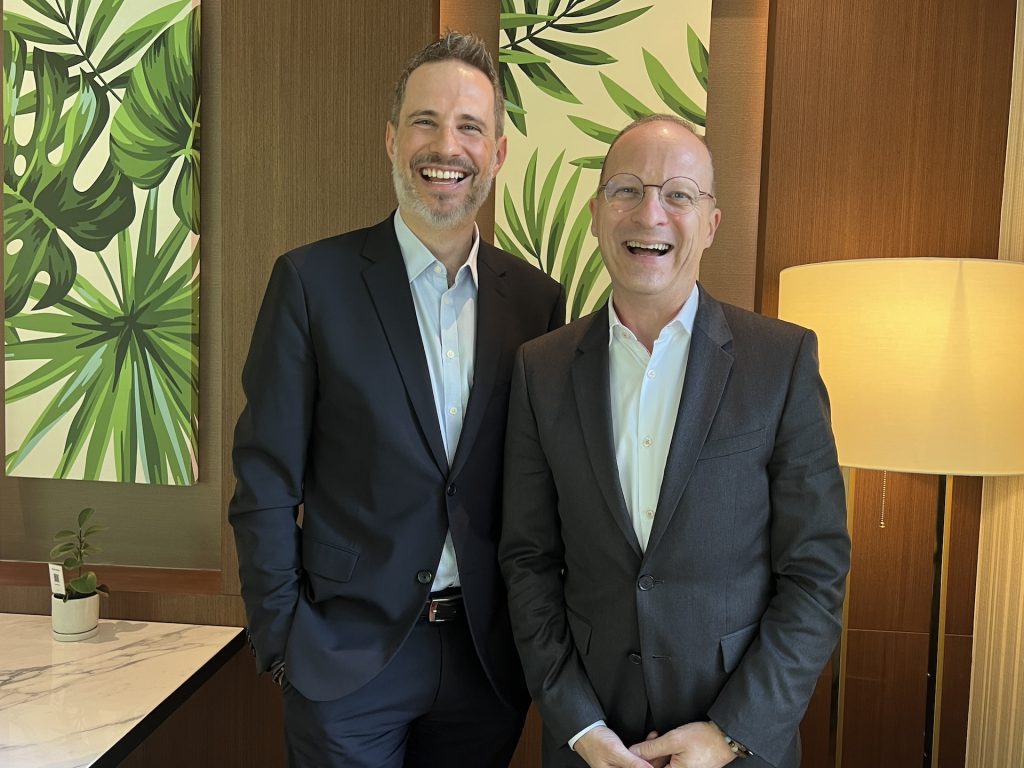
Minet (left) and Racle: All energised to bring previous experience to bear on their new roles to achieve greater clarity and success for 90% of Accor’s portfolio.
Minet calls it a “clear download of strategy” and Racle says, rather than being overwhelming, it’s been “energising and exciting”.
Both executives come to Accor with very different backgrounds, Minet after 20 years in the beauty and cosmetics industry, the last 14 spent with Estee Lauder Group leading its $8.5b International division (China, Asia Pacific, UK, Europe, Middle East, Africa, LATAM & Travel Retail) and Racle, a hospitality veteran, who spent the last eight years as Vice President, Global Brand Management for W Hotels.
I asked Minet why he chose to leave beauty and cosmetics for hospitality. “I have always been interested in travel. I spent six years in travel retail – all the products we sell in duty free – and have always looked at travel corridors and consumer tastes.
“There are a lot of opportunities in travel that seduce me. It is one of the few where demand exceeds offer, although it is very competitive. There is growing access of emerging consumers to wealth in markets such as China, Turkey and India. There is rise of the middle class, travelling is the number one desire for the emerging consumer. Growth is almost guaranteed, it’s how you can exceed that is most interesting.”
He was also lured by the power of the Accor group, outside the US and China. “It is set up for success with a diversification of portfolio for a diverse consumer.” His portfolio covers a total of 13 brands.
Racle started in hospitality when he was 15, working in the front office of a small hotel. “I’ve been a chef, security, general manager. Having a guest smiling and happy is what drives my life. I will never leave the industry.”
He was drawn by the culture of Accor and how it takes care of people. “Covid broke my heart, we had to stop working with a lot of people. In North America, we lost about 45% of the workforce. Accor demonstrated that it took care of people and now we have to bring back the people to the industry.
“It was also good to move from a US-centric brand to a more European global company which is the leading brand in Europe, Middle East, Australia, Latin America and Asia.”

Different paths to immersions, customer at the centre of it all
Due to their different backgrounds, both men had different introductions to their new roles. Racle spent a month on the road, visiting his brands’ teams and properties across the world. “I wanted to understand the culture, what does it mean to work with Accor for teams and owners – to understand the nuances of each market. It was exhausting but refreshing at this point in my career to listen. The second priority is to ask, what is our five-year plan? Building brands take time, it’s a longterm vision.”
For his “induction”, Minet spent time in-hotel, working in the kitchen, cleaning rooms, manning the front desk. “I learnt the business, trying to understand the flow of the hotel, how it works, how we then translate the value proposition of each brand to the experience. How can we constantly innovate to bring something new to the consumer, solidifying the fundamentals and investing in the future? What will Ibis look like 20 years from now, we should be asking that now.” (The Ibis brand, described as “vibrant, casual, friendly” covers 1,278 hotels and 158,793 rooms)
For both executives, it’s not about how many brands each has to manage but it’s about being consumer-centric all the time.
Said Minet, “The common opportunity is this is an exciting time for the industry. Post-Covid, there’s AI and transformation of the way consumers shop. There’s social media. Consumers have more access to information than ever before. They are more influential, have a bigger voice. It is an exciting time for consumer behavior.
“Consumers are looking for experiences, travel is all about experiences. With beauty, it’s a physical product. The big difference is whether you add an experience, pre- or post-purchase and with the plethora of physical products, what makes the difference is when a brand creates an emotional connection through an experience.
“The answer is always in the consumer – knowing him or her better. In beauty, we did product development through research. Each year, we launched 10-15 new products, with different levels of innovation – packaging, new formula, refined storytelling. I’d like to take that knowledge to hospitality. What does it mean – sampling, for instance – to hospitality?”
For Racle, his goal is “to make sure our brands have a point of view, what we want to stand for”.
With W, he had one brand to focus on and built a very clear positioning for the Marriott-operated brand. He acknowledges the challenges of creating singular positionings for eight different brands.
“We have to build brands with one consumer in mind, built for that specific person. There is nothing worse than an undifferentiated brand. Could we move from location-based to brand-based – so that people would travel a bit further to stay with a brand they love?”
In many ways, this would play well into the diversification of tourism that’s badly needed in some destinations. What’s the role of hotel companies to move development away from prime locations to more remote areas, which may not make financial sense from a real estate perspective, I asked.
“Well, guests are asking for that,” said Racle. “Take me somewhere I haven’t been, where there are fewer people, where I can have a purpose and impact.”
Citing Peppers, a brand that’s “so iconic, so Australian”, he also questions, “Would it work outside Australia? Could regional brands become local?” (Key words associated with Peppers are “indulgent, rejuvenating, experiental, memorable” and there are 26 Peppers with 4.715 rooms in the portfolio.)
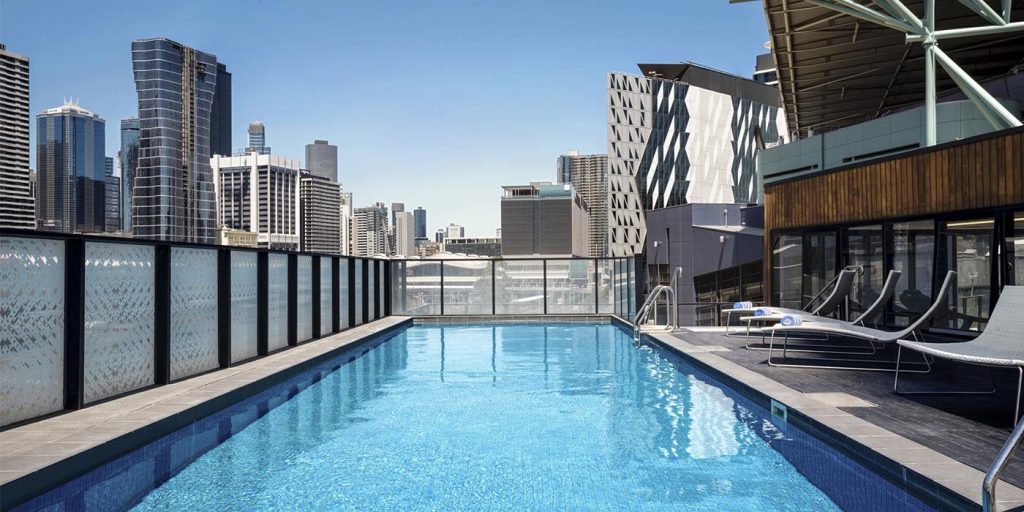
Peppers Docklands, Australia
“We have to rebuild ambience for people without the alcohol”
Both executives fit the profile of the healthy living traveller. Racle, who only drinks decaf coffee and has been alcohol-free for nearly 10 years, said, “We all travel a lot. I want to feel as good as I can and this is the trend for all travellers, that well-being should not be at the expense of travel.”
Added Minet, whose skin glows with health (thanks to Estee Lauder’s Advanced Night Repair, he says when asked which product he uses), “Statistics show we’re going to live longer and it’s about adding life to years, not years to life. People of any age, Gen Z included, are really looking at how they sleep and exercise.”
Chipped in Racle, “There’s a statistic that says only 11% of youths are smoking in the US. They are also drinking less and in New York, there are alcohol-free bars. So we have to rebuild atmosphere and ambience for people without the alcohol. We have to reinvent ourselves because our guests demand that.”
Another mega trend is that of environmental awareness, and it’s a trend not limited to the developed world, said Minet, who looked after emerging markets for the Estee Lauder group. “I had an opportunity to work in emerging markets in Asia and Africa, and I was really surprised by how much the emerging middle class has evolved in terms of appreciation of sustainability and protecting the environment, in India, for example.”
Added Racle, “Consumers are making choices for the right brand with their wallet. They have more influence now, they know what they want to do.”
So even as brands try to build global footprint, they have to understand the nuances of different local markets, especially markets of growth and influence. “The outbound from India, over the next five to 10 years, will be on a scale like never before,” said Racle.
Which brands excite you the most?
This generational change in consumer behaviour will have impact on hotel retailing and distribution. I asked Minet what hospitality could learn from the beauty trade in this regard.
“Accor is also very good at retailing, a significant part of its business is web direct. The beauty (pun intended) of the hospitality industry is, it can really go multi-channel, just like beauty. There is not one consumer buying in one place. The only difference is, in beauty, the product is the same especially on the premium end. In travel, it’s all delivered through the local experience – a Mercure which is about “delivering local” will be different in Indonesia versus Italy.
“There is a growing desire by brands to grow their direct channel because that enables you to establish that direct connection with the customer and build on the relationship.”
Said Racle, “That’s the brand promise. If you book direct with us, we give you the best rate, we know you, we recognize you. That’s our commitment.”
That’s where loyalty comes in, he added. “Consumers are looking for larger loyalty programmes which is why hotel groups are creating brands within the ecosystem. Our job is to house consumers at different stages of their lives, so we can grow with the consumer.”
Asked which of their brands excite them most, Minet said, “I don’t know them all intimately yet but Novotel, the mothership brand of Accor, has the most heritage. It embodies what hospitality is all about. It has strong DNA, financial power and equity to cater to travellers.”
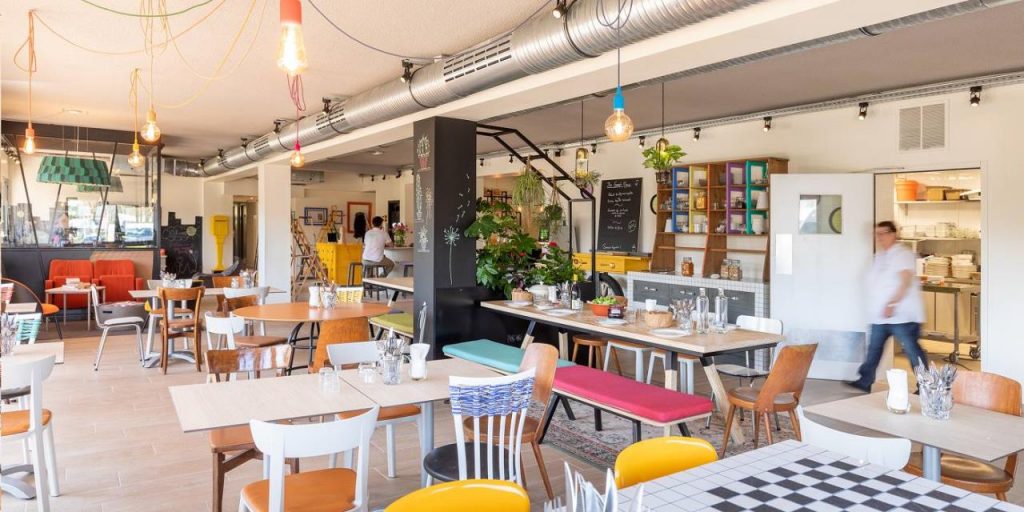
greet – “locally engaged, collective, circular hospitality”
He also called out greet, a “locally engaged, collective, circular hospitality” brand, present mostly in France with 36 hotels and 2,499 rooms. greet is also in Austria and Germany, and opening in Brussels, Belgium, soon. “It is for a very specific consumer, a very interesting positioning, using recycled materials, including the bed and furniture, and its staff are “second life” – from marginalized communities. There’s a social component there and it has a lot of potential. A lot of people who care about how they consume.”
For Racle, who’s a believer “in the intersection of luxury, hotels, fashion and arts converging to give life to unique experiences”, it’s Pullman, the oldest brand of Accor founded in 1869, described as “pioneering, transformative”, with 157 hotels and 44.624 rooms worldwide.
“We are reshaping the brand to make it more socially open for culture-savvy travellers. It has the best of iconic hospitality with social spaces and incredible programming. I saw the first new Pullman in Sao Paolo and I am excited about where this brand could go.”