MOVV (Moving Mobilities), which offers global travel mobility software as a service, and DOWHAT, a smart hotel platform for guests, staff and management, won the Showcase at the K-Travel Tech Summit held in Seoul this week.
Hosted by the Ministry of Culture, Sports and Tourism, and organized by the Korea Tourism Organisation, the one-day Summit saw 10 Korean startups pitch to a panel of judges comprising Nicholas Cocks, Founder & Managing Partner, Velocity Ventures; Timothy Hughes, Vice President, Corporate Development, Agoda; Hyuck-Tae Kwon, Founder & CEO, Auburndale Ventures and Minjun Jang, Deputy Director, Korea Tourism Organization.
MOVV’s CEO Mitch Choi said that he started the business “because there are many situations when you cannot drive by yourself or take a taxi for your mid/long distance trips”.
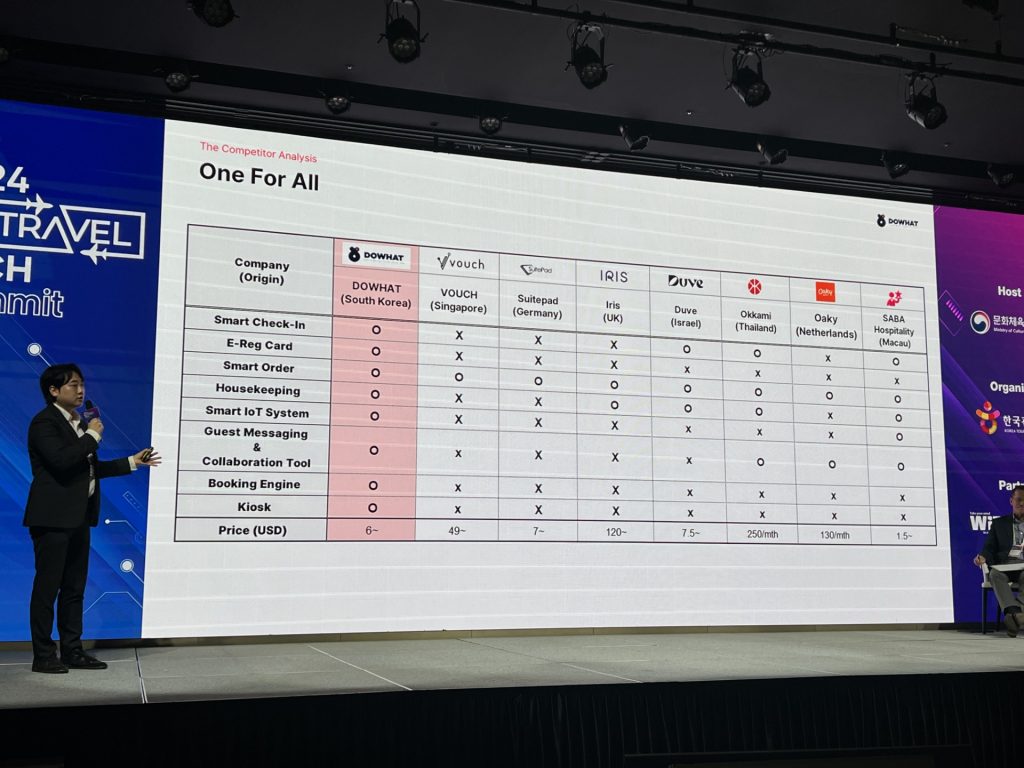
Steven Park, Global Product Director, DOWHAT
“With global flight demand expected to reach 4.7b passengers in 2024, and recent travel trends showing that individual travel and small town/rural preferences, there is a need for seamless ground transportation,” said MOVV’s CEO Mitch Choi.
MOVV enables the digital transformation of car charter services to be as easy as for flights and hotels booking, he said. It offers an ERP service, available for various vehicle types and services such as bus/limousine and rental car (car only or with driver) and a GDS with various online booking channels for B2C/B2B and API integration with platforms.
DOWHAT aims to be Hotel 4.0 through a DX platform to create a customer-centric environment for hotels, said Steven Park, global product director, who said Hotel 1.0 started in 1919 with the first hotel by Conrad Hilton.
DOWHAT was started to solve problems in the hospitality industry, which has one of the highest turnover rates of more than 80% annually, he said in his presentation.
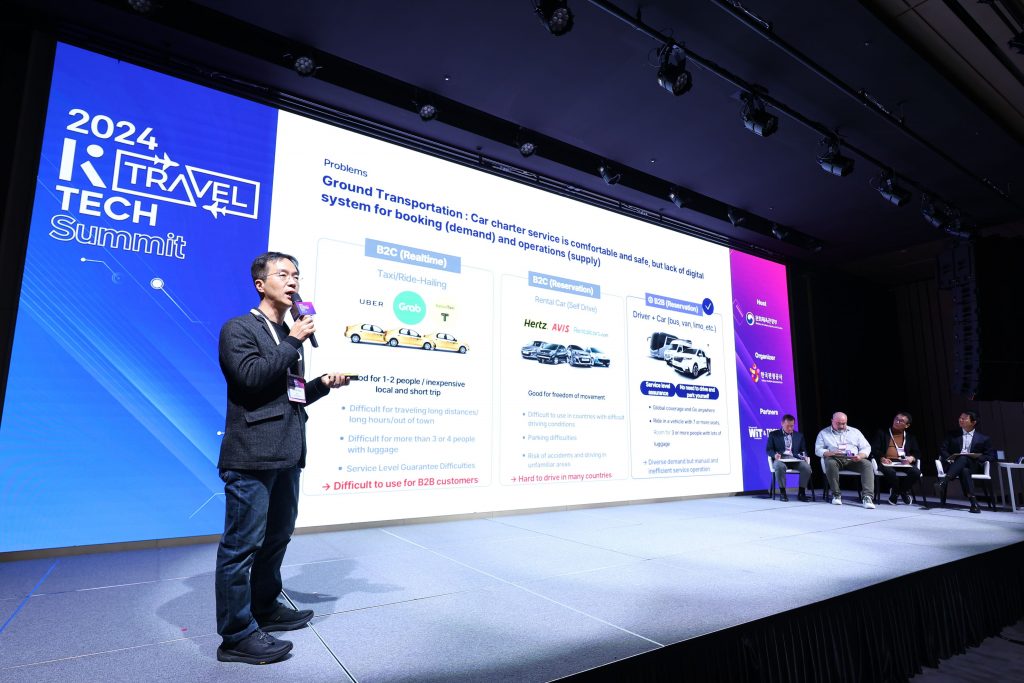
Mitch Choi, CEO, MOVV
Its micro-modular platform enables easy deployment in hotels, automating processes such as smart room services, check-in/out, guest messaging, and Robot Control Linkage and AI Speaker Linkage, for example.
Its deployment in the 320-room Hanwha Resort resulted in increased operational efficiency of of up to 30%, resulting in lowering operating costs by $200m, increased revenue of $300m and an 80% reduction in telephone orders – “less stress for employees”, said Park.
Currently it is deployed in 66 hotels and 20,000 rooms. Its target is more than 120 hotels and 40,000 rooms and DOWHAT aims to expand in Asia by targeting local independent/boutique chains in the region.
Agoda’s Hughes said that the broad range of tech and non tech companies presenting showed a clear trend – “an expanding streak of entrepreneurialism in South Korea”.
Commenting on the two winners, he said, “B2B operational, engagement and distribution tech is hot. And rightly so as there is ongoing need to improve these areas in travel. The challenge is sales. SaaS sales can be very labour intensive, and hard to scale with tech.”
Cocks of Velocity Ventures said MOVV was refreshing and new, while DOWHAT was entering a red ocean. “They need something very special to succeed.”
KTO’s Jang and Auburndale’s Kwon noted the challenges both winners will face when they expand overseas.
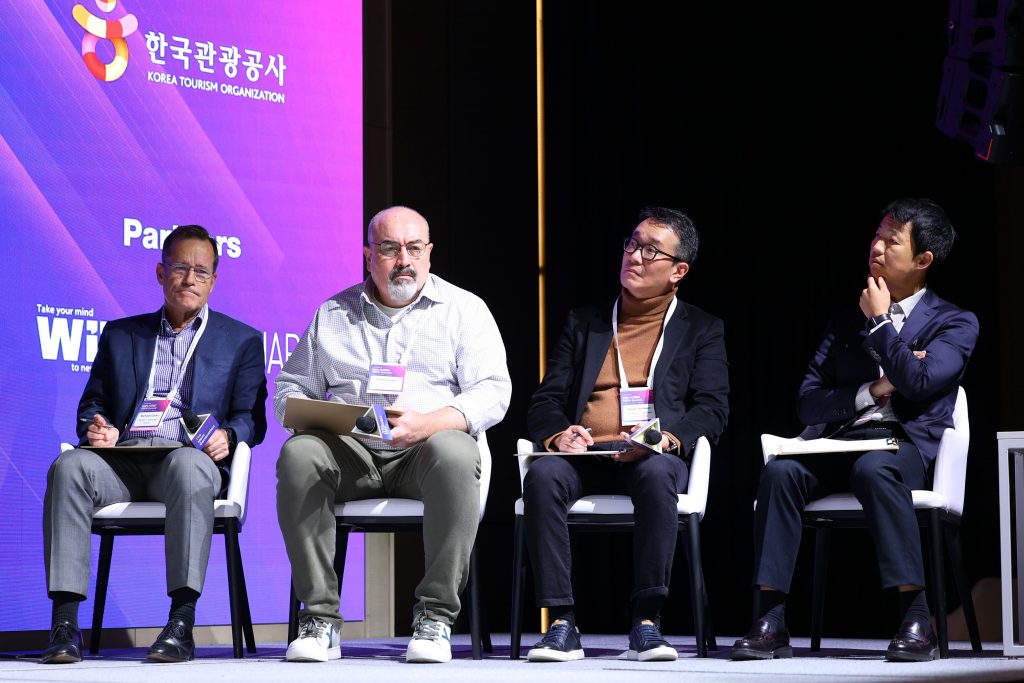
From left: Nicholas Cocks, Founder & Managing Partner, Velocity Ventures; Timothy Hughes, Vice President, Corporate Development, Agoda; Hyuck-Tae Kwon, Founder & CEO, Auburndale Ventures and Minjun Jang, Deputy Director, Korea Tourism Organization.
Jang said MOVV had a well-organised business model and as it expanded overseas, it would need to be highly focused and efficient in its execution, while DOWHAT had to be highly agile and competitive given the crowded market for hospitality tech.
Kwon said MOVV would need substantial capital investment to execute and succeed in its goal of improving the user experience of traditional rental car services.
“DOWHAT effectively addresses pain points in the existing hospitality market. If they can develop a strategic approach to overcome the switching costs of the solutions currently used by hotels, they have a strong potential for success in the global market,” he said.
The K-Travel Tech Summit is part of KTO’s initiative to support the expansion of Korean travel startups beyond Seoul. At the opening, Kim Geunho, Director General, Tourism Industry Policy Bureau, Ministry of Culture, Sports and Tourism spoke of the government commitment to support innovation in the Korean tourism industry while Kim Dong-il, Executive Vice President of Tourism Industry Division, KTO said another office would open in Bangkok, in addition to the two in Singapore and Tokyo.