
A year ago, when GetYourGuide brought its Unlocked Summit to Asia for the first time, I sensed first-time jitters, some trepidation as to how the event and its content would be received by partners. This year, I sensed much more confidence, more purposefulness.
And I guess one shouldn’t be surprised by that change – a year on, after it declared its ambitions to expand in the region, a move it declared as “a return to roots”, APAC became its fastest-growing region globally in Q2 and Q3 2026. And Thailand, its regional headquarters, has emerged as the top destination in APAC.
In the last week too, it signed agreements with the Singapore Tourism Board as well as the Association of The Indonesian Tours & Travel Agencies, Bali Regional (DPD ASITA Bali), the latter announced at Unlocked Bangkok.
And as far as COO & Co-founder Tao Tao is concerned, it’s only beginning – travellers are seeking experiences first and he believes that “the next chapter is that travel becomes truly experience-first.”
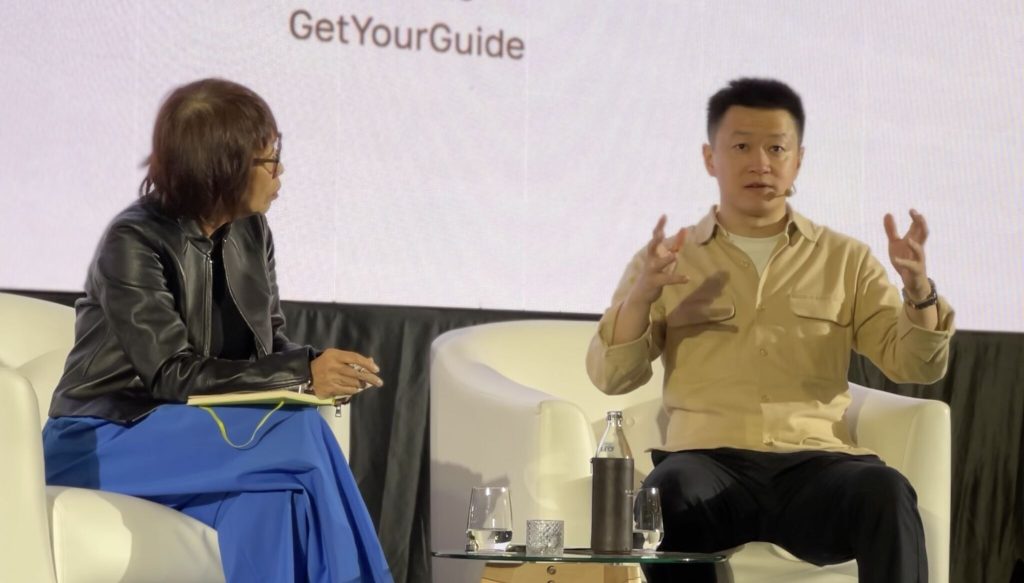
In my interview with him, which at times turned into a two-way flow, with him throwing questions my way, Tao talked about how all the forces were aligned to ensure GetYourGuide’s success globally and continued growth in the region.
Asia’s strength is its depth
Tao’s case for Asia rests on depth. Getting from A to B is solved, he argued: flights are easy, and a Grab or an Uber does the rest. What travellers want now is to experience. “Every Asian country is a universe of culture,” he said, many of them older than Europe’s, and since COVID, operators have innovated hard to curate new kinds of experiences.
I pushed back on the premise that flights are easy. The industry is living through one of the most disruptive periods in air connectivity, with conflict in the Middle East taking out capacity that Asia depends on and while travellers are finding their own detours, surely that must affect travel from Europe, GetYourGuide’s dominion, to longer haul destinations.
Tao agreed that high air fares were an issue but they weren’t dampening the appetite for experiences. He cited his own experience – he’s flying to Sydney for their first Unlocked Summit in Australia and he’s going via Abu Dhabi because air fares are just at around $2,000. “Why wouldn’t you do that?”
He said GetYourGuide’s customers were not only still travelling but they are going further, past the usual hotspots in Thailand, Japan, Vietnam and Korea to the next destinations beyond. “People are seeking out the long tail, which is what we are good at.”
He then asked me which prediction I got right or wrong and I picked my belief in Asia as a market of growth, the reason that underpinned the founding of WiT in 2005. “It only took me 21 years to get there,” I jested, “but look at you, here you are now, wanting to grow in Asia Pacific.”
His next question was, why did it take so long and why now? I pointed to the past 20 years of growth which have built strong foundations for further development; the current, changing political and economic order of the world; the fact that Asia is still enjoying strong economic growth and that “we in Asia are still in love with growth and we embrace the new with fervour”.
Not less tourism but better tourism
Given GetYourGuide’s mission, which is to unlock unforgettable experiences, I asked Tao if he was concerned about the growing noise around over-crowding in certain tourist spots in Europe. GetYourGuide’s Sustainability Impact in Italy 2025 study found that 75% of tourists in Italy visit just 4% of the territory.
He thinks “is there too much tourism” is the wrong question. “The only right question is how to have better tourism. More and better tourism.”
Tourism is an economic engine built not on mega-corporations but on small and medium-sized businesses, many of them sitting in the room, he pointed out.
He brought numbers from research it’s done in Italy.
- 15–20% of customers considered going to Italy because of experiences they saw on the platform
- They spend more: €486 per person per day, about 3x the Banca d’Italia average (€136).
- They stay longer: 8.2 nights, about 2x the Banca d’Italia average (4.33). 71% extended their stay by at least one night, and 18% chose Italy because of what they found on the platform.
- The value stays local: every €1 an international customer spends locally generates €1.58 for the Italian economy.
In short: experiences bring people in, keep them longer and spread them out. Customer reviews also make a tier-two destination trustworthy enough to try, he added.
Its numbers in Italy show that GetYourGuide customers go beyond the hotspots: they’ve visited 95% of Italian provinces and 867 municipalities, and over half of those municipalities have fewer than 10,000 residents.
I remarked that the real problem is distribution and dispersal of travellers. Travellers are hungry to go beyond. In large language models, they no longer ask where to go, but what they can do, or where to hike if they love mountains. Platforms that feed that hunger carry a responsibility to send people to places that are ready for them, I said.
Tao agreed, with a caveat. “Ultimately we are just a platform.”
Tier-two and tier-three destinations succeed on GetYourGuide not because anyone told them to innovate, he said, but because their entrepreneurs took local risks and created the experiences they care about.
“We’re the worst people to ask”
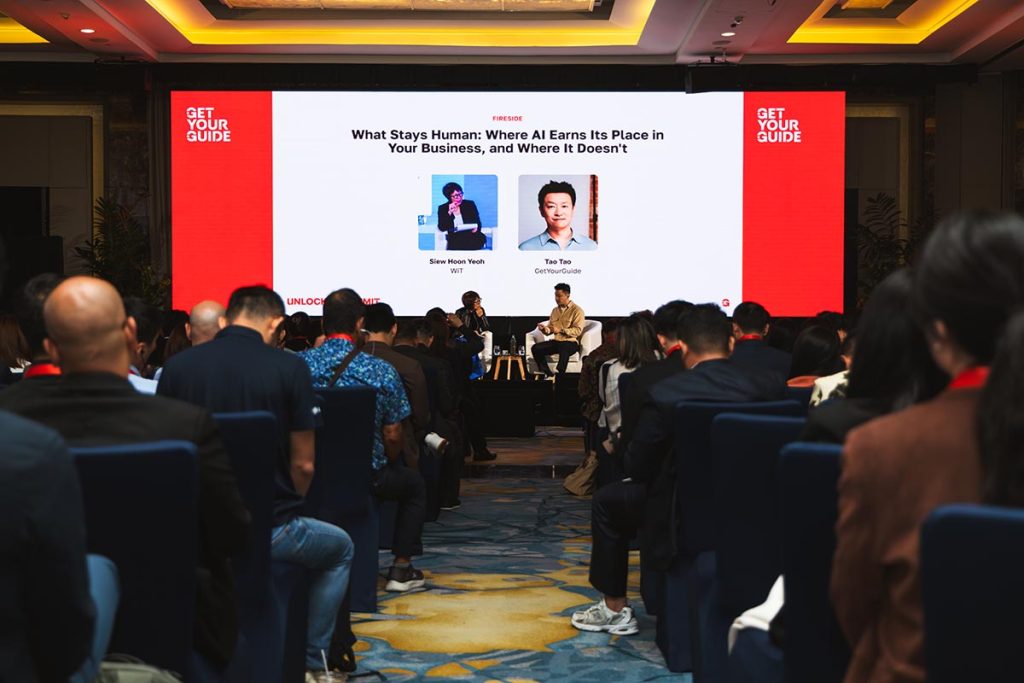
As for what kind of experiences to create, he said that operators often ask GetYourGuide what experience they should create in a given place. Tao’s honest answer drew laughs. “We are the worst people to tell you what to create. We sit somewhere in Berlin looking at a dashboard.” Some of the platform’s biggest hits, with thousands of reviews, are products he would have bet money against. “So don’t trust us. Trust your own instinct.”
I then asked if the old graveyard of travel products – distribution – just got deeper or shallower with AI, along with social, which is changing travel discovery? Has it solved this problem for small businesses or made it worse?
Tao’s answer was the long tail. Niche and unique experiences grow faster every year than the main attractions, which themselves still grow by double digits. An operator can go from idea to live listing with a first review in about two months. New listings get extra visibility, and the system specifically rewards novelty. A platform that already carries hundreds of Vatican tours gains nothing from one more, and neither does the operator. AI is used to judge whether something is genuinely different, so the customer can be told it is.
“Travel is a form of self-expression,” he said. Twenty years ago, a knife-making class in Japan which, by the way he and other GetYourGuide team members seem to love, would have been impossible to find, or to trust.
Operators too are led by self-expression of their obsessions – at the event, we heard from operators who ran cooking tours and adventure activities and you could feel their obsession with what they do from the stage.
“As a marketplace, we match passions,” he said – between the traveller’s, sometimes ones they didn’t know they had, with the passion of a local entrepreneur who wants to tell a story about a place.
Trust, backed by obsession with details, is the moat
In a world of agents, where we now see general agents emerging as well as newly-launched specialist travel agents, what’s GetYourGuide’s position in that universe, I asked.
“As entrepreneurs we’re always very paranoid,” Tao admitted. But he told the close to 300 operators in the room that they are safe. What they create is the human touch: local places, food, smells and sights that no model can replicate.
For the platform, his argument is that AI is a very intelligent autocomplete, and it needs great answers. When creating information is almost free, the scarcest resource is trust in authenticity. GetYourGuide wants to be the trust layer AI asks when it wants to know what to do somewhere.
He gave three reasons it can be:
- Curation. Only licensed, credible operators get on. About a year ago the platform took its top supplier in one Middle Eastern country offline for faking reviews, after many warnings.
- Depth. Super apps go wide and have to flatten. GetYourGuide goes deep in one category: the tour guide’s language, the size of the boat, the last slot on a Saturday, the exact price. AI will struggle to get that right.
- Fulfilment. The meeting point, the message that says someone is sick, the request to add a person or arrive an hour late.
That obsession with the details that go into the running of an experience was evident in the product updates shared earlier in the morning, before our interview.
As for how the agent landscape will play out, Tao declined to predict. The company runs many tests so it never has to be right or wrong in advance. Personally, though, he doubts travellers want to hand over the fun. Nobody into fashion tells an agent, “I need pants, please execute.” One of the app’s busiest days is Monday, when people back at work after a good weekend start browsing travel pictures. “Why would I delegate that fun to an agent?”
Creativity at scale – is that possible?
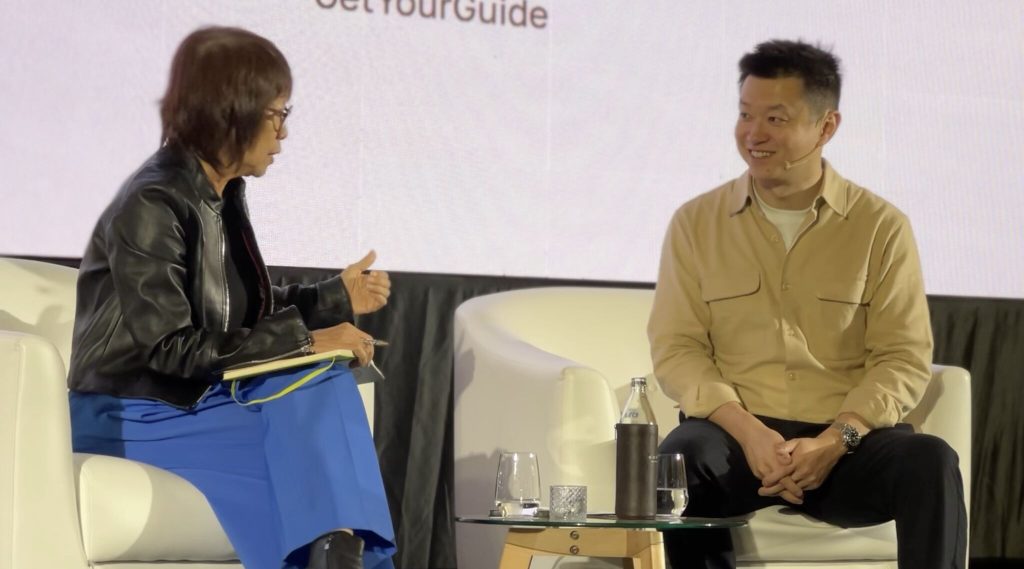
Just as operators reinvented themselves during COVID, I asked Tao what should operators be asking themselves at this inflection point?
Tao sees many who have reached real scale, with meaningful cash flows, and want to grow further. The tempting move is to copy what works in new places. The winning move, he argued, is to build an engine of innovation that keeps finding product-market fit.
His analogy was gaming. Once, distribution was the problem: you needed a game shop and a printed CD. Now anything can go on the App Store, so the winners are the studios with a business model that lets them be creative at scale. The best operators on GetYourGuide work the same way. They experiment, adapt to reviews and trends, and jump fast on new IP when a film or show breaks. “Our platform is to empower operators to do quality at scale,” he said.
I couldn’t resist challenging the phrase – quality at scale, creativity at scale: aren’t those contradictions? Take a brilliant idea, a pub crawl through haunted English villages. Scale it to other markets and doesn’t it lose what made it special?
Tao conceded it is the hard part. Afternoon tea would never work in Japan; knife-making in England would get strange looks. But some operators have cracked it, succeeding in both Mexico and Japan, on the back of a great team and a strong core culture.
The key, he said, is to look to the customer. He recalled an early board meeting when a boatd member asked whether GetYourGuide was customer-centric. Of course, they said. Then you must know what people type into your search bar, he challenged.
They had to look it up. “How can you be customer-centric if you don’t know what people are searching for?” Lesson learnt, Tao said.
The best experiences, Tao said, combine an understanding of the customer, the stories already told about a place, old and new, and the operator’s own creativity and risk-taking.
Looking to 2027 – the long and the short of it
After a disruptive year, how is GetYourGuide planning for the next? Tao described two views. The long one, which he credits for the company’s success, covers technology bets that take years to build. Some features in the day’s product presentation had been in the works for years before they were prioritised.
The short one is about scaling:
- New categories, especially live events.
- Building the brand in core markets
- More product launches for operators, most with AI at their core: relaunched programmes to showcase trusted products, more insights and competitive dashboards answering the top question, how do I rank higher?
The ambition, Tao said, is to put “the most knowledgeable account manager possible”, driven by AI, in every operator’s pocket.
The 21 questions
At the end, I closed with rapid-fire questions on WiT’s 21st-year theme.
The industry’s most embarrassing teenage habit it still hasn’t outgrown?
Connectivity errors. “Something that should be solved, but isn’t fully.”
The best advice from your early days that still applies?
Be customer-centric, and obsess about the customer. You can always obsess more.
What from the beginning don’t you want to lose in the next chapter?
The mission is to unlock unforgettable travel experiences. The purpose behind it is to help people reconnect with a sense of wonder.
“I think we haven’t lost it,” Tao said. “If we ever do, please remind us.”
“I will,” I replied.