A fintech-loyalty play where it’s about the traveller, says Joe Lu
Joe Lu was on a swing with his newborn daughter in Kobe, Japan during a month-long sabbatical, when he got the news that the Facebook engineering office he had started in Singapore and headed since 2019 would be closed down and jobs made redundant.
This was towards the end of 2022 as the tech winter took grip around the world.
“I guess it wasn’t that big a shock, we had been anticipating it given the earlier layoffs announced off the back of the global tech slowdown but I wasn’t mentally prepared when it came,” admitted the Shanghainese software engineer, educated in the US. “We were the first batch to start the engineering office at Facebook in 2019.”
Surrounded by the beautiful nature of Kobe, Lu decided to continue with his vacation while processing the news and wondering what to do next. “My first thought was concern for my team at Facebook. As a senior leader, I had responsibility for a lot of people.”
As for himself, he felt there would be no point finding a job during the bad tech market. “Yet I initially had no huge ambition to be an entrepreneur, I am not one of those who say, I want to start my own thing.”
But become an entrepreneur, he did when he recognized a gap in the market and felt the timing was right to build something on his own. During his 10-year tenure at Facebook, he had built what he called two side hustles. “This was allowed by Facebook, both of them were really promising but I’d never taken the full plunge.” Joe felt that launching something full-time required the right team and the right moment, and things hadn’t quite aligned just yet.
First, he had to find a co-founder which he said was not easy to find people who not only share your vision but are also at the right stage in their lives to take the leap with him. But the timing helped – there were lots of tech talent out there, looking for work. He called his former team mates Jialu, Sean, and Wang Ke, all of whom had strong engineering backgrounds, and they brainstormed on what to build next.
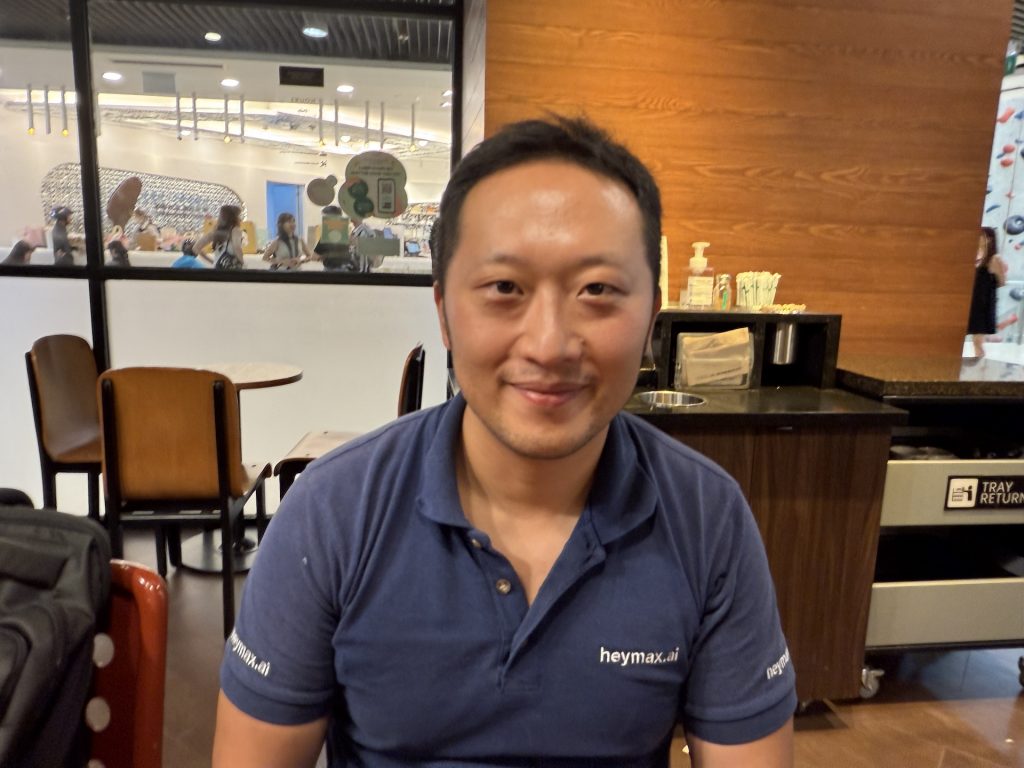
Joe Lu: “We didn’t think of travel at first but when we spoke to our customers, everyone of them wanted to travel more and spend less, just like us. So, we asked, how do we give them more miles?”
The beginning of HeyMax
Two competing ideas came up. “One was like a mix between Meetup and Reddit for parents, to create a community for parents with similar issues and the other was in personal finance. At the end of 2022, AI had become so prominent and using AI for personal finance made sense – to help people make small but impactful decisions, such as what credit card to use where.”
The latter idea won and HeyMax.ai, a fintech company which allows you to earn travel miles on your credit card spend, was born, with four co-founders, all of them software engineers. “All of us came from an engineering culture, that’s clearly not good by the rule book and we needed to adapt,” laughed Lu, noting that startups typically need a mix of business, marketing, and operations to scale successfully.
The startup was launched in January 2023. “To call it a business then would be far-stretched, it basically had one feature – ‘search any merchant, and I will tell you which credit card to use for the best deals’.”
The question then arose, should they run the business in Singapore, US or South-east Asia? After three months of research and ground work, which included speaking to 200 customers a day at a Starbucks in the US, they decided to double down on Singapore. The entire team was already based there, they were familiar with the market, and they valued in-person collaboration to build and scale the business effectively.
Their first step was to build a community on Telegram as “we knew that travel miles enthusiasts already gather on this platform and Heymax’s future customers were already there”.
“We took a community-driven approach and we shared our plans with users and they gave us feedback. We made ourselves visible and vulnerable to our community, whether they were competitors or customers. We now have 9,200 members and are growing on Telegram.”
How it found its groove in travel
Today, HeyMax has grown to more than 100,000 customers in Singapore, runs its own loyalty programme with a universal currency, allowing customers to earn Max Miles across 27 airlines and hotels, including brands such as Accor Live Limitless, British Airways Executive Club and Qatar Airways Privilege Club.
“We didn’t think of travel at first but when we spoke to our customers, everyone of them wanted to travel more and spend less, just like us. So we asked, how do we give them more miles? We looked from all angles.
“The usual route is to create a loyalty currency that ultimately drives more business for the company. But we wanted to put the customer first– how do we help them earn more miles and give them the freedom to use those miles however and whenever they want?
“The next question was: how do we get access to actual miles? We started by looking at the problem from the customer’s perspective—how easily can they earn and use their miles? Then, we considered the other two key players. For airlines, the challenge was proving our scale and value – why should they partner with us? For merchants, it was about demonstrating the return on investment – what were they funding, and how would it benefit them? Solving this three-way equation was key to making our model work.”
The answer came through the customer-led feature on its app – helping users determine which credit card would best optimize their miles.
“That feature brought us customers and as that base grew, people started taking us more seriously. Our first fintech partner was Ascenda and from there, it kind of snowballed. We brought on other features such as double dip opportunities to earn Max Miles on top of credit card points, which we launched in September 2023.”
The critical factor, according to Lu, was “doing it with a completely open and independent platform where you earn Max Miles every time you make a purchase with us. “We connect users to brands they love, and every time they shop, they’re rewarded with Max Miles – a universal travel currency that never expires, has no fees, and offers flexibility for travel-related bookings.”
HeyMax partners directly with brands, creating a ecosystem where merchants can engage high-value customers while rewarding them with miles. Today, the platform features 600 brands, including Shopee, Amazon, Apple, Trip.com, and Singapore Airlines.
Another fintech partnership is with Chocolate Finance, in which HeyMax is the default loyalty programme for card spend.
The real competitors –loyalty programmes vs big tech’s advertising model
As Lu sees it, HeyMax’s direct competition comes from other loyalty programmes, but the broader opportunity lies in reshaping how brands engage customers.
“Our focus is on the traveller economy—capturing everyday spending and converting it into travel rewards,” said Lu. “Traditional loyalty programmes are our main competitors, but we also see a bigger shift happening. Instead of businesses spending billions on digital ads to reach consumers, platforms like HeyMax allow brands to reward customers directly. Rather than just paying for attention, brands can give real value back to consumers.”
He added, “Think about it – over US$1.7 billion is spent on digital ads on platforms like Google and Facebook ads in Singapore alone. Imagine if more of that went directly to rewarding consumers instead of disappearing into ad platforms. We’re offering an alternative where customers benefit from their everyday spending, and brands gain more engaged and loyal customers in return.”
How Gen Z and Alpha view loyalty and miles
Lu observed, “People’s demands and patterns of travel are changing very quickly, being driven by social channels such as YouTube and TikTok. My personal experience as a traveller – my first interactions with luxury brands came through business travel. I’d book flights and hotels, accumulate miles realizing how valuable they were and by the time I am over 35 years old, I am hooked. I needed miles.
“That was the past. Now with Gen Z and Alpha, the journey starts much earlier. They hear about travel perks through social media and influencers, they see their peers maximizing rewards. And they take pride in sharing their experiences – it’s become a form of social currency.
“I always believed travel demand would increase steadily and what happened after the pandemic was not what everyone called revenge travel, it was a shift in how people think about travel rewards, with more diverse ways to earn and redeem miles.”
When asked if HeyMax was in a way “revenge” against his past employer, Lu laughed and said, “Not at all. Customer behaviour is changing, and we have the opportunity to plug into what I call the traveller’s economy, where every dollar spent on daily purchases can turn into more travel opportunities, making trips more affordable and accessible for everyone.”
AI domain: To be cool or does it really mean something?
As for how HeyMax is using AI – it after all has the .ai URL and I asked him whether he had done that to be cool and attract investors attention, Lu laughed. “When we were choosing the domain, we wanted to be an AI-first company and we built a WhatsApp chatbot, which we still have. But that’s no differentiation, ChatGPT can do that.”
What truly matters, he explained, is helping customers make better financial decisions. “The foundation of our product isn’t just AI – it’s trust. People want to know they’re getting the best advice based on their needs, not just another automated response. AI is the future, but we don’t need to force it on people before they’re ready.”
So what happens to the media funnel when AI agents enter the picture? “All those things – credit card, miles – will be completely democratized. It should cost an AI agent nothing to compare options. Everyone will become savvier about credit cards and miles, because instead of relying on search engines that monetize attention, they’ll get direct, unbiased recommendations.”
“Agents should have no self-interest, they are capable and have your back.”
His wild guess is that “a fully functioning HeyMax agent is about five years away”.
“The hardest thing to build isn’t the technology—it’s trust. Trust takes time and long-term consistency. People need to believe, ‘I’ve got your back,’ and that’s what we’re focused on first.”
Fundraising: Scaling to build joy and empathy
Since founding, HeyMax has raised US$2.6 million, and has grown 12x in GMV to $100 million. “We measure our impact by the number of trips we help users take. Our goal is to make it possible for everyone to get a free trip a year,” said Lu.
And despite the small population of Singapore, he said. “Singapore is much bigger than we need to become a unicorn. I know that’s a bold statement but think of the $1.7b in marketing spend here. And the Singapore travel demand is high.”
HeyMax currently has 15 fulltime staff in Singapore, with Lu saying the company’s annualized grew five times y-o-y.
It is now looking to raise another round to expand to other markets such as Australia (where it has been live for over a year), Hong Kong, Taiwan, Japan, Korea and the UAE.
He said, “We want to push the industry in the right direction. We strongly believe that customers want simplicity and want to travel more. Imagine aggregating all your spend across partners in one app – all those incentives. We don’t make you jump through hoops – there is no exclusion in terms of earning miles on the spend and our currency does not expire.
“Travel gives the world more joy and empathy, we want to innovate to give people the means to travel more.”