
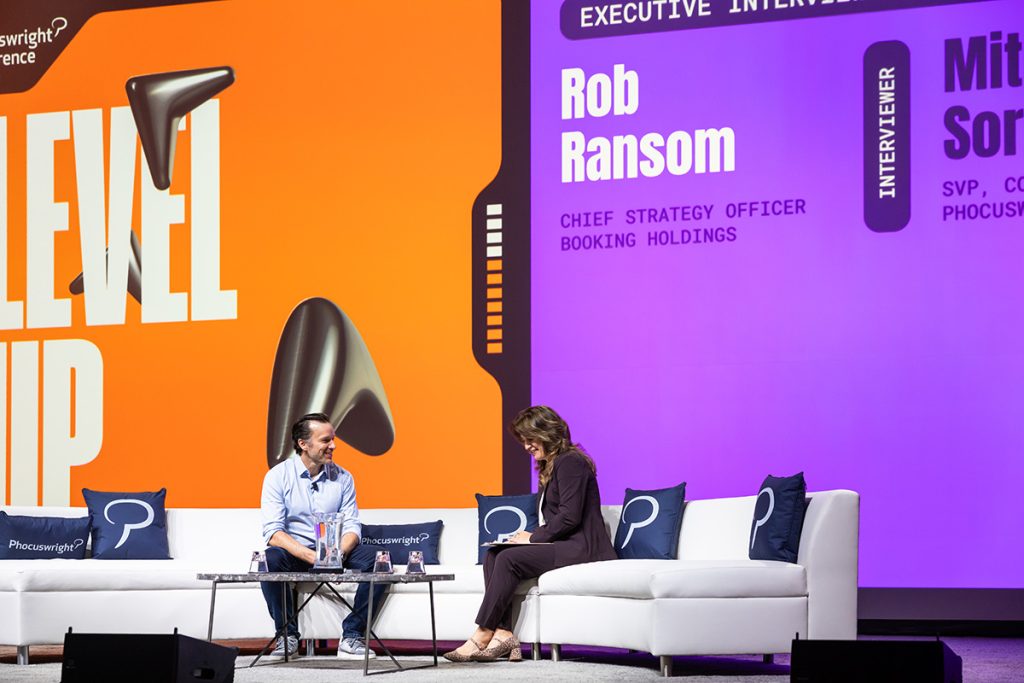
At Phocuswright, in a conversation that oscillated between realism and optimism, Rob Ransom, Chief Strategy Officer of Booking Holdings, laid out how the world’s largest online travel company is thinking about the most consequential shift since the dawn of online travel: the rise of AI-powered discovery, decisioning and distribution.
If the 1990s belonged to aggregation and the self-service revolution, the 2020s may well redefine what “value” means for OTAs – and whether brands like Booking.com, Priceline and Agoda can continue to stay close to the traveller in an age when AI platforms can do much of the heavy lifting.
Ransom’s answer: yes, but only if you evolve the right way.
AI is a big moment, but not the whole story
Ransom didn’t shy away from the fundamental question: If AI can aggregate information, compare prices, produce itineraries, and transact, what’s left for OTAs?
“The value to a consumer in travel is more than just aggregating information,” he said. Travel still requires trust, security, service and the ability to handle disruption. “What happens if my plans change? How do I get support before the trip, while I’m on the trip? How do I pay for it in a secure and trusted way?”
Generative AI enhances the top of the funnel, but the end-to-end journey remains messy – and Booking believes that’s where its accumulated scale, supply relationships and service infrastructure continue to matter.
Google, gatekeepers and feeding the beast
The inevitable question surfaced: By partnering with Google and OpenAI, is Booking feeding a new layer of intermediaries that will sit between OTAs and travellers?
Ransom’s answer was measured. “I don’t know if I’d use the word worry, but think about it for sure.”
He added that fears of “Google eating your vertical” have existed almost as long as Google itself.
But importantly, he noted that Google’s incentives are intertwined with the ecosystem’s health: “They also know that they have a great business when everyone else has a good business too.”
Booking’s early participation in the Google AI Mode partnership and the ChatGPT App Store is driven by learning, experimentation and – not insignificantly – speed. “OpenAI moves quickly. Our team moved very quickly too.”
The ChatGPT app: Low volume, high learning
Booking’s ChatGPT app, which enables users to explicitly invoke Booking.com during a travel search, is still in its infancy.
“It’s a great learning environment. It’s relatively low volume at this point but it’s also an opportunity. We built that very quickly and we have a lot of ideas how to improve the experience.”
The most interesting question – how the LLM chooses whether to present Booking.com or Expedia when a user asks for help – remains unsolved.
“I’m not sure Google knows exactly how that’s going to work… it’s still being figured out.”
Will people still visit websites? And what happens when agents do the browsing?
Cloudbeds’ CEO and co-founder Adam Harris had predicted earlier in the conference that websites may fade as conversational agents take over. Ransom wasn’t convinced.
“People have been predicting that nobody’s going to read newspapers anymore either… It’s generally true, but it’s not true yet.”
Websites will shrink, mobile apps will dominate but the intriguing wildcard lies elsewhere: “Non phone-based, AI-powered devices. Everything from glasses to wearables. In five years, that’s more interesting.”

Fairness, visibility and the DMA era
With AI presenting fewer results, worries about gatekeeping are growing. Booking is already classified as a “gatekeeper” under the EU Digital Markets Act, but Ransom pushed back on the idea that personalisation equals unfairness.
“It really does need to be fair and transparent. If we have the ability to deliver personalized, relevant results, that’s an improvement for the customer.”
The long tail of small hotels – Booking.com’s historical backbone – continues to voice concerns about visibility in an AI-powered world. “They rely on Booking so it’s natural they’re wondering, ‘Hey, is this going to change?’”
Ransom expects new intermediaries to emerge to help independent hotels interface with agentic systems.
Experiences: The memory makers
Eight years after expanding beyond accommodation, Booking’s push into experiences – especially through Fair Harbor – remains a strategic priority.
“People remember the experiences they have on a trip much more than where they booked the hotel or where they booked the flight.”
Fair Harbor has been “very important,” and the experience supply side, often fragmented and underserved, continues to be an expansion area.
The Connected trip: Harder than it looks
Booking coined the “connected trip” concept years ago, yet Ransom admits the work is far from done. “It’s much harder than we thought… just a lot of complexity. Still a work in progress.”
But the ambition remains the same: reduce friction across every element of travel.
Asia, growth and the portfolio view
As Chief Strategy Officer, Ransom looks across all Booking Holdings brands. Asia, driven by Agoda’s strong foothold and the region’s outsized growth projections, is central to the long-term plan.
“Asia is at the top of the list… it allows us to allocate our capital between different brands in a way that supports that geographic growth.”
Vertical expansion – flights, experiences, insurance – remains the other core lever.
And yes, the long-running eTraveli acquisition process continues, with hope for resolution in 2026.
B2B consolidation: Three paths become one
Booking.com, Agoda, and Priceline each built their own B2B distribution businesses. The company is now integrating them into a single unit.
“It takes some time to pull those together, but we can serve partners better. It makes a lot more sense.”
What he hopes people say in 2030
Ransom closed with the big-picture hope: “We took this AI… and really integrated and delivered an amazing customer experience, even better than people thought possible.”
And the next travel unicorn? “I will say Singapore.”
Indeed, a fitting end and a hopeful signal to WiT’s home region. Thanks, Ransom.