
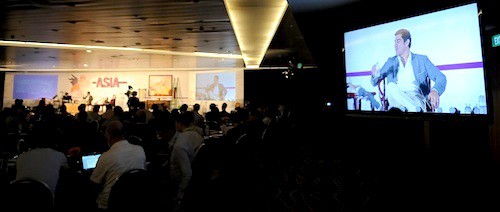
 Sitting at Penang airport and just got the news on my social feed that Lou Reed is finally taking the wildest walk of his life. Reed, 71, was a huge influence on blues and rock in his time and his words and music always made me smile for all that it implied.I feel like I too have just taken a walk on the wild side with the completion of the week that was Web In Travel, starting on Monday with the Bootcamp and then ending on Friday with the last three ITB Asia clinics which we help run.As always, I learnt many things – too many to put in one post – but here’s a recollection of the key thoughts I took away from Day 1, October 22.• It’s no longer good enough to be a multi-national that succeeds in going global. You have to be a meta-national – a brand that’s everywhere and no one cares where you are from. Think DHL, it’s everywhere and we don’t really know who owns it – from Parag Khanna (pictured above) who kicked off the day.• It’s also no longer good enough to have IQ or EQ. You need TQ, Technology Quotient.
 • We all need Google to give us traffic but beware, “Google’s trying to rape you” so try find alternative channels to acquire customers – (pictured right) AAE Travel’s CEO Kathleen Tan’s comment will go down in WIT history as one of the most colourful ever made on our stage.
• The “father of online travel”, Rob Rosenstein, CEO of Agoda, remains sceptical about social – yes, it can deliver transactions – Tan spoke of a personal Instagram post that yielded tens of transactions – but can it scale, he asked?
• One of Booking.com’s challenges in expanding in Asia is its flat hierarchy which sometimes doesn’t translate that well in markets used to more formal structures. But the giant is getting bigger – it delivers 500,000 room nights a day globally – and Asia is delivering great results as it scales across the region. Its obsession with customer focus will be the key that unlocks The Asia Factor.
• Up to 22% of traffic for TripAdvisor comes from Asia and mobile is the big bet for the world’s largest travel site – it’s become the one everyone’s watching with its move to meta-search, its blending of price and reviews, its integration with Facebook, its partnership with Samsung, its launch of TripAdvisor Connect and its aggressive plans to dominate the region.
 • Meta’s truly the new battlefield and it is clear that the winner will be the one that can build a brand fastest in Asia. Even though Kayak hasn’t done much work in Asia yet, its name has got good recall. Trivago’s launching television ads across the region. Skyscanner is scaling well across Asia and its new funds will help it build awareness and expand beyond flights. Wego has to defend home turf and is using the freshly-raised capital to build its brand. We take a bet there will be more consolidation and acquisitions in this space the next few months.
• Rakuten’s marketplace model allowing hoteliers to engage directly with its customers, Wotif’s launch of dynamic packaging and Ctrip’s launch of international language websites to cater to foreign travellers to China – Asia-based OTAs are playing their local advantage to defend territory and to achieve a global footprint. Who will be able to scale outside their home market?
• Is it too early to write Wotif off in terms of unlocking The Asia Factor? CEO Scott Blume’s trying to arrest the decline of market share in Asia by hiring new teams, putting more resources and looking not just at Australian outbound but inbound business to Australia. If there is one outsider OTA which should succeed in Asia, it should be Wotif with its Australian advantage – will it squander away the Asian Century?
• Google’s new survey of travellers across Asia reveal that 83% use online to plan hotel stays and that they want it simple, personal and mobile. So if you’re still thinking about it, stop thinking – it’s time to take a walk on the mobile side of things. 39% used a mobile to plan their last stay and 59% want the freedom to book wherever, whenever.
• But critical question to ask – should one even bother with an app if you don’t have a brand? Best bet is mobile-optimised experiences across all devices. Device-agnostic is the new religion.
• Fact is, you attract new users with mobile, according to AAE Travel’s technical director, Lorin Kobashigawa-Bates. They spend more, having an 8% higher average booking value, they visit 22% more pages per visit and they have a 30% longer average visit duration – and they want location-aware search, personalised notifications, live updating data, last minute deals and mobile-only deals.
• Jury’s still out on same-day booking apps – can it scale across a region that’s so diverse and can it compete with same-day/last minute services being launched by big players such as booking.com, Expedia, MakeMyTrip, Ctrip, Rakuten? HotelQuickly.com has so far raised US$1.6 million to prove there is a market of such consumers – be they business travellers or party goers too drunk to get home.
• Facebook is betting its next billion customers will come from Asia and if it is to scale its travel vertical, it needs to beef up resources in the region. There are advertisers who are keen but find it hard to get support. Accor Asia Pacific launched its Social Media Monitor at WIT, which will form the basis of its social media strategy for 2014. Starwood launched a travel deals page on Facebook with a US$75,000 budget and that has so far earned it $2 million in revenues, double the target it set its agency Brand Karma. Expect Facebook to gain more traction in Asia where an average 181 million people use it everyday.
• Some mobile trivia from Facebook (June 2013 data) – 819 million people access it on mobile every month – 46% do it when commuting, 44% in bed and 34% while watching television.
• Tours & activities is ripe for disruption – but it’s a hard space to crack because it’s extremely fragmented, the supply chain is very low-tech and the per dollar value per transaction is $50, said Rezgo’s Stephen Joyce.
 • But just as Uber has disrupted transportation across the world – a jaw-dropping number was shared by Uber’s Sam Gellman that there are 700,000 taxi trips in Singapore a day – could an Uber of Tours emerge? The potential after all is in-destination when the traveler is already in the place and wants to book a tour, said Viator’s Ken Frohling.
• As for entrepreneurs, well, the Monday Bootcamp was about not only about doing things differently but to think unconventionally as well, if you want to remain self-employed. Thing is, said Philip Wolf (pictured right), founder of PhoCusWright, entrepreneurs don’t see themselves as risk-takers; rather they see those who work in corporattions as the risk-takers because essentially they are surrendering their destiny to someone else. Wolf picked the sharing economy as the trend to watch that could have longterm implications on travel.
• For those of us smaller players who are wondering how we can compete and scale, heed the words of Mandip Singh Soin, founder of Ibex Expeditions which still curates and customize itineraries for intrepid travellers after nearly three decades. Much wants more – “however, much we have isn’t enough and we keep wanting more and it’s important to know how much is much,” he said.
Stay tuned for ideas from Day 2.