The online travel giant just moved 4,000 employees into a state-of-the-art new home. But the real story is what’s happening inside the company, including a sweeping B2B transformation, an AI rethink, and a forecast on where Asia travel is heading next.
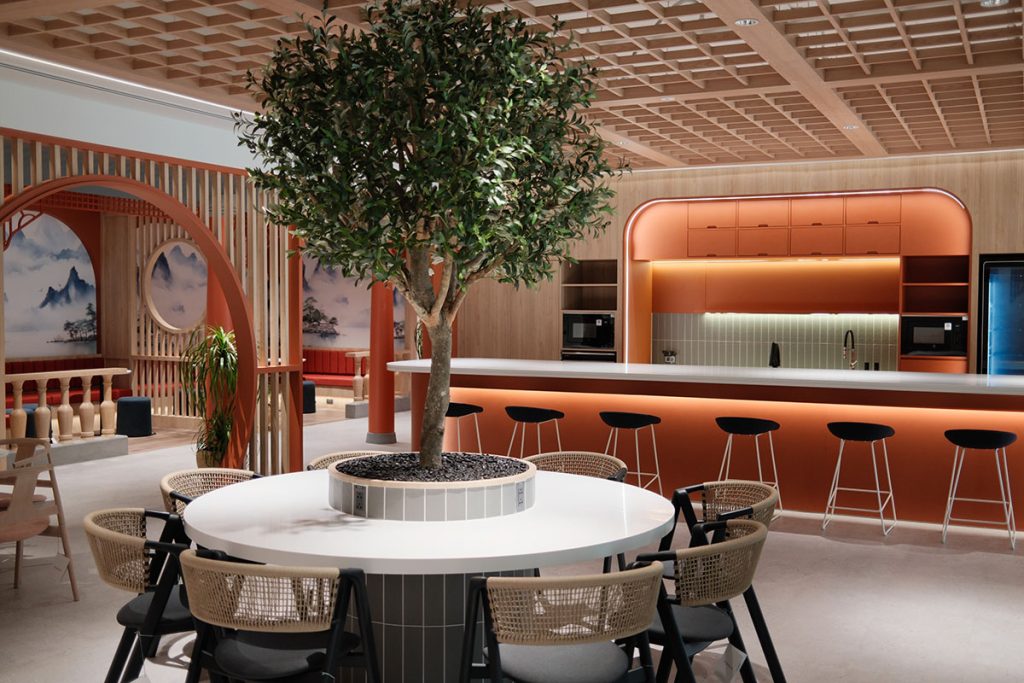
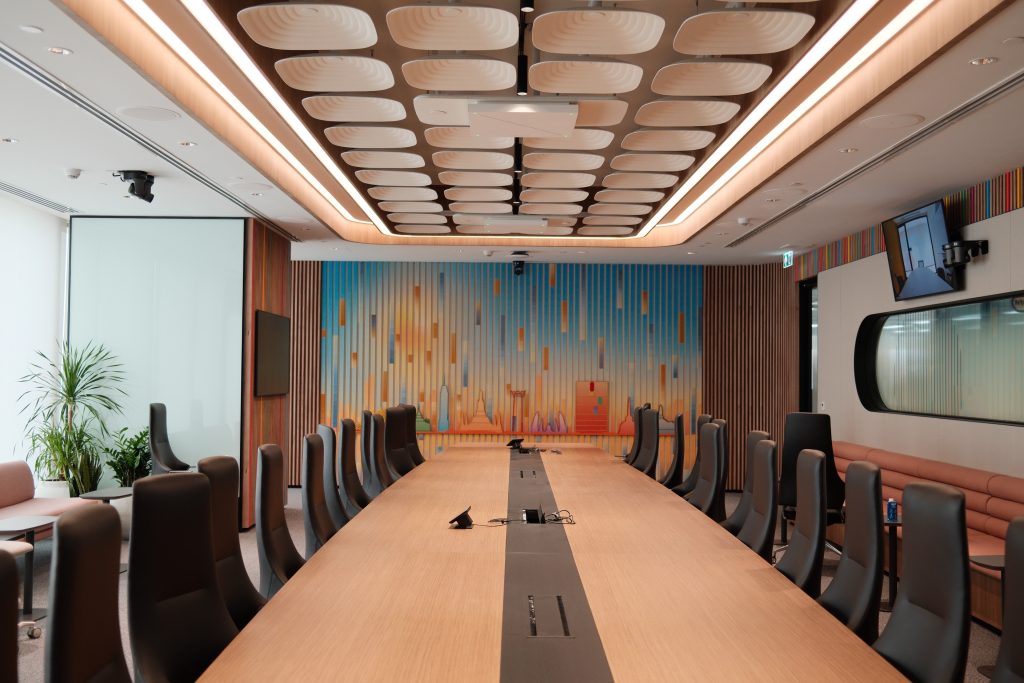
Spanning more than 26,000 square metres across seven floors in one of the Thai capital’s most ambitious mixed-use developments, the new campus brings nearly 4,000 employees under one roof, complete with a dedicated Network Operations Center, hot desks all around, and professional production studios.
It’s worth noting that when Chief Commercial Officer Damien Pfirsch and SVP of Supply Andrew Smith joined the company 14 years ago, the entire Bangkok operation ran on a floor and a half. They’ve watched it grow to fill ten floors at the previous Central World space, and now this.

The big merger nobody’s naming yet
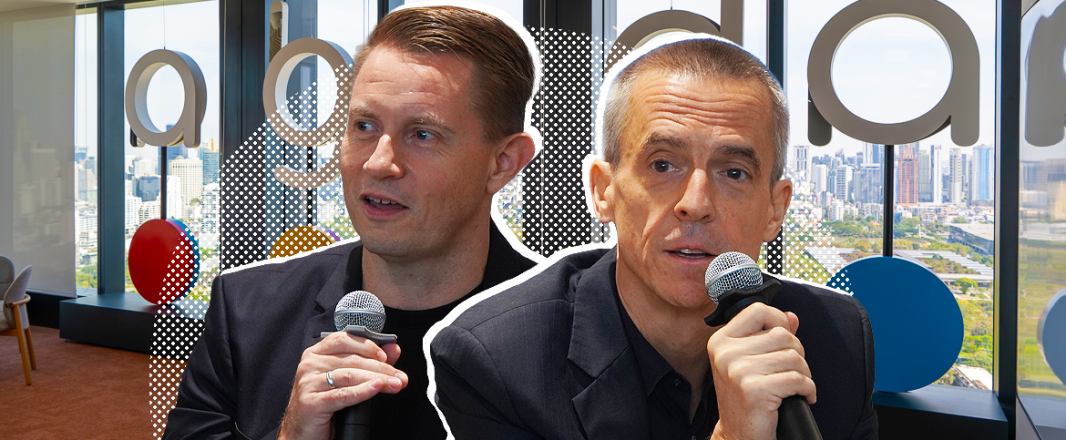
The most significant news out of the company right now is a consolidation quietly revealed in Q4 last year that Pfirsch was careful, and candid, about sharing with the media during a roundtable held at the new hub.
Booking Holdings has decided to bring together the strategic B2B partnership arms of Booking.com, Priceline, and Agoda into a single unified organisation. That means Rocket Travel by Agoda, which Pfirsch currently heads, will become part of a single B2B organisation.
“The goal is to offer a more cohesive, streamlined experience to our partners,” Pfirsch explained. “Today, there are partners all around the world that work with Agoda and Booking.com but they engage with a different person, and some of the processes are different. We want to make it easier for partners to work with us.”
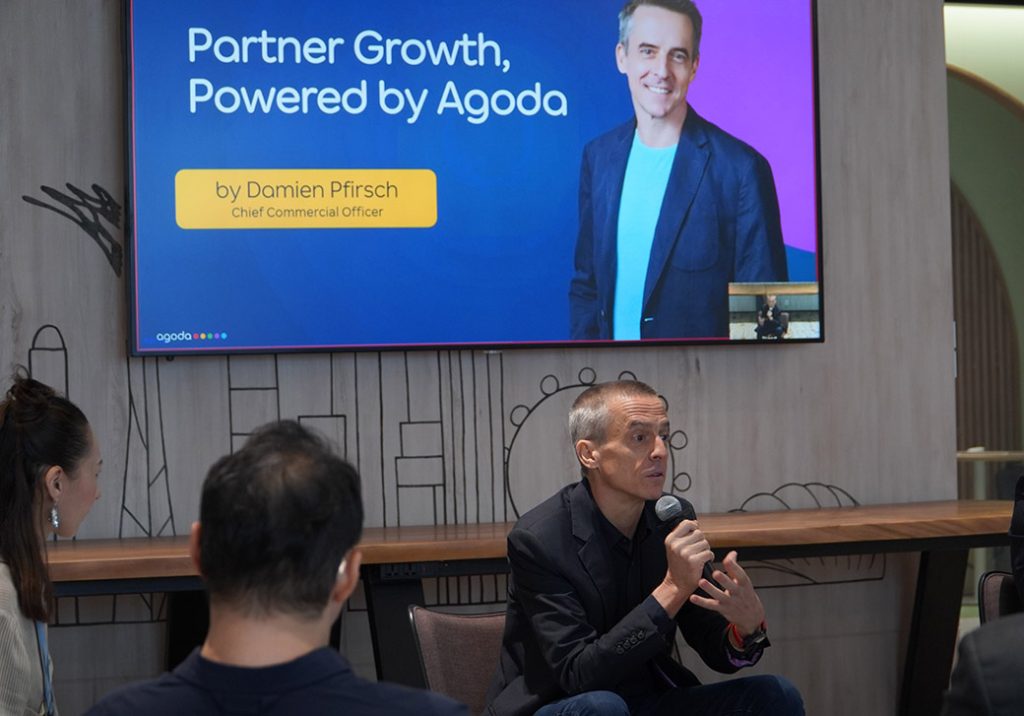
“The goal is to offer a more cohesive, streamlined experience to our partners,” Pfirsch explained.
He outlined three core objectives behind the consolidation, including simplifying the partner experience, pooling the best of what all three OTAs have to offer, and accelerating innovation. “As we are coming together, it increases our innovation capabilities to be able to engage deeper with partners and develop additional solutions and services for them,” he said.
No name yet, no exact launch timeline. But Pfirsch was clear this is a significant undertaking, pulling together people from the US, Europe, and across Asia into an entirely new structure. “It’s a large transformation and it takes quite a bit of time,” he said. “But whenever we have something we can share that becomes public, we’d be very happy to share it.”
What the B2B engine actually looks like
To understand why the merger matters, it helps to know how Agoda’s B2B operation currently works. Under Rocket Travel by Agoda, the company engages partners through three broad channels which include integration (APIs, white-label platforms, redirects), activation (advertising and marketing tools, loyalty and payment programs), and deeper co-built products for specific partner needs.
Financial institutions like Citi in the US use white-label travel portals powered by Agoda so that cardholders can redeem and earn loyalty points through travel. Major airlines including American Airlines and Scoot offer hotel booking to their frequent flyer members via Agoda’s infrastructure. Cash-back platforms like Shopback, a partnership running for eight or nine years now, use Agoda’s supply to bring travel to their user base. JTB, Japan’s largest travel agent network, runs on a full end-to-end Software-as-a-Service platform built entirely by Agoda to their specification.
Pfirsch estimated that Agoda’s B2B volume is roughly split into thirds. One third from driving traffic to B2C platforms, one third from API inventory exchange, and one third from white-label solutions, with the latter particularly driven by large US banks, where the credit card loyalty points economy is enormous.
“The fun part of partnership is not coming and saying, here’s a menu of three solutions, tick here and sign here,” Pfirsch said. “The fun part is building a business together. If you have an idea, don’t look at what others are doing, come and share it with us, and hopefully we can build something big together.”
Agoda’s AI play means back-end first, then the customer
On the technology side, Pfirsch described what he calls an “inside out” approach to AI. “When AI came, everybody said it’s going to transform the way people book. I’m just going to take my phone and say, ‘hey, book me a hotel in Phuket’, and it’s going to do everything,” he said. “The reality is, maybe one day, but it’s not the case today.”
Instead of rushing AI to the customer-facing side of the platform before it’s ready, Agoda focused first on internal applications. The company has built roughly 200 proprietary AI tools used internally across teams, from customer service and report generation to hotel management and financial reconciliation. “We developed a lot of different tools to enable people to use large language models in a safe and compliant way,” Pfirsch explained.
Now, with that foundation laid, the company is gradually pushing AI to the front end.

“People in the region are exploring each other’s countries,” Smith said. “What they want to experience is something that is both very personal, deeply localised, and allows them to reach all these new destinations within the region.”
Andrew Smith walked through three live customer-facing implementations. The first is a property chatbot that can answer hyper-specific questions about individual hotels, drawing on years of reviews and customer service data. Questions like whether a baby cot will fit in the room, or the clearance height of the car park. The platform is currently fielding around 30,000 of these questions per day.
“We have millions and millions of reviews; that’s proprietary data that we can use to train the chatbot. Before AI, it was quite hard to access that information even ourselves,” Smith said.
The second application is review summarisation, which means surfacing key themes from hundreds of reviews through interactive visual summaries rather than walls of text. The third is a planned expansion of the chatbot to the property listing page, where users can compare across multiple hotels and get help understanding cancellation policies during checkout, a change Pfirsch noted is already showing “a very big impact on conversion.”
What Asia travel actually looks like right now
According to Agoda’s data, Asia is still the growth engine, and intra-regional travel is at the heart of it. “People in the region are exploring each other’s countries,” Smith said. “What they want to experience is something that is both very personal, deeply localised, and allows them to reach all these new destinations within the region.”
Secondary destinations are a particular bright spot with travellers venturing beyond the big airport hub cities into smaller towns and rural areas like Japan’s rural prefectures, Indonesia’s villa clusters, and Thailand’s lesser-known coastal towns. “The Thai traveller has been to Tokyo a few times, so the next time they go to Japan, it’s definitely not Tokyo,” Smith added. “The data shows this very strongly.”
South Korea was singled out as a standout source market with a strong passport, high travel frequency, and showing up in virtually every Asian destination on Agoda’s search data.
Smith described India as a country in an early, high-growth phase of travel with a high outbound appetite but still building out its infrastructure to receive inbound visitors from the rest of Asia. “Everybody knows India as a country, but I don’t think everybody understands the diversity of tourism experiences available,” Pfirsch said. Agoda’s approach is layered, signing up supply across secondary Indian cities, offering full-language localisation for first-time inbound travellers from markets like Vietnam, and providing 24/7 in-language customer support.
On geopolitics, it’s too early to call
On the question of how current geopolitical tensions, particularly in the Middle East, are affecting travel flows, Smith was careful not to overcorrect. “It’s a very dynamic situation. Is this going to be a transient issue that gets resolved in a few weeks, or is it more a systemic, long-term challenge? Nobody knows.”
What he did say is that domestic and short-haul intra-Asia travel is ticking up, partly as a hedge, partly as a convenience. And Thailand specifically is seeing a shift in origin mix. Chinese arrivals are down, but Indian arrivals are up significantly, and Japanese visitors are up too as the yen strengthens. “That’s a great thing about having this regional approach, some national legs go up, some go down, but everybody wants to travel.”