Amanda Currie breeds microbes for a living now. She’s gone from reading spreadsheets in financial regulation to studying soil on a farm.
“I found myself looking at soil under a microscope,” she told a WiT Queenstown panel on “Food, Identity & Tourism”. “And when I did that, I realised the soil was really alive. That changed my entire perspective around farming.”
That line stayed with me longer than almost anything else said at the first WiT Queenstown. Because underneath all the AI talk and the panel debates, the word that kept surfacing in sessions – as often as “AI” itself – was resilience.
And the best explanation I found for what resilience actually means was not on stage, but when I visited her 745-hectare farm in Central Otago, about an hour’s drive from Queenstown.
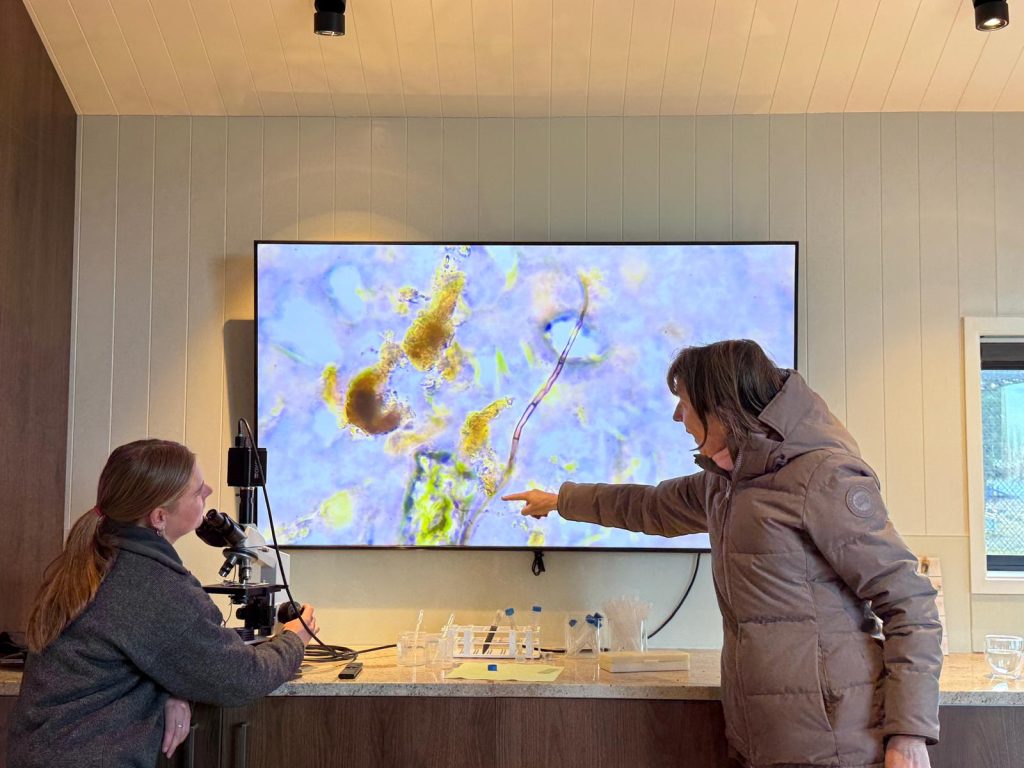
Amanda Currie breeds microbes for a living now. She’s gone from reading spreadsheets in financial regulation to studying soil.
The farm beneath the farm
Amanda and her husband Adrian Currie left corporate life – he used to run Asia Pacific for Booking.com – to build Tinwald Farm, a regenerative estate running cattle, sheep, horses and a single-vineyard Pinot Noir.
Adrian makes the wine. Jason runs the farm’s grazing systems, moving 250 Angus cattle and 1,500 sheep in careful rotation, because – as he told us, as we watched his dog work the flock downhill – the health of the soil depends entirely on how the animals move across it.
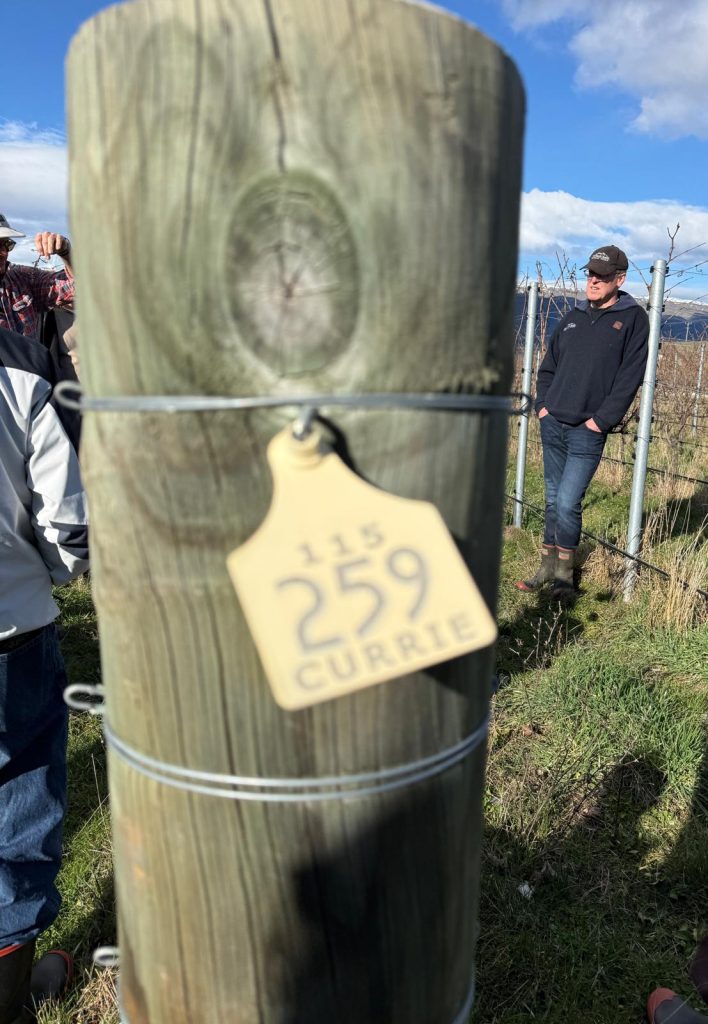
Amanda and her husband Adrian Currie left corporate life – he used to run Asia Pacific for Booking.com – to build Tinwald Farm, a regenerative estate running cattle, sheep, horses and a single-vineyard Pinot Noir.
Meanwhile, Rob prunes the vines by hand, branch by branch, “in pursuit of balance”.
Amanda’s work is the one that fascinates me. She isn’t farming sheep or grapes. She’s protecting microbial life in the topsoil – the invisible layer that, she says, “is protecting the whole planet, not just running the farming system.”
Everything visible at Tinwald – the wine, the cattle grazing on green hills, the horse-drawn carriage that visitors ride – depends on something nobody sees and almost nobody thinks about.
In essence, resilience is a foundation invisible enough that you forget it’s there until you go looking under a microscope.
Two airlines, two theories of the invisible
Nikhil Ravishankar, CEO of Air New Zealand, opened WiT Queenstown making a version of the same case, from an industry about as far from soil science as you can get.
He was blunt about the airline’s troubles – a fifth of the fleet grounded for years by Pratt & Whitney and Rolls-Royce engine issues, roughly $2 billion in aircraft sitting idle in the desert, a forecast loss in the hundreds of millions.
“When you are in New Zealand and you have only 115 planes and your competitors have 1,500, 1,600 planes, you just have to be smarter.”
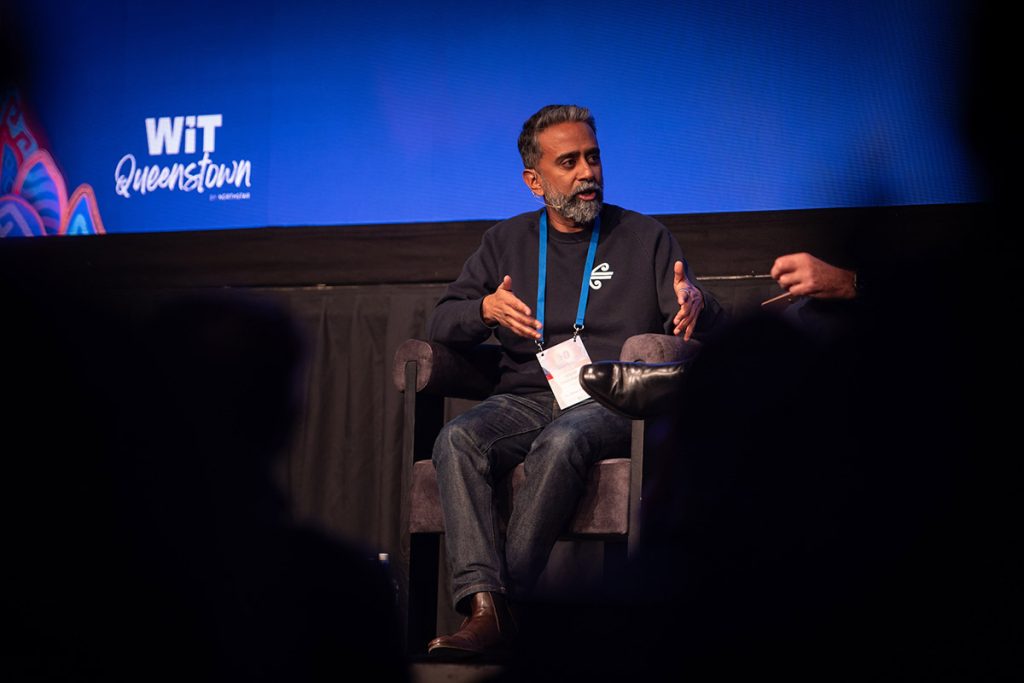
Nikhil Ravishankar, CEO of Air New Zealand
Part of the answer is technology – specifically, breaking down what he called the “fuel silos” that airlines have built into their own software: fleet planning, network planning, crew rostering and maintenance, each running on separate systems, each planning cycle taking six months because nothing talks to anything else.
AI, he argued, is the first tool that can sit across all of it as “an almost universal optimiser” –think of it as Amanda’s microbes, in a sense, but wired into enterprise software instead of soil.
Meanwhile, at Fiji Airways, CEO Paul Scurrah has an ambition to become the world’s happiest airline – a mindset he traced back to running Virgin Australia through COVID and into voluntary administration.
“It teaches you that you should have an aspiration for being as happy as you can in the circumstances you’re in,” he said. “It’s back to optimism… at the core of happiness there’s a level of gratitude.”
Some might argue that happiness and gratitude are also the building blocks of resilience.
When I asked James Thornton, CEO of Intrepid Travel, about resilience – a North Ridge Partners report had documented travel’s history as having gone through 19 shocks and each time it recovers – he didn’t buy into the part about technology playing a key role in building resilience.
“Technology does enable a degree of resilience, but ours comes from our people,” he said. “We’re a people business – 4,000 people around the world, hundreds of collective years of travel experience, our own destination management companies in over 40 countries.”
The equilibrium problem
I then asked Thornton how he’d rethink the purpose of travel, so that the industry becomes more resilient.
“It would be that travel was designed to benefit communities, not just customers,” he said. “The way we’ve all grown up designing travel is for the benefit of the traveller – give them a wonderful time, they come back, that’s an NPS of 83. But travel doesn’t have the equilibrium right now. Communities aren’t sufficiently benefiting, and when they are, it’s too infrequent, and it goes to too few people.”
You know what – I’ve heard some version of that line at nearly every WiT event this year – Cape Town, Tokyo, Barcelona, Penang.
Which brings me back to Amanda Currie and her scientific work with soil. She taught me that a healthy farm begins with the life you cannot see. Perhaps the same is true for travel.
Its resilience may depend less on the technologies we build above the surface than on the invisible foundations beneath them – healthier communities, stronger relationships, connected systems, and a clearer sense of balance between visitors and the places they come to experience.
Like good soil, those foundations are easy to overlook, until you realise they’re what make everything else possible.