From search to answers, from flights to packages, from metasearch to B2B: the Skyscanner CEO on how a 20-year-old brand plans to stay relevant when the ground shifts every week.
The last time I interviewed Bryan Batista on the sidelines of Phocuswright last November, my opening question was blunt: is your business dead?
So when the Skyscanner CEO sat down for a coffee chat at WiT Singapore 2026, he was relieved to be offered what he called a soft question. Compare the cultures of the three companies that have shaped him: Tesla, Booking.com and Trip.com Group, Skyscanner’s parent.
Tesla, where he worked in the early 2010s, was about “taking customers through a technology transformation”, the electrification of the car. “Very exciting, mission-driven, high pace, high intensity.” Booking taught him how to scale: “globally scalable, locally relevant”, with a very strong culture.
Skyscanner has taught him the value of trust. “Having trust in a brand, especially in a crowded marketplace, and being traveller-first, really embodies the ethos of our product.” And Trip.com? “Engineering and app-first excellence,” he said, admitting that Western players like Skyscanner have been slower to adopt an app-first mindset.
I then asked Batista, a foodie who loves mastering new dishes, to cook all of that into one recipe for the Skyscanner he’s shaping.
His answer: Tesla’s intensity for a period of technological change. Booking’s know-how on scaling intelligently. And Skyscanner’s trust on top, because “there will be many players. We’re seeing them pop up overnight, and you have to have a trusted element or you can quickly be brushed aside.”
“It was easy back then”
Batista calls this the most challenging time he has known to lead a travel business, and he discusses it often with his chairman, a Booking veteran from the 2010s. “I always say it was easy back then. We had an ash cloud at some point.” Today it is health crises, economic crises and “technological change unlike any we’ve seen in our lifetime.”
His answer is resilience, and a phrase he returned to throughout the interviews: firm plans, held loosely. “We’ve gone away from the world where you could set a three-year plan, put it in a drawer and go execute. You’re setting almost weekly plans right now.”
From search to answers to action
Of course, I had to ask, will AI replace search? “It’s a fair question. We need to evolve. It’s as basic as that.”
He sees four steps. Move beyond the search box and its long list of results to a single answer to a natural-language question. Turn that answer into a recommendation. Add personalisation, drawing on past searches and bookings. Finally, take action on the traveller’s behalf.
He knows the pressure the room is under. “I’m sure a lot of you who operate in search or OTA businesses got calls from your investors in the last few days saying, did you see this news? How are you responding?”
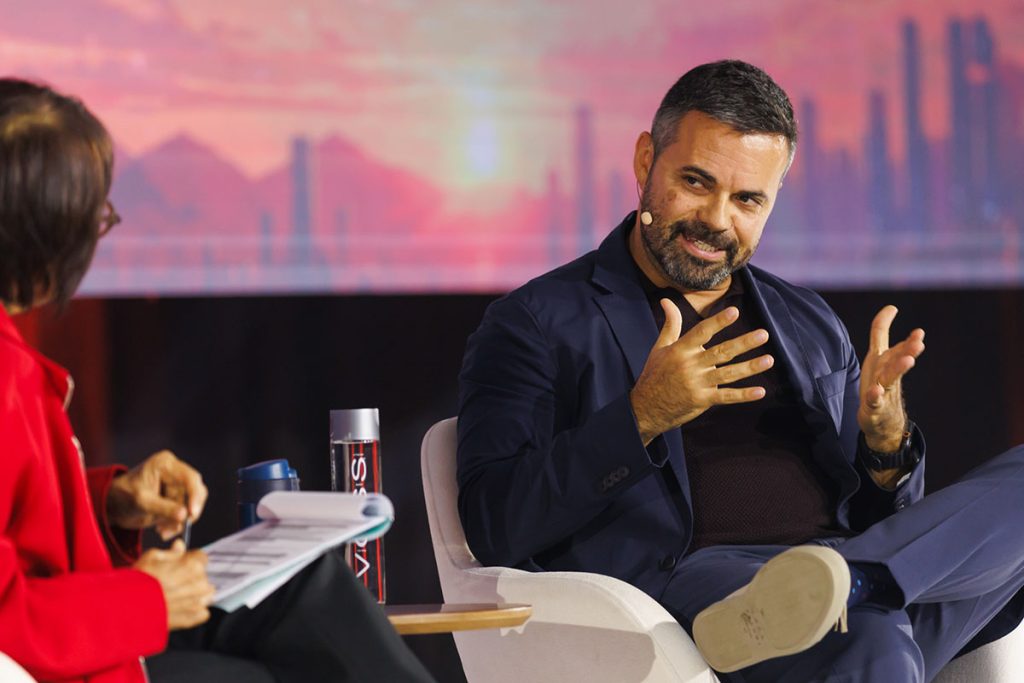
His advice is humility, without panic. “This is a step, a phase in the transition. Is the end game that our phones will have all their apps deleted and we’ll just have one assistant? I don’t think so.”
Instead he expects demand for trusted vertical assistants that answer travel questions best and act on them, the role he believes Skyscanner is built for. Friends send him screenshots of trips a general AI assistant booked for them. “I ask, did you get the best price? They have no idea. And that’s okay for now. It’s exploratory and fun. But rather soon people will want that capability with the best price on top, and the most relevant route for them.”
Domain expertise and brand trust – the golden keys
So is domain expertise the moat? “I think so. And with that comes trust,” he says.
Trust lives in the brand, and he insists it is never taken for granted. “You have to keep earning it, or that trust goes away.”
The threat is real. I told him that when I asked the AI models where they source travel information, they put Reddit first and YouTube and vlogs second. Skyscanner made third place, tied with Google Flights. To Batista, this is “a perfect picture of the evolving demand distribution picture that everyone in this room faces.”
Google shook that picture up over the last 18 months. SEO results vanished from search pages, everyone piled into SEM, and the auctions became overpriced. “Everyone is trying to get the same traffic, but now paying a lot more for it.”
Skyscanner’s response is to diversify: social, YouTube Shorts, TikTok, brand investment and partnerships. “Demand is diversifying.”
He accepted the idea that in a disruption, generalists win first and verticals follow. The verticals that are “well armed from a technology and product perspective, and close to travellers” can make that comeback very quickly. “We may not be the first agent out there booking flights for travellers. But we should be able to catch up quick, because we’ve invested in technology. We’re a technology business in the end.”
The bets: beyond flights, beyond search
Three launches show what those plans look like in practice: Explore with AI, the Road Trip Planner and Longtail.
Explore with AI targets a large group. More than 50% of Skyscanner’s travellers don’t know where or when they want to go. “A search box is not enough to fulfil their needs,” he says. The product offers a conversational, natural-language interface. It can compare destinations side by side, contrast itineraries, and explain why travelling later in the year, when it’s quieter, might be the better call.
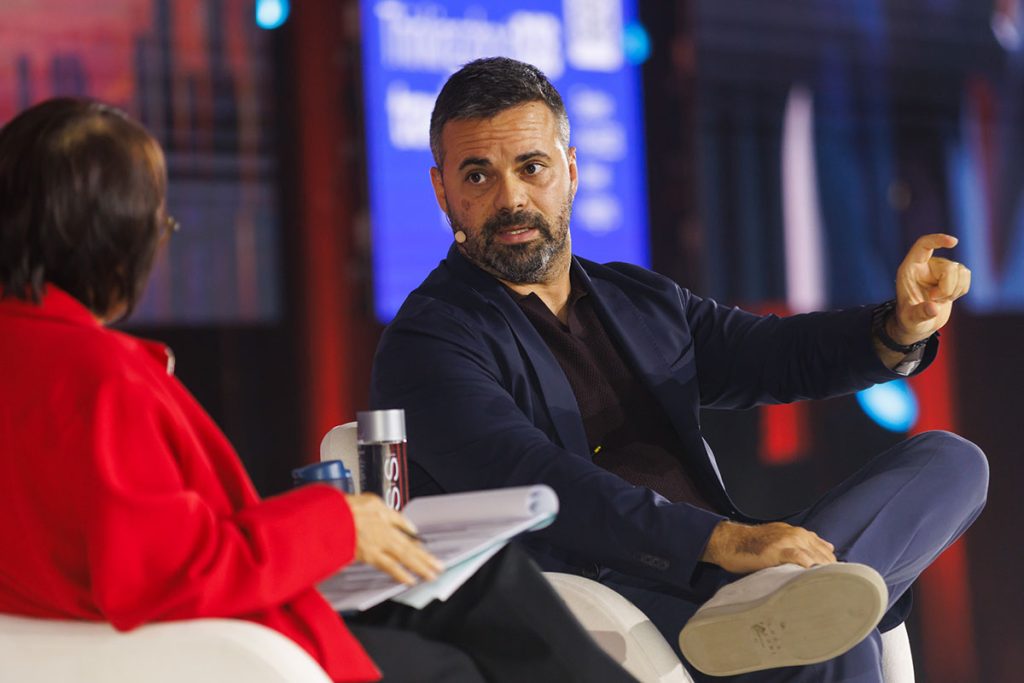
The bet Batista is most excited about is Longtail, Skyscanner’s move into B2B. “Skyscanner sits on top of over 20 years of deep flight demand data, flight search data. Longtail is an excellent vehicle to start bringing that into the hands of airlines” to inform pricing, route timing and more. Domain expertise, it seems, is a moat that can be sold.
Then there is agentic booking, now being tested rigorously with select partners. Will that make Skyscanner the merchant of record? No. “We do not take the transaction. We simply facilitate it via our existing OTA and airline partners. We’re not there to book that transaction or take care of the customer service. We’re there to give a smooth handover,” he says.
Is that in-between position vulnerable? Not in his view. The real risk would be standing still. “If we just said, we’re a metasearch, traveller, you’re on your own when you get to the OTA or airline site, then we’d be vulnerable.”
When agents talk to agents
What happens to the model when a traveller’s AI agent talks straight to Skyscanner’s? “This agent-to-agent conversation will happen, and it’ll happen soon. The market will need to figure out a fair exchange for that.”
He notes that very few such deals have been signed. “If there’s no value exchange, then who will create the content? That’s a big problem.”
The storefront must survive too. “There still must be a Skyscanner app. Otherwise we lose that data, that expertise, that access to the best rates and to all the partners, and we become an irrelevant agent.”
He was relaxed about KAYAK co-founders Steve Hafner and Paul English reuniting on Lola, the AI travel startup backed by Booking Holdings. “I don’t think they’re retreating from meta. Steve’s just doing something different. I bet whatever he’s working on is going to be cool.”
Master of flights, or jack of all trades?
With hotels, packages and multimodal on the roadmap, does Skyscanner risk losing its mastery of flights? “It’s a fair challenge.” Priority number one is the core: “continue to invest in flights.”
Packages are the most natural extension, because they bring together flights expertise and deep hotel supply. The goal is to show travellers real-time savings when a package beats booking the parts separately. Multimodal, mixing rail or bus into a flight journey, is “flight experience augmented.”
Why not just plug into Trip.com, a master of both, I asked? “They’re plugged into us,” he said. “Trip has fantastic solutions, but in certain markets several other players do too. We want to give travellers that choice.”
The Asia playbook
Asia is where the money is going. Three of Skyscanner’s priority “investment markets” are in APAC: South Korea, Japan and India. On the Middle East, he hopes the conflict is resolved quickly, and expects the region to “get back to business” as a major travel hub that keeps growing.
The Asia playbook has three parts: product localisation, marketing localisation through the right channels, and commercial strength, meaning having all the relevant partners on the platform.
Korea shows how this works. Once the preserve of local ecosystems such as Naver and Kakao, the market is now one where global players are thriving. Skyscanner launched a feature last year that highlights payment discounts available by payment method or OTA, which is highly relevant locally. It also helps that Korean consumers already compare prices before they buy, a habit shaped by Naver, “a great competitor of ours.”
Stare into the future, look forward
The rapid-fire round brought the conversation back to food. His must-have dish in Singapore? Beef hor fun, eaten the day before and made soy-free to suit his allergy. “It took a while, but they did it.”
And the best advice he got at 20? It came from his father. “Don’t plan too much. Keep looking ahead. Stare into the future, look forward.” He thinks it is particularly relevant now.
As he said at the beginning, firm plans, loosely held.
Watch the full session here