
While the industry obsesses over who will own the AI front end, Etraveli Group’s CEO is betting on the unglamorous plumbing behind every flight booking. He says it’s the part no LLM has come close to solving.
There was no better setting for this conversation. Mathias Hedlund sat down at WiT Singapore 2026 in Marina Bay Sands, a building with a casino which ranks among the most profitable pieces of real estate on earth – this year, it hit a new Q1 high of US$788 million in revenues.
The session was billed as “The Dirty Work: A Gambling Man’s Bet on Flights”. The question was simple: in an agentic future, where would the CEO of Etraveli Group place his chips?
His first move was to hedge. “I’ve heard a lot of people make assumptions about how things are going to be, and I’m super humbled, because it’s happening at such a pace,” he said. Consumer research tells you how travellers think today, “but when they think today, they think about the opportunities they know about today.” Two or three years from now, that could look very different.
Then he showed his hand. “I do believe you’re going to see a lot of changes on the front end. But I have not seen anything real that points towards AI or LLMs solving the whole back-end mystery, the deep back end of it.”
That back end is the dirty work: sourcing, pricing, fulfilment and servicing a flight ticket. Etraveli has bet on it hard for two decades. “In this case it was more luck than skill,” he admitted. Luck or not, it looks like a winning hand.
Blocked twice, moved on
Weeks before the event, on September 9, the EU General Court upheld the European Commission’s 2023 veto of Booking Holdings’ €1.63 billion bid for Etraveli. Hedlund wasn’t fazed.
“That was expected to me. We moved on a long time ago,” he said. “We’re seeing a future where we would probably IPO in a couple of years.”
The relationship with Booking is intact. After the first block the two strengthened their partnership, now an eight-year contract. “We’re working extremely closely together and making great progress. I like to think of it as an infinite relationship, whether it’s ownership or not.”
Booking can still take a final appeal to the European Court of Justice. Hedlund argues the ruling matters well beyond the two companies: “The judgment sets a precedent not only for Booking but for others as well. This block is much bigger than the Etraveli–Booking transaction.”
Who does what
Hedlund took a question crowdsourced from the audience: how does the Booking partnership actually work? The design principle was that Booking must drive its own strategy. “If they felt they couldn’t, we wouldn’t have a long-term relationship.”
The split is clean:
- com decides how much money it wants to make, quarter by quarter, whether to invest hard or harvest. It designs the front end, chooses which ancillaries to offer and how they’re presented.
- Etraveli does everything behind the glass. It handles sourcing and the relationships with airlines, GDSs, content aggregators and metas. It sets the price of each individual ticket, handles fulfilment, and runs global customer service, answering the phone as Booking.

Two strategies, one platform
How does Etraveli grow its own brands while powering one of its biggest potential rivals? “It’s basically two different strategies from one platform, and they’re very separated.”
Etraveli’s own consumer brands win on price, backed by unit economics Hedlund thinks are unmatched. “We operate flights with more than 20% EBITDA/Net sales margin. I don’t think anyone else does that in the world.” That margin comes from discipline: “We’re very good at pricing, taking the orders we want to have, not taking orders we don’t want to have.”
Booking plays a different game. It has a great brand and loyal customers, and it wants a smooth experience. So it says no to certain revenue streams and ancillaries. On a Skyscanner search, Etraveli’s brands often rank first, with Booking fourth or fifth. “If you’re price-sensitive, you come to us. If you want loyalty and a trusted brand, you go to Booking. They don’t need to be cheapest.”
Booking also brings the direct traffic Etraveli lacks. In return it borrows Etraveli’s unit economics, “which means they can still have a good business without being as price-aggressive as we are.”
Cross-sell runs one way. People come to Etraveli’s brands to buy flights. On Booking, flights feed a wider trip. How big is that effect? “That’s for Glenn (Fogel) to answer,” he said.
Content beats price
In the agentic era, Hedlund doesn’t think price is the deciding factor. “It’s much more important that we have the absolute best content globally, and that it’s bookable with quality and, preferably, speed.” As agents get access to that content, price on its own may count for less.
That is why new storefronts don’t scare him. He wants Skyscanner, Google and Booking to stay healthy and keep selling his inventory. “But I’m not afraid of other storefronts coming. As long as we deliver the best content with quality on a global basis, we can play.”
His bets on the new storefronts: Google first. “I think Google’s going to be very, very strong, and that’s good for us. We have a very strong relationship with Google.” ChatGPT “for sure will go into commerce.” Anthropic, he said, has a different strategy. Some of what is happening in the US may not transfer exactly the same way to other regions.

Growth without headcount
On AI inside the company, Hedlund gave the most striking number of the session. For a decade, Etraveli’s revenue and costs both grew about 20% a year, “like two lines following each other.”
“This year is the first time they don’t follow each other. It’s the first time we scale. We continue to grow at the same pace, but we don’t hire more people.”
This isn’t a straight cut. It’s a swap of skills. “We need different competences. Our company is evolving, becoming more of a B2B company. We need more people in B2B, more people in AI, fewer administrative people, and developers doing more.”
Is B2C slowing? “Absolutely not. We’re growing with the market or better. But I don’t believe our B2C business can grow 20% per year going forward. I think B2B can.”
Everyone, it seems, is betting on B2B. Booking Holdings is folding the B2B units of Booking.com, Agoda and Priceline into one unit under Agoda CEO Omri Morgenshtern. What would Hedlund do in Omri’s shoes?
He declined to advise “one of the most capable in our industry.” He then gave a sharp diagnosis anyway. “Agoda is a bit of a wild kid in the Booking Holdings family. They are allowed to do things that Booking.com is not allowed to do, and therefore he can act with more speed.” Running the combined B2B business means more corporate compliance and a bigger organisation. “If he can bring the speediness of Agoda and the strength of the overall corporation, then he can be successful. I think that’s his main thing to solve.”
The whole engine, or just the parts
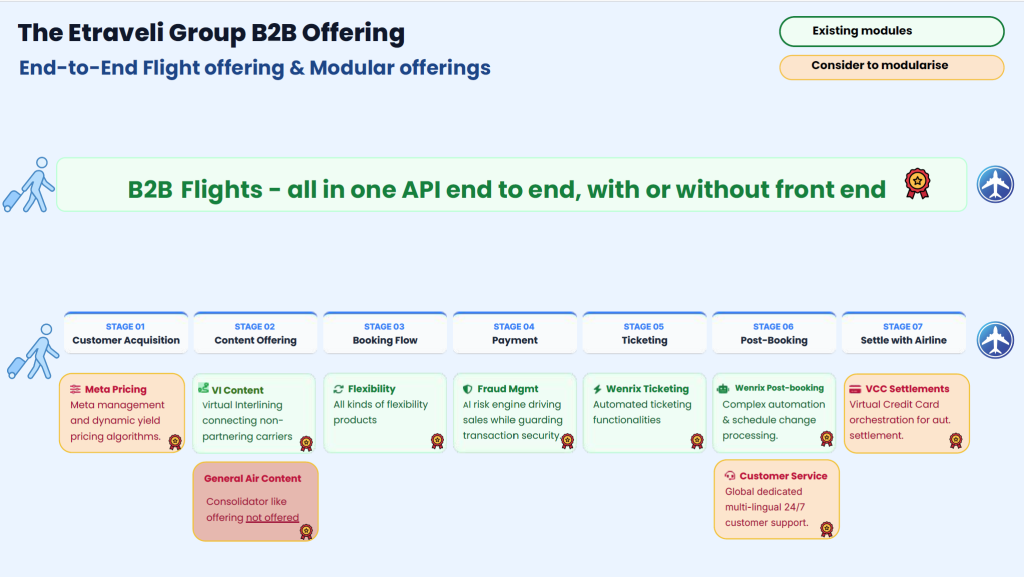
Etraveli now sells its platform two ways. A partner can buy the whole engine: sourcing, pricing, fulfilment and service, with or without the front end. That is the Booking.com model. A second major brand will sign on for the full platform next month, though Hedlund wouldn’t name it, except that it’s “a brand we will all know here.”
Or partners can buy modules. Etraveli has broken the platform into pieces so others can strengthen their flight business one capability at a time.
Wenrix, the travel AI platform Etraveli acquired this year, runs at arm’s length. “Wenrix has every single OTA in the world as a customer, which is great for us, because now we have a platform to sell our modules through too.”
But neutrality is non-negotiable. “If you’re serving the whole industry, you can’t be integrated into a company operating an OTA in competition. It’s super important that it’s separate.”
The fraud bet: 10 to 1
The module Hedlund was most passionate about is fraud, which he calls one of the industry’s blind spots. “It’s so unoptimised in the industry.”
Most players run fraud as a separate function, he said. They measure acceptance rates, fraud losses and the cost of managing fraud, and stop there. What they miss is the false rejection. Block too aggressively and you turn away good customers. These are often the most profitable ones, arriving through direct traffic or traffic you’ve already paid for. “Then you go out and buy traffic on paid channels at much lower margins in order to meet your growth targets.”
In the spirit of the session, he offered odds. “I can bet 10 to 1 that anybody in this room would benefit from having our fraud module.” The proof: in one proof of concept with an OTA, the module delivered a €15 million EBITDA improvement.
Anything missing from the platform? Not yet, but he’s watching AI. He has done five acquisitions in his time at Etraveli, “and I would say five out of five has been good.” The lesson, whether a deal is integrated or kept separate, is to “put the magnifying glass on what you’re buying and put it into the engine.” Any next deal would most likely strengthen the B2B tech platform.

Placing the final bets
Worst bet? Early in his career, a TV game show tied to a gaming product. It had a fancy set and a big launch. “The idea was not well thought through. That was an unnecessarily expensive mistake.”
Higher stakes: a slot machine or an EU regulator? ”Neither pays back 100%,” he said. “But I’d still say the EU regulator, because even though I disagree with their decision, I think they do a very important job.”
If Etraveli were a casino game? ”I’d like to think there’s some skill in it, not only luck. So I have to take away roulette. Poker is probably a bit more skilled than blackjack.”
IPO, 100%? ”Not 100%. But I do believe the odds are in favour of us being independent and going that route.” Another private equity owner is possible, he added. Etraveli is on its fifth or so. And Etraveli is “building the company so we can be acquired by a strategic as well, for sure.”
Watch the full session