
“What were you doing at 21?” That was the question that opened WiT’s Next Generation Leaders 2026, sponsored by Booking.com.
More than 50 rising stars in travel, all under 35, were asked to remember that moment and hold that feeling in their hearts as they deliberated their role in travel at this pivotal moment, and debated the event’s theme, “A New Beginning: Building Purpose and Impact In Your Journeys.”
“21 is the age you stop being defined by where you came from, and start being defined by where you go from here,” said Yeoh Siew Hoon, founder, WiT. “You’re newly liberated, wildly excited about the future, a bit terrified by the uncertainty but knowing you have to move forward with purpose and intent.”
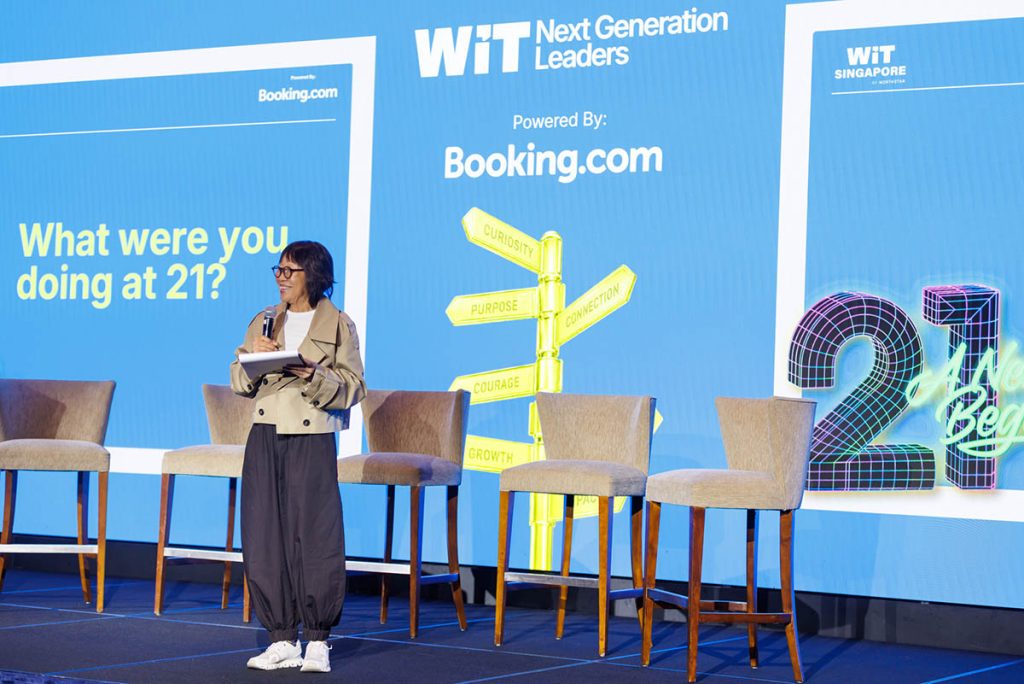
Siew Hoon: “To be honest, I never really thought about the impact I wanted to have till much later on in my life. I just wanted to have fun, really.”
Then, tying it back to the event’s theme of purpose and impact, she offered two ways in. “Some people find purpose early on in life, and then build impact. For others, impact leads first and purpose forms later.”
She counted herself among the first. “To be honest, I never really thought about the impact I wanted to have till much later on in my life. I just wanted to have fun, really,” she said. “But for most of my life, I’ve been driven by an unquenchable thirst to tell stories, find out other people’s stories and share them, and I felt somehow that was my calling.”
That purpose, “to be a busybody,” as she put it, and to tell interesting people’s stories, led to the impact. It meant connecting travel people through a web of stories, facts, insights and intelligence, told through articles, podcasts, videos and events, and forming a tightly knit community of people who love travel. That community, WiT, is turning 21 itself this year.
What followed was less a panel than a set of confessions. Four leaders who have long since left 21 behind (Rajnish Kumar of ixigo, Laura Houldsworth of Booking.com, Alice Goh of HeyMax and Darrell Chan of Airbnb) took questions written by the people in the room. They talked about debt and doubt, burnout and blame, and what humans are still for when the machines start booking the trip.
Download the full Next Gen Leaders 2026 Report here.
Is purpose a luxury?
Siew Hoon put the first provocation on the table. She wondered aloud whether talking about purpose and impact is a luxury. A lot of people, after all, are simply trying to find a job, make money and do the everyday stuff.
The room had the same worry. One attendee, Henry Beh, My Indie World, asked: “We are told to choose a purposeful path, but if that path can’t pay the bills for five to ten years, how do you know when to keep going and when the cost is too high? And how do you tell real purpose from recognition, from looking purposeful?”
Rajnish Kumar, who left the safety of corporate life to co-found ixigo, answered with his own 21-ish moment. “We chose an impeccable moment to start,” he said, drily. “I was neck deep in debt. My co-founder was neck deep in debt as well.” His family was going through a difficult time. His brother, back from the US, shared his one room; Rajnish slept on the floor. His brother took an auto-rickshaw, the cheapest transport there was, and Rajnish walked, so they could save enough for a drink at the weekend.
“All I remember is that despite all of that, I was extremely happy,” he said.
But he was also single then, with no one depending on him. Follow what you want to do, he told the room, “but not at the cost of your health, not at the cost of people around you who depend on you.”
He warned against the milestone trap: telling yourself you’ll look after your health or spend time with your kids once you hit the next funding round. “That never happens, because you keep going. You never stop.”
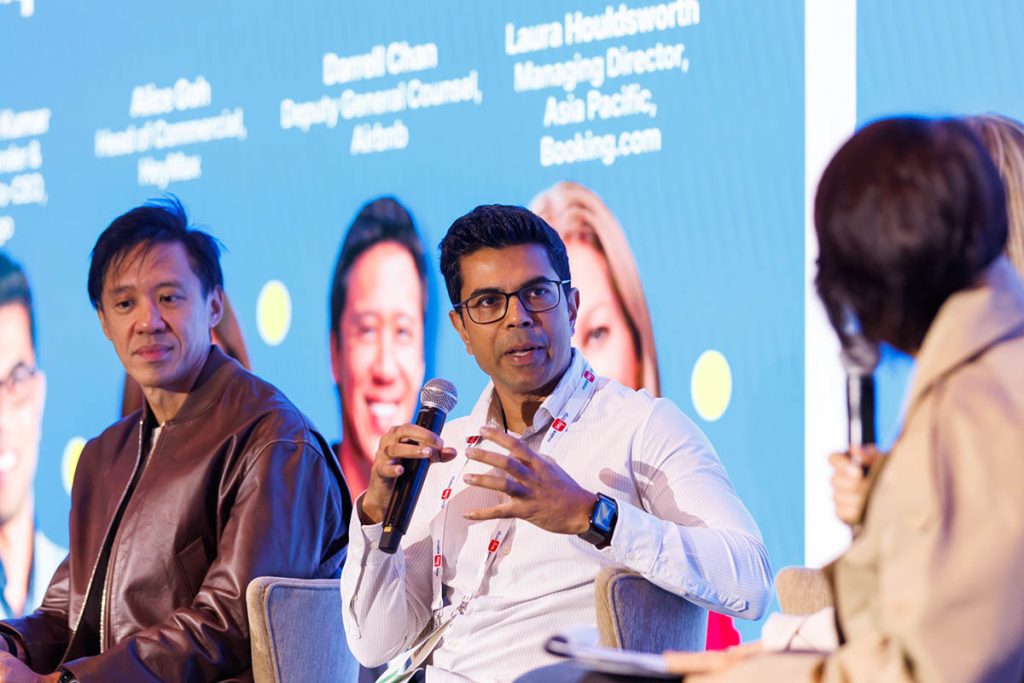
Rajnish Kumar warns against the milestone trap: telling yourself you’ll look after your health or spend time with your kids once you hit the next funding round. “That never happens, because you keep going. You never stop.”
If your purpose means you can’t support the people around you, he said, then that purpose really is a luxury. The two have to run in parallel. Purpose first, in other words, but never purpose alone.
Darrell Chan told of a crisis of purpose that led him out of law entirely. He became a brand manager at a fashion company and took a 40% pay cut to do it. At that point in life, he said, you can take risks: as long as there’s food on the table, you can adjust your lifestyle. The opposite lesson came later, when he took a job in the film industry for a 40–50% pay rise. “Probably the worst choice I made. Never move for a job just for money.”
Laura Houldsworth’s path ran closer to the other route. She has spent her career inside large organisations, and she pushed back on the idea that purpose belongs only to founders. “I think there’s a way to find your purpose within a large organisation,” she said. She pointed to Booking.com’s sustainability ambitions and its effort to quantify the company’s impact on a billion lives: the travellers and the communities that benefit.
Then she told a friend’s story. The friend had left a big corporate salary, moved to Thailand for her family, and built a life of consulting and charity work. That week, an accountant’s statement showed her in black and white how far her income had fallen, and she was shocked. Then she thought about the charity shop she now supports, and how alive she feels there. “How she sparkles,” Laura said. Her friend’s question now isn’t whether to go back. It’s how to make that number a little bit higher.
The weight of a thousand decisions
A question from an attendee went straight to what keeps under-35s up at night. What is the most common mental trap or burnout habit that people entering travel and tech fall into, and how do you avoid it?
Alice Goh, who had worked in two banks and in start-ups across several countries, offered a simple morning test. You need to wake up thinking, “I really want to do this today. Big company or small doesn’t matter. If you wake up every morning dreading work, that’s the trigger to stop and rethink.”
She named the trap she sees most often: newcomers who feel they must know everything and do everything to prove themselves. “You have to let go of knowing everything, because you cannot,” she said. “This is massive burnout, because it’s just not possible.”
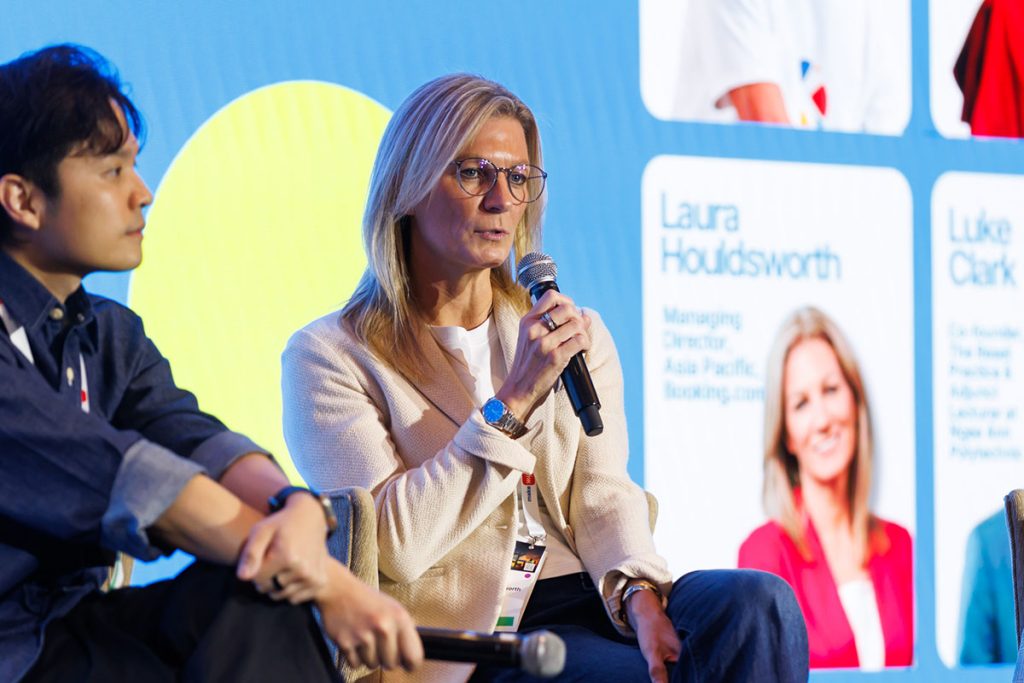
“I think there’s a way to find your purpose within a large organisation,” said Laura Houldsworth, pointing to Booking.com’s sustainability ambitions and its effort to quantify the company’s impact on a billion lives: the travellers and the communities that benefit.
Rajnish agreed. After 20 years, he still runs the same test on himself: does he wake up with the same passion and curiosity to solve a problem? But something new is breaking people, he said, and that is time compression. AI has sped up execution so much that what used to take five days no longer does. Leaders may now be making five or ten times more decisions a day than before. The machines carry the execution, but humans still carry the decisions, “and the burden of these decisions is what makes you feel the weight.”
Work is everywhere now too: the phone, the laptop, and a swarm of AI agents working for you. When it all works so well, it gets hard to let go. “It’s not because they don’t like what they’re doing,” Rajnish said. People do so much of it that they eventually burn out.
The consensus – the people they had seen burn out were the ones who took work personally. “The trick is caring enough to make a difference, but not caring so much that you take it personally when things don’t go your way.”
Another question from the audience: Leaders say fail fast and take risks, but who bears the cost when an experiment fails? How do leaders create room to experiment without unfairly hurting people’s sense of how they’re performing?
Rajnish called it a matter of culture. “One of the things about toxic culture is asking ‘who did that?’ instead of asking ‘why did that happen?’”
When teams ask why, people sit on the same side of the table and fix the process, because no one wants to make the same mistake twice. When teams ask who, someone ends up across the table, cast as the culprit, and nobody dares to experiment again.
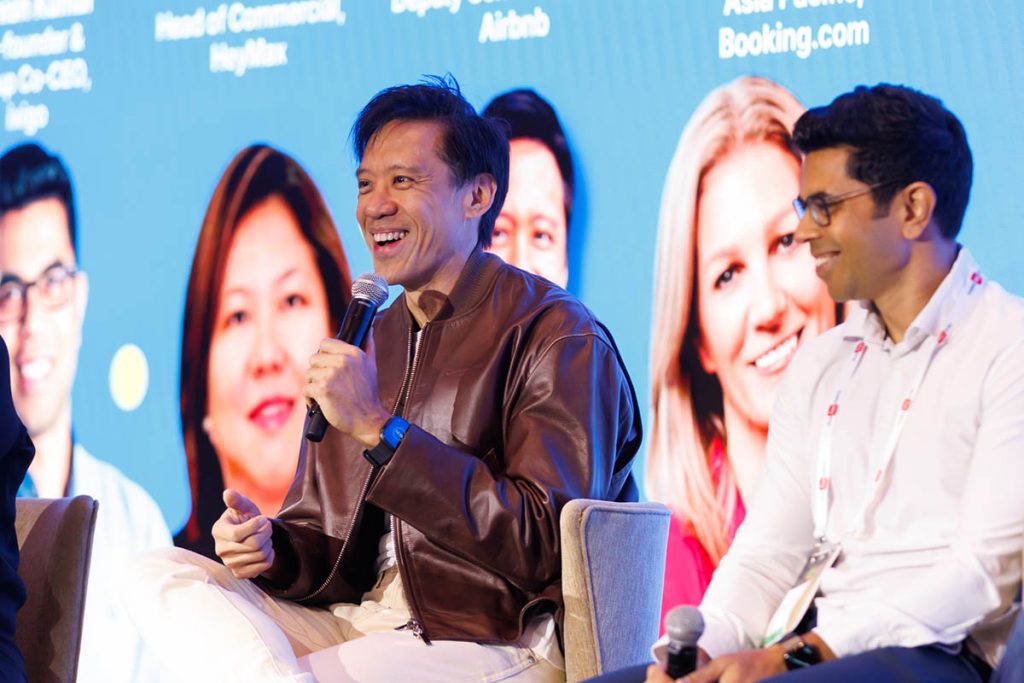
Darrell Chan: “Never move for a job just for money.”
When the agent gets it wrong
The next question moved to one that hangs over every travel company building agents: as AI moves from recommending trips to booking them, where do trust, authority and accountability break, and who takes the blame when the agent gets it wrong?
Darrell took the question. “The short answer is whoever is deploying it,” he said. Businesses already face a trust deficit, he added, and the only way through is to show the evidence: agents that are tested and work as intended, not in ways nobody meant. Even the large model makers are slowing down, he said, taking a pause to think through the potential for harm.
Which jobs will last? The deeper answer is anything that needs the human touch. “Human connection is going to be the main premium,” they agreed. In a future where AI does most of the work, people will travel to escape an automated world for one that is offline and connected. That leaves travel with plenty of room.
Human strength or digital prowess?
A quick show of hands asked which one each person needed to work on more. Alice chose human strength. Digital skills can be learned by anyone with the mindset to keep learning, she said. Human skills are harder to learn, but once learned they last, and they are what sets us apart from machines. The others went the other way: they needed to keep their digital side up to speed, precisely so that their human judgement could challenge the machine.
Then came rapid fire.
One skill or mindset travel leaders will need in the next five to ten years: EQ. Taste. Looking around the corner. Curiosity.
One outdated industry rule to throw out: That the job is done when the booking is done. “Their job only starts when the booking is done,” one panellist said. Also gone: move fast and break things, a rule that worked in the previous era but doesn’t in the age of AI.
One traveller behaviour the industry underestimates: The power of social media and influencers. The growing discontent of consumers who, used to AI flows that do everything for them, will expect travel to work the same way. And the value of collaboration, in a tech world where it is easy to believe you can do it all yourself.
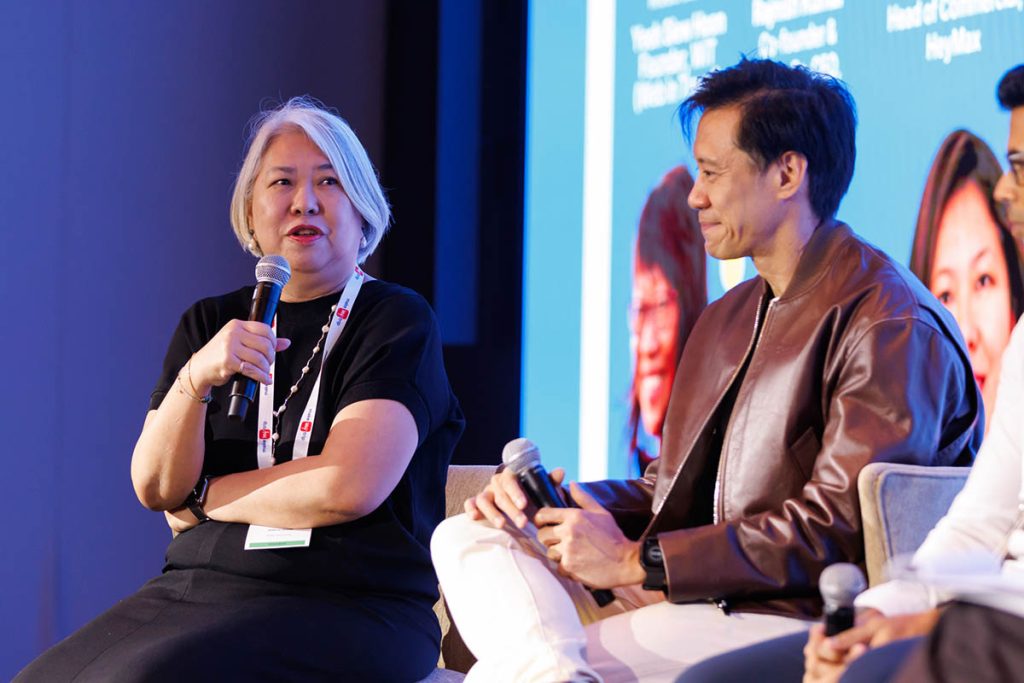
Alice Goh says you need to wake up thinking, “I really want to do this today. Big company or small doesn’t matter. If you wake up every morning dreading work, that’s the trigger to stop and rethink.”
Still 21
Then the coaches took the stage: Marcus Yong of Klook, Jacinta Lim of Seek Sophie, Luke Clark of The Reset Practice, and Mich Goh, formerly of Airbnb and now at OpenAI. Mich took the first question: what is the one part of travel you would keep out of the machine, even if automating it saved money?
Showing people around, she said. Giving people insights into a place. And the moments when things go wrong, as they sometimes do on a trip. Machines can do a lot, she said, but when something has to be decided or escalated, a human still really matters.
That was the thread running through the morning. Being 21 meant moving forward without a map: sleeping on the floor and somehow being happy, taking a pay cut for work that felt right, learning the hard way that money alone is a bad reason to move. The industry is now facing its own version of that moment. The machines are getting faster, the decisions are getting heavier, and the booking is no longer the end of the job.
Purpose first or impact first, the morning suggested that the order matters less than the pairing. Rajnish’s purpose had to make room for the people who depended on him. Laura’s friend found her purpose only after a career of impact, and is now working out how to make it pay. Purpose is not a luxury, but it has a price. The skill is knowing what you can afford to pay, and who else is paying it with you.