
What are hospitality leaders feeling right now? It depends where one looks. WiT Singapore offered a broad-brush snapshot of today’s hotel Asia zeitgeist, courtesy of two contrasting panels – and arrived at some fascinating destinations.
“So what’s your spirit animal?” It’s the sort of whimsical question you get asked at a transit café, or onboard a cross-continental train: hopefully with a nice cold drink in front of you. It can be fun to hear grown adults link their identities with the perceived qualities of a favourite character in Zootopia, last seen walking on two legs and speaking with a sassy accent.
Ask someone in transit what their “spirit hotel” might be, and the chances are that they’ll take similar leaps. Yet the reality of running hotels is about as different to this identity game, as the real-life animal kingdom is to these “spirit animals”. The actual business of selling rooms is not dissimilar to the law of the jungle: and regardless of how charming or distinctive others might be, those rooms that quietly making solid net returns, are no less important. Just as with the food chain, we need all types of properties to make our ecosystem work.
In 2026, the hotel food chain looks set to change in ways many of us can’t yet comprehend. For those still struggling to understand social commerce, the role of agentic AI in the selection of properties, just makes the head hurt.
Such huge questions are the landing ground of Generation WiT as it turns 21: and they demand that we hear from a wide range of hoteliers in travel’s food chain – to appreciate their view, and see how they’re feeling about the path ahead.
From two women talking big numbers at the business end of the market, to three men baring their heart and soul at the experiential end, we take a journey through the hospitality food chain, at a fascinating moment for the sector.
Hannah Yulo-Luccini: One room, everywhere
When Hannah Yulo-Luccini first came to hotels after some 25 years in real estate development, she bought a developer’s clarity to the job. “Hospitality is bringing a product that people really love,” says the CEO of Hotel101 Global. “If you design the product that will delight your customers, then there’s very little left to do.”
Hotel101, which made its Nasdaq debut in July 2025, is built on the logic of our most successful fast-food chains. One awesome room, all around the world. Yulo-Luccini happily compares it to a Big Mac: and that discipline runs deep.
“We have one type of light bulb in the entire property,” she shares. The 680-room Madrid hotel, which just opened in March, directly employs just 30 people, she says, focusing on the front-facing roles where guests need the love. “We need to make sure that we’re giving them five-star service, even at the mass market price point,” she says.
The business model is just as distinctive. Retail investors buy individual rooms, and owners share 30% of gross room revenue, pooled across each property and paid out equally every month. Because every room is identical, “nobody can argue about revenue,” she says. The inspiration lies outside hotels. Southwest Airlines, she notes, didn’t just win passengers from other airlines; it won them from the bus and train sectors too.
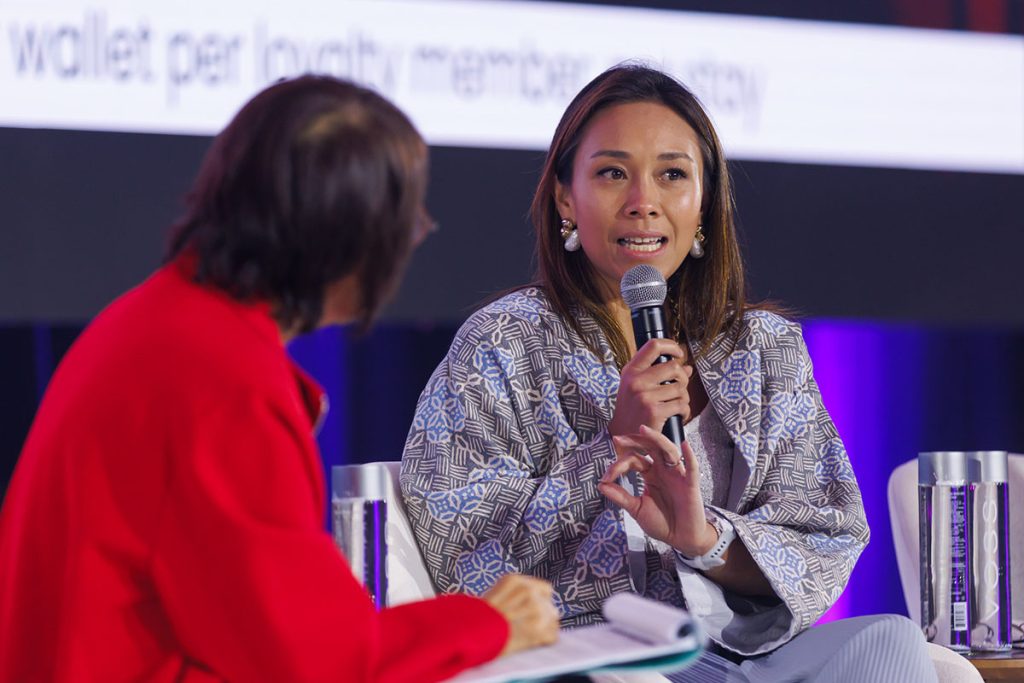
On stage, Ascott’s Tan Bee Leng asks a fair question: is Hotel101 not leaving some value on the table from travellers willing to pay more? “We don’t have to be everything to everyone,” she replies. “But the point is, we can be a wonderful thing for a lot of people: and I think that’s good enough.”
For the traveller arriving late in a strange city, Yulo-Luccini sees comfort in knowing exactly what you’ll get, right down to where the light switches are. That same simplicity shapes her view of technology. Hotel101 integrates existing systems rather than building its own: and one room type makes new tools easier to adopt. Take robot housekeepers: “You program it once, and literally go from room to room to room.”
Distribution is just as pragmatic. Hotel101 sells through big online travel agencies, and doesn’t spend on marketing of its own. “Our commission to the OTAs is our marketing,” she explains.
As the chain and brand love grow, so too does a story of community advancement. Hotel101 Global was the first Filipino-owned hotel company to list on the NASDAQ in 2025 – a milestone not just for the company but for Philippine enterprise. As Hotel101 expands abroad, Yulo-Luccini says, it helps broaden the accommodation narrative in a positive way.
“The good thing about it, as we move from country to country: suddenly Filipinos are seen not just as employees, but now as employers – now as investors. And we’re investing massively across the world.”
Tan Bee Leng and the 17-part orchestra
For Tan Bee Leng, wearing different hats has been an important part of a storied career journey – and it’s likely a key reason she’s so adept at nuance within her business. Tan originally reached hospitality through communications; she then led group communications for CapitaLand; ran its philanthropic arm, CapitaLand Hope Foundation; and is now chief commercial officer of The Ascott Limited, as well as managing director of digital ventures at CapitaLand Investment.
She therefore seems a perfect person to ask about the qualities that today’s women leaders can bring to the world: “Resilience,” Tan reflects: “We play many, many different roles – and every role requires us to have that resilience and that grace.”
Tan has lived through one transformation already. Some 15 years ago, Ascott began moving from owning its properties to managing them for others. This was at first “extremely hard”, she recalls. The company had to build websites, launch loyalty programmes and rethink distribution – to change everyone’s mindset from owner-operator to serving third-party owners.
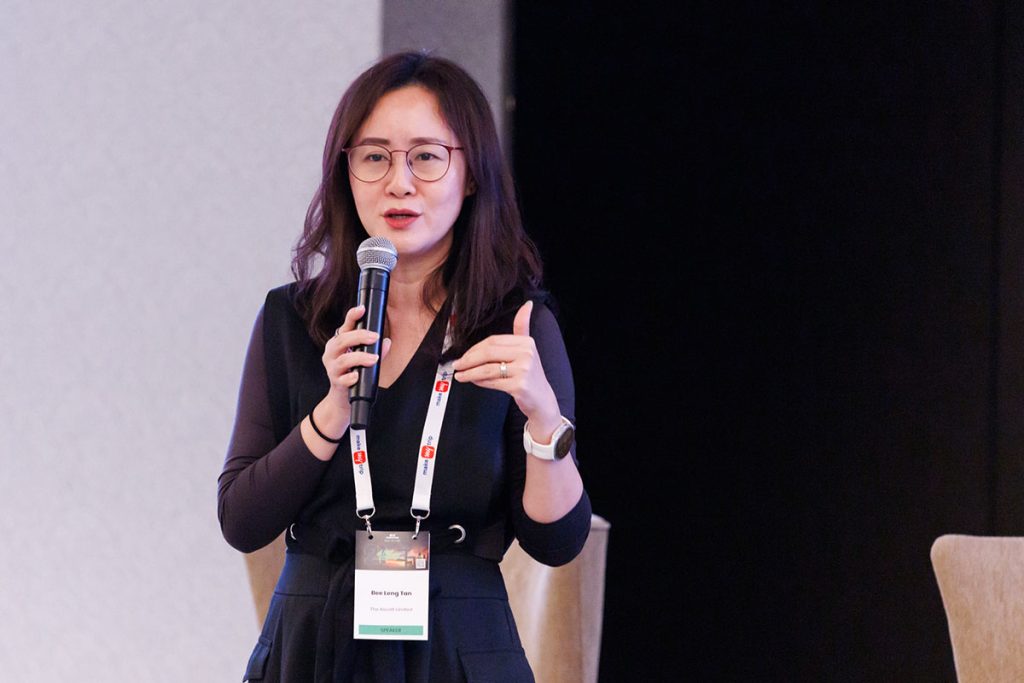
Ascott now runs 17 brands, from economy to luxury. Citadines alone has now passed 200 properties. Asked by Yulo-Luccini onstage why the group needs so many brands, Tan is frank. “I know we don’t have to win everybody – but in most businesses, we try, and want, to win everyone.” Ascott sees its brands offering its guests “individual swim lanes that don’t necessarily duplicate and overlap”. Yet just like a pool, each offers its own specific journey.
That said, when owners ask for something new, she resists the temptation of yet another brand, given that brand equity takes time and money to build. Instead, Ascott stretches existing brands across formats: “We keep the brand DNA, the brand promise: but we are able to go into different formats,” she clarifies. The Ascott brand, built on long stays, now extends to business hotels, full-service hotels and resorts.
Then comes the next transformation: agentic AI. What keeps her awake is “what to invest at what stage and how much to invest”. Ascott’s answer, for now, is in the groundwork. Hotel systems were built for humans to manage in silos, she explains – so inventory, reservations, payments and loyalty need to first connect. “All of the systems need to come together like an orchestra, and then really create beautiful music in harmony.”
She sees AI as both “extremely exciting, and terrifying”. Yet she also sees a key role for her peers in the industry: “Hospitality right now is the voice for the human,” she says, and it can “credibly own this space about the need for humans in the loop.”
Ask for her advice to her 21-year-old self, and the response leans again to humanity. “Don’t fixate on having big breaks. Actually, bite-sized small wins – they do compound.”
Sokoun Chanpreda: A survivor builds a better world
Sokoun Chanpreda fled Cambodia with his family in 1970, as civil war broke out, then grew up in Bangkok. Had they stayed, he says, “I probably would be dead.” When he returned in the early 1990s, he came to help: “I was born in Cambodia, so I was going there to explore and help the new Cambodia. But when I did that, actually, I realised how lucky I am.”
Chanpreda co-founded Bangkok’s Bed Supperclub, then went on to build Hotel de la Paix in Siem Reap. Now iconic, Shinta Mani began almost by accident: a building bought to house and train the future staff of that hotel. In 2004, a hospitality school followed, training young Cambodians for free. One thing, as he puts it, led to another.
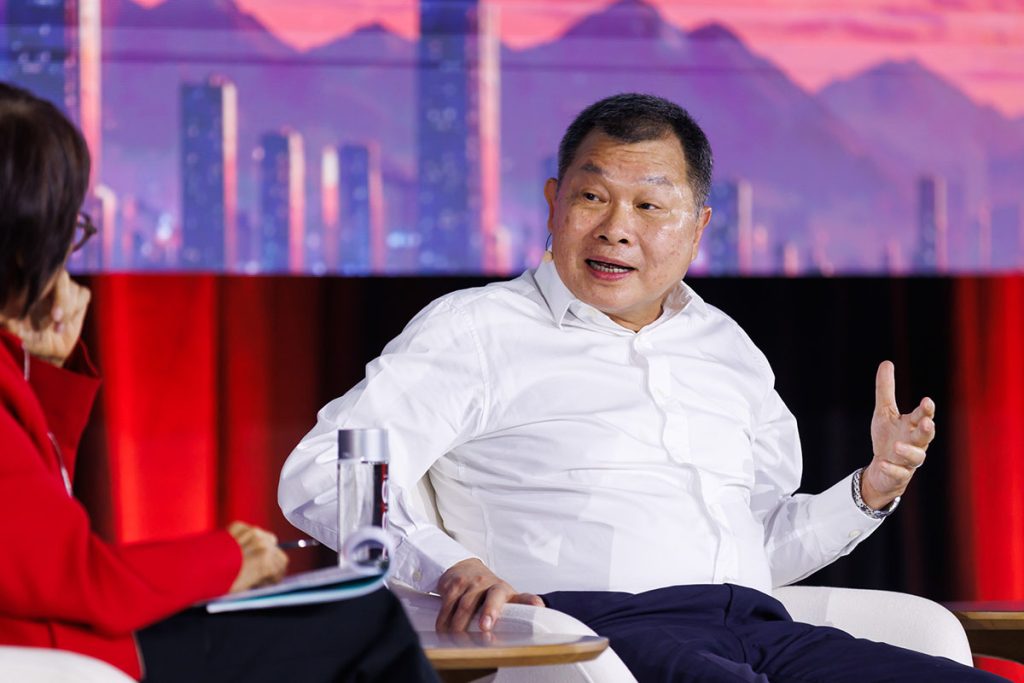
Philanthropy is at the core of the brand’s DNA. Yet he keeps it strictly separate from the hotel business. The hotel pays the running costs of the foundation, so that every dollar donated goes to the programmes. Staff are not allowed to ask for donations, and nor will you find an extra dollar quietly added to your bill. He finds that practice uncomfortable for guests: “How do you go to the reception? Please take my $1 out. It’s like, come on, how cheap can you be, right?”
Yet asking less, has brought in more. One guest saw the programme, walked to reception and donated US$20,000 on the spot. Other families went home and set up a foundation that, over 15 years, raised more than US$2 million for the programme. The key is that guests see results: “When they see the fruit of the program,” he says. “People want to be part of that.”
That reputation now travels far beyond Cambodia. In July, Shinta Mani Mustang in Nepal, which Chanpreda says operates as a franchise, was named No. 1 in Robb Report’s 50 Greatest Luxury Hotels on Earth: “How in the world, from a small company in Cambodia, do we end up to be number one?” he marvels. Looking ahead, in Saudi Arabia, he says, a hotel designed by Bill Bensley at Al Soudah will be managed by Shinta Mani. He believes the brand’s social mission is why it was chosen.
On AI, he is disarmingly candid. “I think I’m so ignorant of AI,” he admits, though he has just been shown how to use Claude, and is “fascinated”. One thing he won’t accept is AI writing emails for his managers: “In the end it’s using two AIs to communicate with each other,” he says. “It’s just ridiculous.” Hospitality, he insists, will always be “about the human relationship, the human service”.
Kittisak Pattamasaevi: Inheriting a vision, empowering a team
When Kittisak “Kitt” Pattamasaevi came home in 2005, there was a resort waiting for him. His father had built the ultra-luxury Trisara in Phuket as just 39 villas with private pools, at a time when others might have built a 300-room tower. Beyond the resort itself, he says, he inherited a mindset: “To create something that at that time the market had not seen before.”
He also inherited relationships. Some guests stayed for weeks, and some owners for months. “Now their children are beginning to also bring their own children to stay there,” he says. Inheritance is “a really wonderful thing,” he reflects. “But it’s also the responsibility of how not to basically mess up something we didn’t build.”
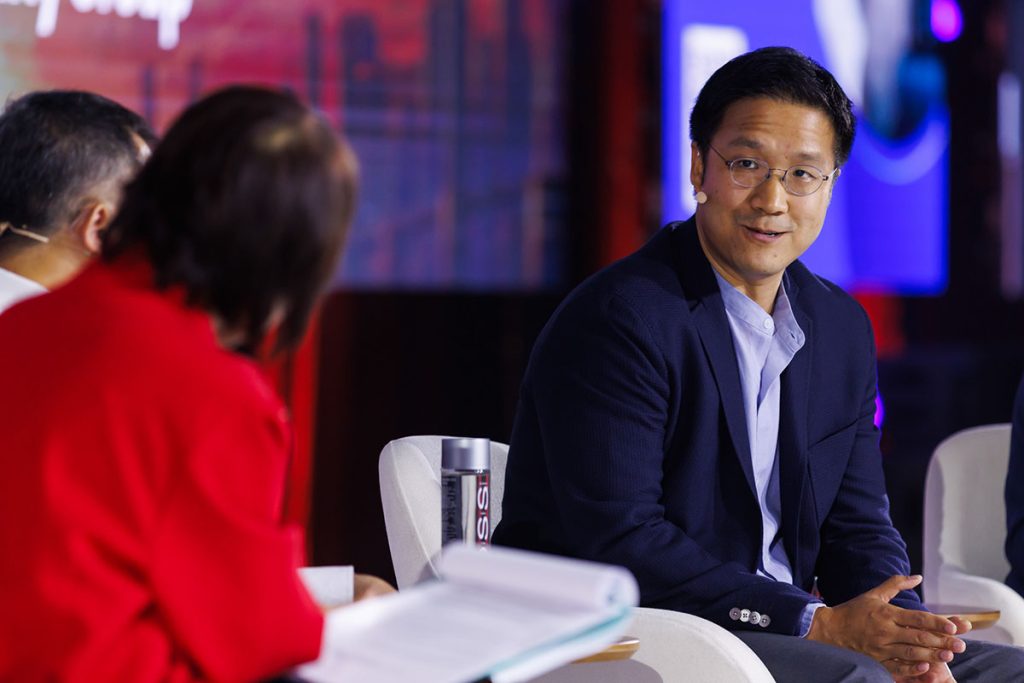
His parents’ way of doing good was to build around the trees: keeping as many of them as possible. That still guides Montara Hospitality Group today, now under his leadership as CEO. At Tri Vananda, its wellness project in northern Phuket, Pattamasaevi says more than 85% of the land is kept as forests and lakes.
His own generation, he believes, has another opportunity: growing local talent. He has seen a Thai convenience-store worker go on to become a restaurant manager, then share in recognitions such as a Michelin Green Star. With wellness on the rise, he imagines the same manager talking to guests – not just about produce from the permaculture farm, but about nutrition. It is a way, he says, to “help the local people to elevate themselves: and grow with the business.”
On AI, he finds it “very exciting, but also pretty scary”. He believes it will make “the human heart even more important”. AI can analyse his health, he points out, but that won’t make him change his habits: “It’s going to take humans to actually make another human change,” he insists.
He also has a thought on scale. Genuine human connection, like the community work that guests see at Shinta Mani, can’t simply be copied and pasted from one place to another. “But it is very scalable in terms of reputation,” he says.
If AI can free up people’s time, he believes, organisations can double-down on the people aspect: namely “genuine, deep human connection and relationships”. Scary and exciting, then, yet still an AI future we can embrace: “I think we’re gonna make so much change thanks to it.”
Bill Black: from product to experience
If Chanpreda and Pattamasaevi share a common thread, hotel management leader Bill Black is as close to its human embodiment as you’ll get. Web in Travel describes him as the man who “managed to start both on their paths”. He co-founded Shinta Mani Hotels with Chanpreda: and is now also executive director of Montara Hospitality Group.
He first joined Chanpreda to help build Hotel de la Paix, with strict instructions to stay away from Bed Supperclub: “I was definitely not cool enough to understand how they operated,” he quips. At their first meeting, the finance director raised a more urgent problem: Shinta Mani had 15 rooms, an average room rate of US$20, and was losing money every month.
In the early 2000s, Black recalls, Cambodia was “extremely poor”, still recovering from genocide, with basic hotel skills extremely scarce. So Chanpreda’s school trained young people, and the hotel employed them. To set it apart, they invited guests to connect with the community and do so respectfully. Too many visitors who came for Angkor Wat, he says, stay just three days and never returned: “But that’s not Cambodia.” For just US$100, a guest could fund a water well that gave a village family clean water for the first time. For US$50, a bicycle could get a child to school.
WiT plays a part in this story. After Black spoke at an early event, Yeoh recalls, the conference raised funds for the Shinta Mani school and took a group there to build wells. The WiT for Good programme grew from there.
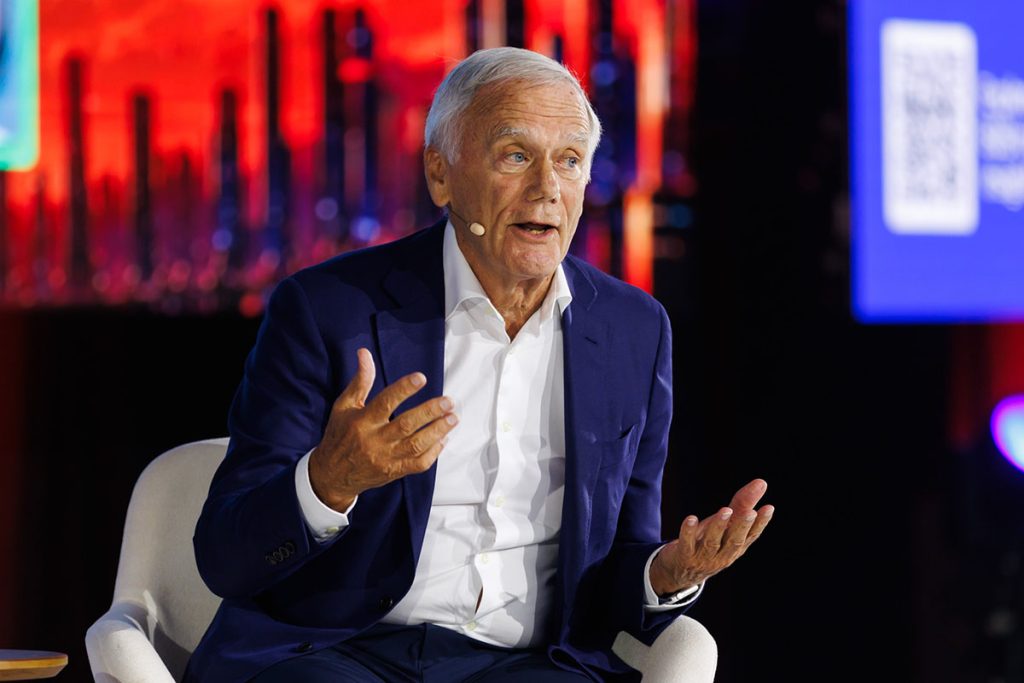
Black was asked, what ties his two on-stage partners together? “They’re both business people. They’re both profit orientated, but they both really approach their business through their people,” he reflects. His advice on growing Shinta Mani is to go slowly and selectively: an expansion “has to be done very very carefully”.
He has seen technology waves before. “I was scared when they introduced computers to hotels,” he admits. “Then I got more scared when the internet came along. But we lived through it – and the same thing will happen with AI.”
What has changed, he reflects, is the offering. Hotels once sold the product: a modern room, a pool. Today, with competitors already next door by opening day, they are selling experiences. Black calls himself “old school”, and admits that Kitt’s digital approach worried him at first. Yet now he sees him using technology to build trust with guests before they arrive: helping them discover for themselves what might suit them in the spa.
“I think this is where technology can really be a benefit to the hospitality industry,” he says. “It gives us an opportunity to get close to a customer – so that we can choreograph an experience that’s unique, specifically to them.”
The ties that bind
Five visions, five unique and enlivening personalities. Travel needs its journey makers to come in every variety – because its journey-takers do too. Yet listen closely, and the similarities are striking. All five are promise-keepers. Along the way, they’ve all learned to focus and say no. Each of them has built ladders for people around them. And all five hold similarly mixed feelings about AI.
Yet thankfully, none of them sees the central role of people shrinking. Tan calls hospitality “the voice for the human”; while Pattamasaevi expects AI to make “the human heart even more important”.
So what’s next? The five are already building. Ascott is connecting its systems so that agents can work across them. Hotel101 is designing for automation from the first room. Shinta Mani is taking its model to Nepal and Saudi Arabia: while Montara is betting on wellness within the breezy forests of northern Phuket.
As for the question we began with: how will AI agents choose between these hotels? None of the five at this point, claim to know. Yet their stories provide a powerful map of outcomes. Whether it’s a promise kept to guests every night; systems that talk easily to one another; or a reputation that, as Pattamasaevi puts it, will scale even if the experience can’t be copied.
Whether the business at hand is hard yards or heart and soul, these five are all journey makers. As Black reminds us, the industry has lived through tech disruptions before. What carried the hotel sector through then, is part of the ties binding us now – the level of care provided to those who walk through their doors each day.
For Sokoun Chanpreda, who went from fleeing war, to running some of the world’s most acclaimed hotels, some things will happily never change: “In the hospitality business, it’s about human relationships, human service, and human contexts.”
Watch ‘Sustaining Hospitality with Heart and Soul’ here: