
When Jollibee acquired Mang Inasal in 2010, it wasn’t just another consolidation in the Philippines’ fast food wars. It was the coming together of two entrepreneurs born in the Year of the Dragon – Tony Tan Caktiong and Edgar “Injap” Sia II – who believed scale, simplicity and system could transform an industry.
In 2016, that same DNA crossed over from fried and barbequed chicken to hotel rooms when the two partnered to establish Hotel101, as a hospitality subsidiary of DoubleDragon Corporation.
And on July 1, 2025, it landed on Wall Street, making Hotel101 Global the first Filipino-owned hotel company to list on the NASDAQ – a milestone not just for the company but for Philippine enterprise.
Today, it trades at close to US$2 billion in market capitalisation.
Behind it stands CEO Hannah Yulo-Luccini – finance-trained, real estate-bred, fast-talking and fiercely pragmatic – tasked with taking a very Filipino idea global: “We’re bringing fast food principles into hospitality,” she says. “One product for the world, simple, consistent, scalable.”
Plus, she adds, “We’re democratising hotel ownership. Anyone – you and I – can own a hotel room, but with a difference from the usual condotel concept,” says Yulo-Luccini, who’s moved from Manila to Singapore, to pursue this mission.
One room. One formula. Everywhere.
Catching up with her at her office in Singapore, she tells me why Hotel101 is different.
While global hotel groups proliferate brands like fashion labels, Hotel101 does the opposite. While groups like Marriott or Accor have multitudes of brands and room types, Hotel101 has one type of room globally, she explains.
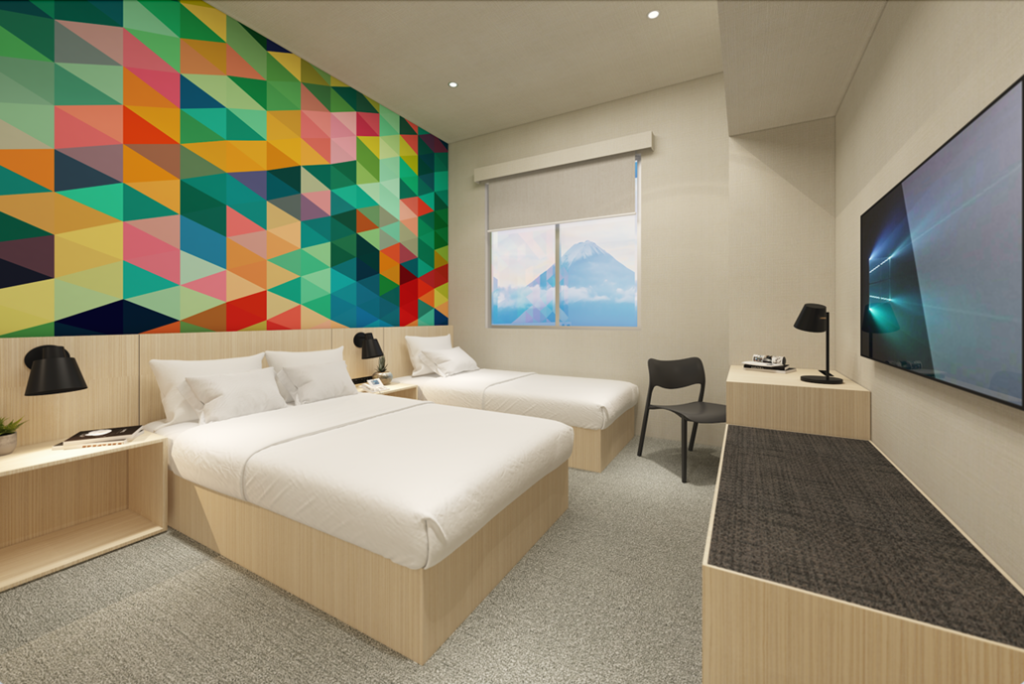
Its one room type is replicated across all its hotels.
At the showroom in Hotel101’s offices, I saw a minimal, functional, well-laid out unit – 21 square metres, but somehow it felt bigger. It comes equipped with a kitchenette. It felt much like the Section L service apartment I stayed in Tokyo last year. Self-sufficient. Efficient.
This one model is replicated across Manila, Madrid, Niseko, and soon Los Angeles, Milan, Melbourne, Medina – and wherever it is expanding to.
Expansion is aggressive: In the Philippines, it has12 projects. This year, it’s opening a 482-room property in Niseko and a 680-room Hotel101 in Madrid opened this week. “While we typically build 500 rooms, it depends on the city. What we don’t change is the room type,” she says.
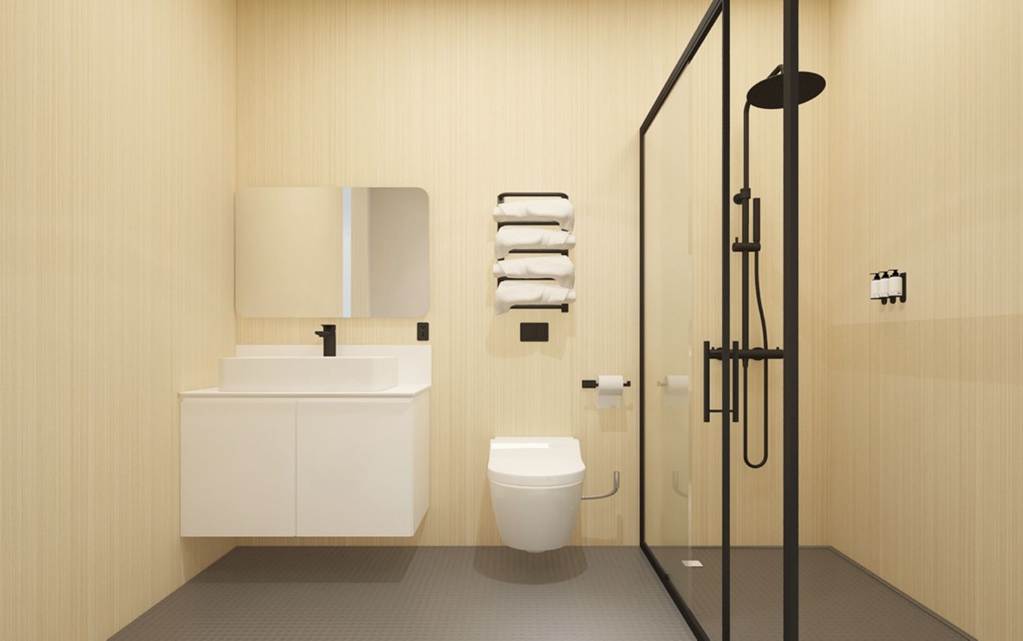
One type of room for the world.
She likens it to the Big Mac. “It might not be the best burger in the world, but it is the most eaten burger in the world. Your grandmother can eat it. Your granddaughter can eat it. Everyone understands it.”
It will also be entering Los Angeles, Milan and Melbourne and in Saudi Arabia, where it has signed for 10 projects, with the first one in Medina.
Its long-term ambition is one million rooms and to be in the top five global hotel chains by 2050.
Beyond scale, there’s pride. “Filipinos are everywhere in hospitality,” Yulo-Luccini says. “On cruise ships, in hotels, but always as employees. Now we’re investors, employers, brand owners. We want to bring Filipino hospitality to the world.”
Driven by simplicity, unit economics, scale
She explains the logic:
- Build large-scale hotels (typically 500 rooms, sometimes more).
- Standardise everything.
- Drive down operating costs.
- Price at select-service levels.
- Deliver full-service amenities.
While a typical Holiday Inn Express averages around 100 rooms per property, Hotel101 builds five times that to deliver economies of scale that allow:
- Full-sized swimming pools
- All-day dining
- Business centres
- 24/7 front desk
- Self-check-in kiosks
- Kitchenettes in every room
- Luggage Storage
- Multi-Function Room
- Fitness Gym
- Children’s Playground
- Children’s Pool
- Hot Mineral Bath (In locations like Niseko)
- Onsite Parking
- Convenience Store
Rates differ according to location. In Madrid, it will hover around €150 and in Manila, closer to US$70. Occupancy in the Philippines has averaged above 80% over eight years, compared with a national average of 64% in 2024.
“It’s not because we’re special,” she says. “It’s because the value proposition is clear.”
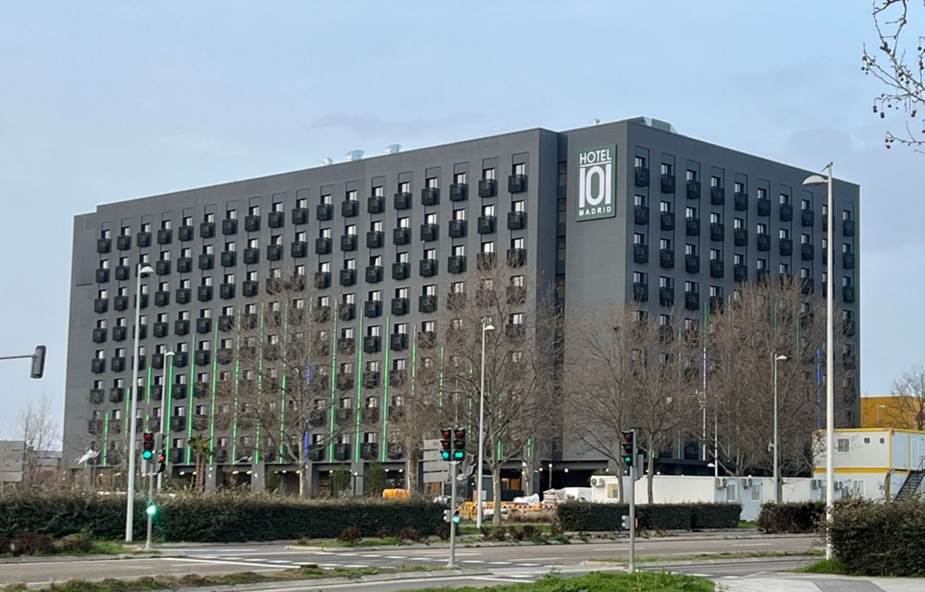
Hotel101 Madrid: “The value proposition is clear.”
Condotel model, re-engineered
Of course, the concept of condotel or time share in which individuals can own rooms is by no means new but she says Hotel101 has re-engineered the model. Each hotel is sold unit by unit, with individual titles and freehold, much like buying a condominium studio.
But unlike traditional condotels – many of which imploded during Covid – Hotel101 does something different, says Yulo, and she rattles off the following.
- Owners receive 30% of gross room revenue, with no deductions.
- No maintenance bills.
- No capex calls.
- No arguments about operating costs.
- Revenue distributed monthly.
“It’s top-line sharing,” says Yulo-Luccini. “You don’t care what we spend. You just get your percentage.”
Over the past eight years, she says, unit owners have received around 7% annual yield – modest, but steady. And during the pandemic, when Manila locked down repeatedly, Hotel101 Manila ran at 96% occupancy because its rooms, equipped with kitchenettes, were ideal for quarantine stays.
That moment convinced Sia, founder of Mang Inasal and Hotel101, that this was exportable. “We need to take this to the world,” he told her.
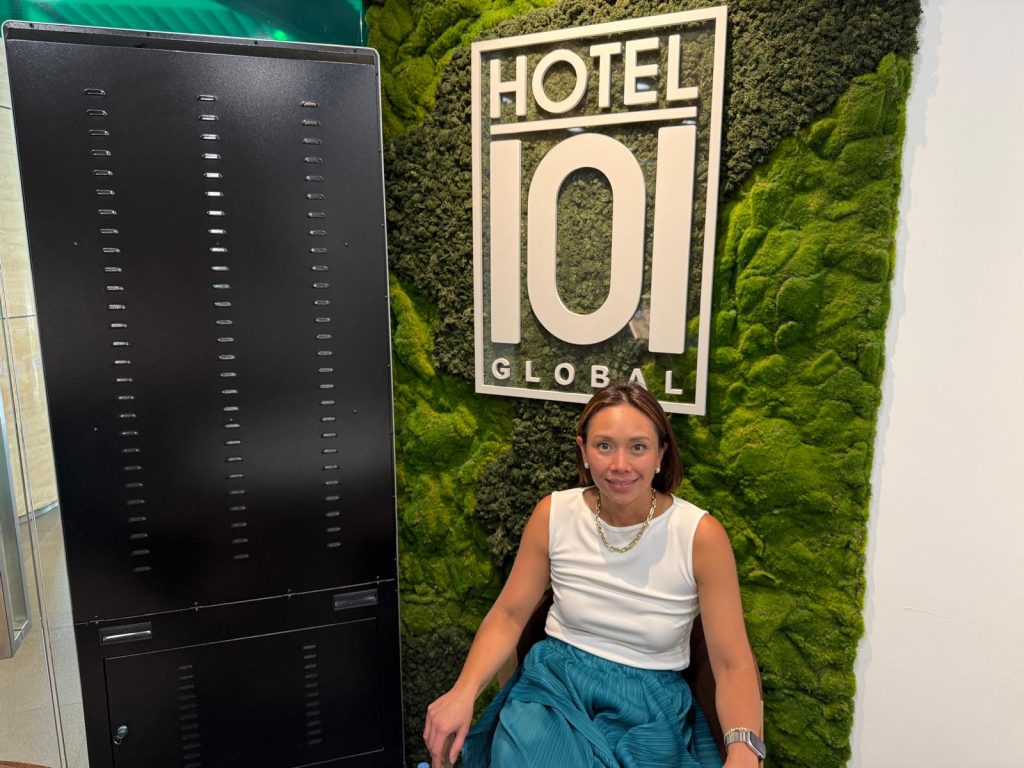
“We’re democratising hotel ownership. Anyone – you and I – can own a hotel room, but with a difference from the usual condotel concept,” says CEO Hannah Yulo-Luccini
Fast food thinking in a hotel world
The company’s parent, DoubleDragon Properties, is already the Philippines’ largest community mall developer, with 50 CityMalls across provincial cities.
Its founders built scale by identifying gaps:
- No fast food version of Filipino chicken barbecue? Create Mang Inasal.
- No modern provincial community malls? Build CityMall.
- No simple, transparent condotel model? Build Hotel101.
The philosophy carries into operations:
- Outsource F&B to strong local partners (Madrid’s operator holds two Michelin stars).
- Outsource housekeeping to specialist agencies.
- Keep core brand-facing staff in-house.
- Use technology aggressively.
- Scale without bloating headcount.
With fewer than 70 employees last year, Hotel101 generated revenue per full-time employee comparable to other pure technology companies – closer to tech benchmarks than traditional hospitality metrics, says Yulo-Luccini.
She calls it proptech. “We’re not just a hotel company. The business model is the innovation.”
They integrate systems like RMS Cloud rather than build proprietary tech. One room type makes it easier to deploy automation, AI and robotics in the future. “Imagine robot housekeepers,” she says. “You only programme it once.”
And she’s pragmatic about distribution, working with OTAs freely. “They do what they do, we do what we do – we are focused on scale and network effect, not distribution.”
In my time with Yulo-Luccini, what struck me was her focus, pragmatism and clarity – probably something she learnt from the founder of Jollibee, Tony Tan. Asked what’s the biggest lesson she’s taken from him, she says, “What I admire most is his peace. Nothing rattles him. He understands priorities in life.”
With two young kids and settling into her new life in Singapore, Yulo knows what it’s like to balance ambition with frenzy.
Personally, she says she’s never chased titles. She joined the group almost a decade ago, and just worked her way up. “I never asked for a promotion, never asked for a raise. I just did my best. And it happened.”
What I found interesting about the Hotel101 model is it goes against the grain of the “norm” of global hospitality.
While others are obsessed with differentiating, it is betting on standardization. In a world fragmenting into niche brands, it is betting on one room type. It doesn’t care about direct vs indirect distribution. It spreads ownership across hundreds of small investors and locks in 25 to 50-year management control.
Well, if its parent company, Jollibee Group, could conquer the Philippines and much of Asia with fried chicken – as of September 2025, its total store network stood at 10,304 stores (3,445 in the Philippines and 6,859 locations worldwide) bringing in a net income of P8.65 billion (almost $400 million) for the first 9 months of 2025 – perhaps hospitality can too, with one room.