
Twelve years after pitching on a WiT stage, the Klook co-founder says the company has proved experiences can be digitised at scale. The next level is a whole destination ecosystem.
Every hero’s journey starts with a call to adventure. For Eric Gnock Fah, it came on a trip to Nepal.
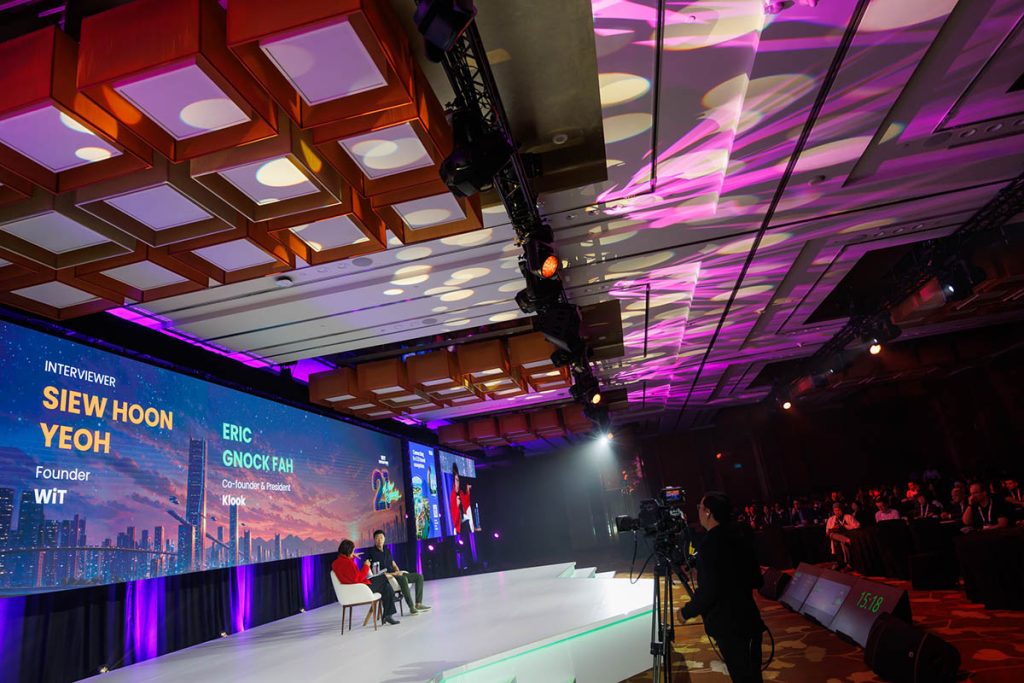
He grew up in Mauritius, speaks seven languages and was a banker at Morgan Stanley. Then he and travel buddy Ethan Lin set out to change how their generation finds things to do on holiday. In 2014, they pitched Klook on the WiT Japan stage. Twelve years on, Gnock Fah returned to WiT Singapore 2026 as co-founder and president of one of Asia’s best-known travel brands.
He followed Tony Fernandes on stage, and he counts the AirAsia founder among his heroes. “There are so many crises all entrepreneurs go through. What inspires me is the determination to never give up, and to turn things around.”
Twelve years is a full cycle of the Chinese zodiac, an auspicious milestone. Will the next cycle be gentler? Gnock Fah reached for a gamer’s metaphor. “Sometimes I feel doing a business is like playing a video game. You reach the next level, you gain some experience, and then you find a bigger boss.
“The last 12 years were about proving that experiences can be digitised at scale. The next chapter for us is building the ultimate destination ecosystem.”
That means experiences, eSIMs, live concerts and rail tickets, and meeting almost every need a traveller has once they land.
AI: The coffin and the saviour
Klook has stared into the coffin before. When the pandemic brought travel to a hard stop, it survived. So is AI the next nail, or the rescue?
“Definitely not a fad. It can be a coffin, and it can be a saviour,” he said. “All major breakthrough technologies have two sides.”
AI is changing how travellers discover and book, and some businesses, old and new, will be disrupted, he said, but he is just as excited about how AI can grow the pie. Language is still a source of friction abroad. Now there is real-time translation in AirPods and in the new Meta glasses.
“Ten-plus years ago, Google Maps made navigating the world really easy. Now AI is going to make understanding the world much easier. It will expand the market, and we will benefit.”

Why agents struggle with experiences
Gnock Fah was 27 when he started Klook, a young disruptor himself – in the same age band as Noah Shinn, founder of Instinct, who claims that travel already makes up a big slice of his agent’s transactions. How does he see the new disruptors and where does that leave a destination specialist?
He sees a parallel with mobile. When it arrived, it changed consumer behaviour. Companies that were slow to build apps didn’t survive, while the big OTAs innovated and now take more than half their transactions on mobile.
Agentic commerce, he argued, works best with standardised products, the kind you buy from Amazon or Walmart. Experiences are a different beast. “It’s very difficult to standardise. Diving versus going to see the elephants: each one is very different. It’s not a homogeneous product.”
That is why Klook’s own AI bet looks the way it does. Klook won its first round by going mobile-first. This time it is going conversation-first. “Right now our tech and product team cares slightly less about the perfect UI. We’re putting more resources into the chatbot.”
After 12 years, building a perfect interface for comparing non-standard products is still extremely hard. “In a chatbot, you can take care of that much more easily, just through conversation.”
Klook’s chatbot will soon add agentic capability, so travellers can buy through the chat.
The real competitor is offline
With Booking, Trip.com and other giant OTAs moving into experiences, does it make it tougher to compete with? Gnock Fah sees validation. “It proves this category is viable.”
The real competition, he said, is offline. “Over 60% of merchants don’t even have a website. If they are not online, an agent can’t even get to them.”
More players means a bigger market. Is there a price war going on, he was asked? “For any e-commerce platform, best price is a prerequisite.”
Getting those merchants online is the work Klook does. Around 95% of experience merchants are small businesses without the systems to take bookings at scale. “They focus on delivering the offline experience and service. That’s what we help them focus on. We take care of booking, marketing and working with creators, so we can bring this ecosystem online.”

Profitable, and selling more to the same traveller
There’s no denying it’s a tough sector. GetYourGuide took 16 years and about US$750 million in equity funding to reach profitability, helped by repeat customers and high-margin multi-day tours common in Western markets.
Klook has been profitable since last year, Gnock Fah said, and close to 50% of its business comes from repeat customers. Tours are a high-margin category for Klook, but the strategy is breadth: “How do we sell more to the same customer?”
That comes back to the destination ecosystem strategy.
Onwards with global expansion: US emerging as key market
The dream since day one was to be a truly global brand born in Asia, and the numbers are moving. Five years ago, almost 100% of Klook’s revenue came from Asia, by origin and by destination. Last year, close to 20% came from Western origin markets.
The US is now one of Klook’s largest markets, even with long-haul travel disrupted by the conflict in the Middle East. “And we’re still very small there. It’s a huge consumer market, and we’re just getting started.”
Social: From marketing channel to storefront
Klook began investing in social long before it was fashionable. “We started social 10 years ago. Back then it was a marketing channel. Today it’s more like a store.”
Klook was an early TikTok partner in turning creator content into bookings. It also works with creators on Chinese platforms, and has launched creator shops. Some platforms, such as Instagram, still don’t let users buy directly, but “social is now meeting commerce.”
The destination ecosystem: Live events
Live events are part of the next level. Klook’s BTS packages for Singapore in December did very well. Sports tourism, big in the West, is catching up in Asia, bundled with services from attractions to ground transport.
Live events are growing, he said, “from a very small base”. The business is quasi-local and dependent on local sourcing, so Klook is selective. Hong Kong, Taiwan and Singapore are its three main markets for now.

What outsiders underestimate about Asia
For the many non-Asian delegates in the room, Gnock Fah’s lesson was this: in Asia, crisis is constant. Klook launched in Hong Kong during the protests. Then came a sharp fall in travel between mainland China and Taiwan. Last year, China-Japan travel went from a huge corridor to “almost zero”. There have been Japan-Korea disputes too.
“Every one or two years there’s a crisis.” The only defence is diversification: being present in so many destinations that no single shock can sink you.
So why should foreign brands invest in Asia if it has so much volatility? “Asia has a fast-growing middle-income class, and they are very keen to adopt new brands and new technology. As a newcomer, you have a better chance to grow in a new market here than in the West.”
Zen and perseverance
As for what has the first 12-year cycle taught him personally, he said, “To be Zen.” With so much noise about AI, staying calm is a skill in itself, he said.
And the quality to carry him through the next 12? Perseverance.
There will be moments when it feels like there is no future, he said, and the lesson is to keep going anyway.
Watch the full session: