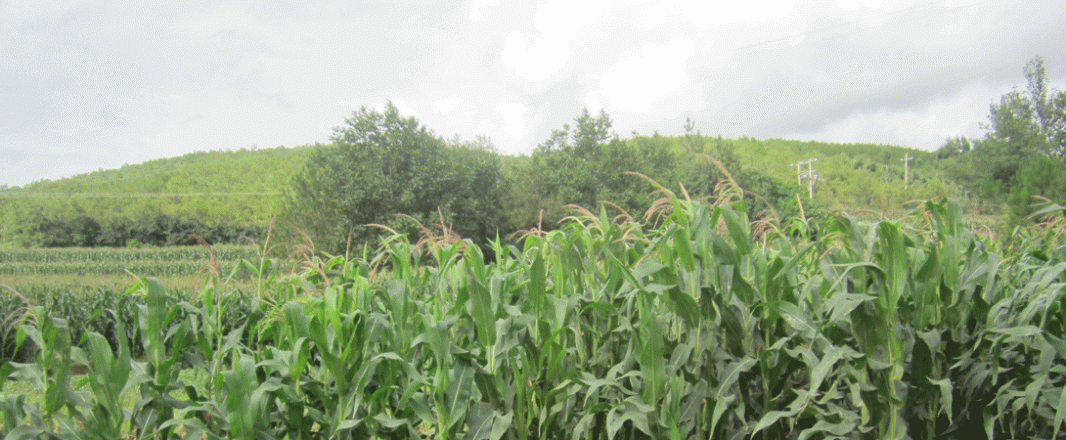
I wake up with a sense of excitement. Never mind the rain, but today is the day I will finally get to see Shangri-La. It’s a place I’ve long wanted to visit, it being the home of Uttara, my friend, for the last 16 years.

The tranquil setting of Shangri-La
But first, we take a detour to Yuhu, the base of Joseph Rock, a self-made botanist who came to Yunnan looking for medicinal plants and in the process, discovered what is now said to be the highest biodiversity in the Northern Hemisphere.
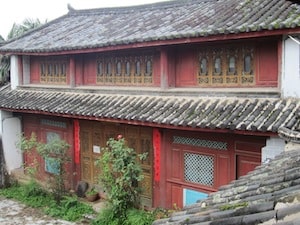
Residence of Joseph Rock
Rock, who collected around 80,000 species of plants and herbs in the region to be sent to Britain and America for identification, became National Geographic’s “man in China” from 1920 onwards and lived a rich and colourful life, documenting his discoveries and encounters with local tribes and the Dong Ba religion. His life and works are told in Joseph Rock’s Residence.
.gif)
Bicyclists on the road to Shangri-La
Uttara says it is wise to allow your body to adjust so it’s good to do what we have done – travel from Dali up to Shangri-La in a few days. So far, I haven’t felt any altitude sickness but I wondered what it would be like at the “Royal Plains” which is what the Tibetan name of Gyalthang means.
This is the most scenic part of the Tea and Horse Caravan Trail so far. We skirt the two main lakes – La She Hai and Wen Hai – and we can see Jade Dragon Mountain in the mist. We’re traveling towards the Yangtze River and Tiger Leaping Gorge and onto the middle plateau.
We’re now within what is called the Great Rivers National Park, the area traversed by the three great rivers – Salween, Mekong and Yangtze – which are less than 80km apart, so you can imagine how fertile the region is. While the Salween and Mekong flow southwards into Myanmar, Thailand and Laos, and onwards, the Yangtze takes its first bend at Shegu and flows northwards, staying within China, forming the lifeline of the motherland.
We stop at Shegu for lunch and take in the significance of this spectacular site. You can see where the Yangtze bends from a vantage point. It’s my first sighting of the Yangtze – I’ve seen the Mekong and Salween – and so this moment will now remain embedded in my memory.

Bend of the mighty Yangtze River
We continue to head northwards and at one point, we cross a bridge and suddenly the architecture changes. We are in Diqin Tibetan Autonomous Prefecture of which Gyaltang is capital and Naxi style architecture gives way to the sturdier look of the Tibetan homes.
.gif)
Zero visibility, a surreal experience
It’s a steep ascent into the mountains for two and a half hours, with Shudu River careening down on our right, and at one point, we rise above the clouds – which means it’s almost zero visibility as fog rolls down the mountains – but Pangan, known to his team as “the best driver in Yunnan”, is steady at the wheel.
Now I know why Yunnan is called “Land South of the Cloud”.
We drive through pine and rhododendron forests which then make way for rolling Tibetan grasslands dotted with traditional villages. It’s like being in a Zhang Yimou movie.
As we enter the high grasslands of Gyalthang, the air becomes decidedly cooler. This is one of the most prosperous valleys of the East Tibetan region. Its high altitude allows both farming and animal husbandry – horses, yaks, cows, goats. Known to be savvy traders, Gyalthang folk were some of the most active merchants on the old Tea and Horse Caravan Trail.
It’s been a long day and the body needs adjusting to the high altitude. Time to call it a night in Shangri-La and prepare for a brand new day in the land of the Lost Horizon.
Next: Spending time in Shangri-La
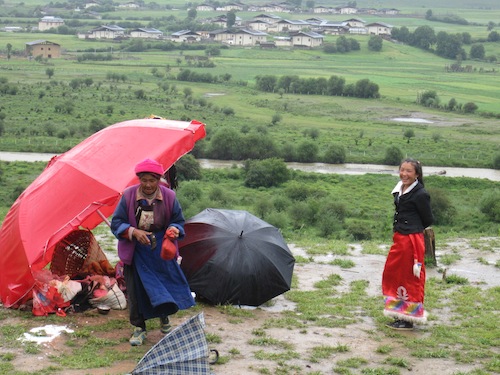
Gyalthang folks enjoying the great outdoors