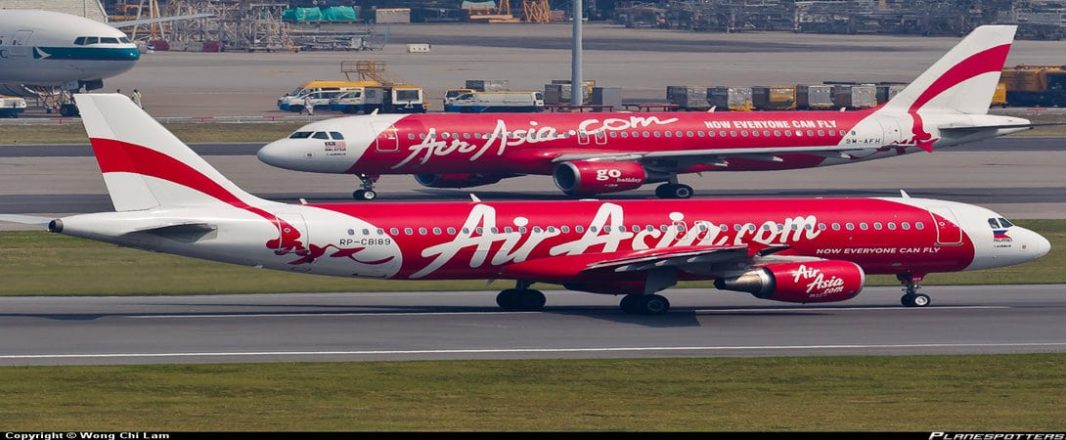

And some wonder why journalists, especially those of us based in Kuala Lumpur, are giving AirAsia so much coverage. This is because this home-grown airline is making news, news and news – usually all within the space of one week.
Take Monday June 20, for instance. AirAsia hosted two press conferences back to back – one following the airline’s AGM and the other to announce the launch of its aviation training centre. And interesting news is usually generated from an AirAsia’s conference.
The news that raised eyebrows at the conference was when AirAsia Group CEO Tan Sri Dato’ Sri Dr. Tony Fernandes announced the airline would order 200 A320neo aircraft, Airbus’ upgraded and more fuel-efficient workhorse, worth US$18 billion at the Paris Air Show at Le Bourget.
Well, he kept his word as AirAsia placed a firm order with Airbus for the 200 A200neos, with the contract sealed at the air show in Paris. This is the largest order ever for the A320 Family and makes AirAsia the biggest airline customer for the Airbus single aisle product line worldwide.
This US$18 billion deal is billed the biggest civil aircraft order in Airbus’ history by the number of planes. And that’s another reason why AirAsia creates waves wherever it goes.
Fernandes said the new order was in line with the airline’s rapid expansion plans and its long term vision to grow its associates throughout the region. It is also to cater to expansion plans in the Philippines, Vietnam and other parts of Asia
“With the introduction of the Airbus A320neo, AirAsia guests can look forward to more exciting routes from AirAsia as we can now explore more destinations with the enhanced range presented by the new-gen aircraft.”
 The A320neo (pictured right) with new engines and large wing tip devices, called sharklets, will deliver fuel savings of up to 15% and additional range capability of 500 nautical miles (950km), or the ability to carry two tonnes more payload at a given range.
The aircraft is also more environmentally friendly as the fuel savings translate into some 3,600 tonnes less CO2 per aircraft per year, as well as reductions in engine noise. It will lower operating costs for AirAsia as well.
Altogether, AirAsia has now placed firm orders for 375 A320 Family aircraft, with 89 already in service on the carrier’s fast-growing pan-Asian network. This will swell AirAsia’s fleet of jets from 93 to around 500 by 2020 to meet surging demand for air travel across the booming continent.
The 200 planes are expected to be delivered from 2016 to 2026.
“With the trajectory of 500 aircrafts, it will make us one of the biggest airlines in the world,” said Fernandes.
AirAsia’s current fleet of 93 aircraft is busy flying 160 routes throughout Asia and within Malaysia.
The additional aircraft definitely comes in handy at the rate AirAsia X, AirAsia longhaul budget affiliate, is spreading its wings. Earlier this week Malaysia’s Transport Ministry granted AirAsia X’s application for flights to five new destinations – Beijing, Shanghai, Osaka, Jeddah and Istanbul. But its much desired route, Kuala Lumpur-Sydney, is still out of its reach and remains solely the domain of MAS – for now at least.
AirAsia CEO Azran Osman-Rani confirmed the airline will fly to two of the routes within 12 months, but declined to name them until all regulatory and airport authorities approvals have been obtained to enable the airline to land in the countries.
Africa is next on AirAsia X’s horizon. Fernandes disclosed that a team from the airline was in South Africa, Egypt and Morocco to survey new routes, adding that there was a lot of potential in Kenya and Somalia.
“We will definitely fly to Africa at some stage,” said Fernandes, but did not elaborate on exact destinations and dates.
On the Asian Aviation Academy, the RM200 million (US$66 million) joint venture with CAE, a global leader in flight training solutions, Fernandes said it was aimed at training pilots, cabin crew, maintenance workers and ground personnel for airlines in the ASEAN region.
The centre will train about 12,000 pilots a year in the academy, with the number of trainees to grow exponentially.
Pilot training programmes will be available from July 1 while non-pilot training programmes will commence on October 1. Trainees from other airlines will also be accepted.
The training centre will start operations with six CAE-built full-flight simulators currently located at the AirAsia Academy in Sepang, Selangor. These include four full-flight simulators for the Airbus 320, one each for the A330/A340 and the Boeing 737 Classic.
“Our goal is to make the centre a prominent ‘aviation university’ and to make it the largest training centre in Asia,” added Fernandes.
.gif)
Looking at AirAsia group’s performance in May the airline has good reason for more cheer and more plans for its expansion. The AirAsia group collectively carried 20.4% more passengers in the month compared to a year earlier. Its load factor rose to 79% from 75% from May 2010.
The airline’s passenger load factor in individual countries also increased – in Malaysia passenger traffic climbed 14.8%, in Thailand 32.8% and in Indonesia 27.4%.
• Group photo above: Launching the Asian Aviation Academy. (From right) Tony Fernandes, AirAsia group CEO; Dato’ Saifuddin bin Abdullah, deputy minister of Higher Education, Malaysia; Jeff Roberts, group president, civil simulation products training and services