I wake up to the pattering of rain on my bedroom window. I rise from my bed of roses (the most colourful bedsheets I’ve ever slept on) to face Day 3 of my Tea and Horse Caravan Trail.
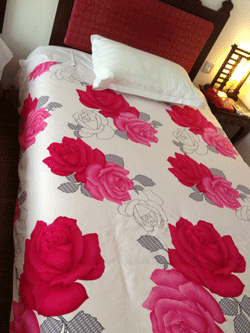
Bed of roses
We decide to have breakfast at Bakery 88 (breakfast at Landscape leaves much to be desired) and there, we meet another couple who’s made a new life in Yunnan – a young Beijing girl and her French husband. Both met as students in Paris. She worked in a department store, he in insurance. Both got laid off. They travelled to Yunnan and decided to take a lease on a restaurant in Zhongdian (Shangri-La), Arrokhanya.
Don’t we all harbour secret desire to uproot ourselves and start somewhere totally new?
Today, we are headed to Shaxi, an important stop on the trail, but first we stop off in Xizhou, a lakeside town about 45km from Dali. This town was an important trade centre for the wealthy Bai merchants and still houses several elegant merchant stone homes. We pop our heads into one of these homes, which is now, lived in by individual families all renting separate rooms.
A visit to Xizhou is not complete without trying the local bread, Xizhou Baba (pictured left). Yunnan has an abundance of wheat and rice, and noodles and breads are a staple in the region.
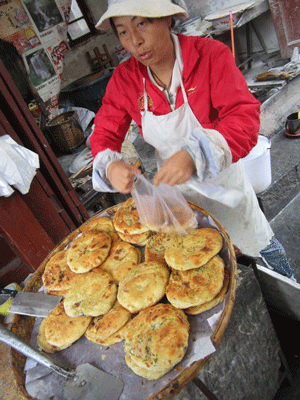
Vendor selling the local bread, Xizhou Baba
We take a horse cart ride in the rain. Hei Ma (Black Horse) is eight years old and is as comfortable trotting on ancient cobbled streets as concrete highways. Like his human owner, he’s gotten used to urban encroachment on rural life. For most of the ride, our driver was busier with his mobile phone than with his reins – which really shows who is really in charge here.
It’s a novel experience, riding on a horse cart on a six-lane highway with lorries, trucks and jeepneys passing by, but Hei Ma makes me feel safe-ish.
We stop for lunch in a tiny shop in Dengchuan, which for some reason is known for its yoghurt. And so we buy a carton. Our car is beginning to feel like a caravan, loaded with food from fruits to breads to pickles. Now, we are really beginning to feel merchants travelling on the Tea and Horse Caravan Trail, only with a different purpose.
The road to Shaxi takes us through lovely rural landscapes – fields of rice, corn, barley, wheat flanked by mountains shrouded in clouds. Chinese villages are dotted across the landscapes – it’s all I imagine old China to look like and I wish I could paint it. But I have to be contented with snapping away with my smartphones.
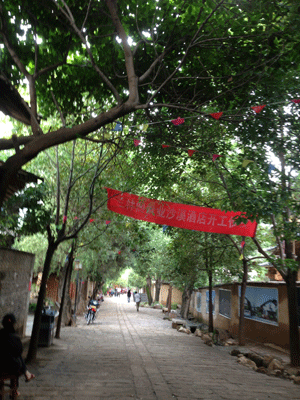
Walkway to Shaxi flanked by willow trees
Amid the rural scenes, you see roads being built. Agricultural land is being cleared for the road. They are building a new highway that will cut travel time between Lijiang and Dali from three hours to an hour. At one point, the road turns into a narrow, winding pass and as we climb upwards, we see a truck on its side in a ditch. No one bats an eyelid – must be a fairly common occurrence.
I fall in love with Shaxi at first sight. Willow trees flank the walkway into the old town (pictured left). No vehicles are allowed. Its history goes back 2,400 years old – as early as 400BC, Shaxi was a copper mining town with expertise in smelting bronze.
Later in the Tang and Song Dynasty, it became an important stopover on the trading route, which started in Puer to Dali, through Shaxi, on to Tibet, Myanmar and India. Walking into Sideng Market Square (pictured right), the heart and soul of Shaxi, is again like walking into a movie set. The square is dominated by a theatre and temple, and shops and stables flank a red sandstone paved square. We walk down one of the side streets and end up next to a river where we watch a lone fisherman trying his luck.
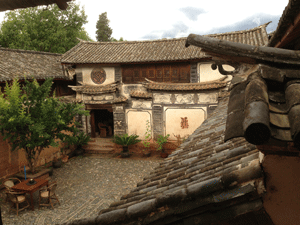
The Old Horse Inn (Laomadien)
Our inn for the night is called Old Horse Inn (Laomadien), with only nine rooms. The town is overbooked. There’s a big student group on an art trip and clusters of them are gathered around the square, capturing the picturesque scenes with their paintbrushes.
At night, the town is lit with oil lamps, lending a magical air to the place. You really do feel like you’ve stepped back in time. We step into a little place called Hungry Buddha which, would you believe it, serves the best thin-crusted pizza I’ve ever had.
It’s run by an Italian man (yes, he came to Shaxi, fell in love and set up the restaurant) who’s taught his two young Chinese female staff to bake bread, make pasta and pizza. The menu is limited because it’s “temporary” even though the place has been opened six months – only one type of pasta and pizza available – but both are delicious.
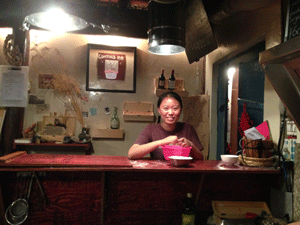
Jenny, a worker at the Hungry Buddha
The two girls are obviously proud of their new-found culinary skills and speak passionately about the use of natural ingredients. One of the girls, Jenny (pictured right), is from Hangzhou. She studied hotel management, worked for six months in a hotel and then decided to travel to Yunnan.
And yes, she too fell in love with Shaxi and the restaurant and decided to stay and work. “I want to do something I like,” says Jenny.
Yes, again, the setting may be different, but human aspiration is universal.
Next stop: The road to Lijiang