For the most part of this year – OMG, is it already mid-July – I’ve been travelling places and speaking about Asia, how the region’s changing, how travel’s moving and, most crucially, how we as folks in Asia are evolving as citizens, consumers and travellers.
 It started with the AIME event in Melbourne where I moderated the CEO Summit and there, I heard an economist tell mainly Australian leaders to look at Asia through a new prism (oh, I should use another word these days) and the first thing they should do is widen what they read – so that they’d understand there is a new Asia on the rise – an Indonesia that’s more than terrorism and corruption, for example, and that there’s more to the region than China or India, as big economies as they may be.
In Berlin in March, we focused on three trends that were changing travel in Asia – the emerging Indonesian online market, social media and the mobile leapfrogging phenomenon – and told our audience (mainly Europeans) not to be terrified by the strangeness but more by the sameness. Markets become more understandable when you slice and dice them according to what you want to do and achieve because, fundamentally, people are more similar than we think. Yes, how we do things may be different but what we want are pretty similar – in terms of being consumers and travellers.
There were also our own events – WIT Indonesia, WITX Thailand and WIT Japan – and this was when I sensed that while there was an over-arching narrative that was making Asia more similar than it’s ever been, there were peculiarities and idiosyncracies associated with each market – be it geographic or by interest – that make Asia such a wonderful, dynamic and exciting place for people who love solving problems, creating opportunities, building businesses and making history.
It was however the WIT Hospitality roadshow – in which we covered Malaysia, Vietnam, the Philippines and Cambodia – that capped my learning. These “outlier” markets are as exciting and they are developing in ways that are unique to them – mobile means more feature phones than smartphones, there’s rising political and social awareness and there are plenty of hungry consumers just waiting to buy and experience travel differently.
And so came together “The Asia Factor”, the theme for this year’s WIT Conference. Let me connect the dots.
One, Asia has arrived as a region. Yes, please, no more emerging, arising … it’s here. Interest in the region is at its highest. Over the next two months, I will travel to Sydney, Honolulu, Seoul and Shanghai to share the Asia story with different audiences.
Activity by foreign brands in this region is intense. This is not new. What’s new are the names – Airbnb, Homeaway, Uber, Spotify, Momondo, Trivago. What’s also new is the shift of focus from Europe or US first to Asia first by some companies bold enough to make the leap.
Online may only be (on average across Asia) 20% of the overall travel market but by golly, it can only accelerate as more players enter the market.
Two, Asia-born-and-bred brands are staking their ground and scaling – MakeMyTrip, Rakuten, AirAsia, Wego – just some of the names that are expanding
.jpg)
Hello Kitty on a fender guitar
Three, Asia is evolving in ways that are unique and different. The instant messaging phenomenon that’s come out of China, Japan and Korea –WeChat, Line and Kakao – are the new social in our part of the world. Will “cute” be able to cross the oceans? Well, Hello Kitty proved she could, and has.
Four, the great thing about Asia is that there are always new frontiers to explore for those that dare – from “outlier” markets like Myanmar to Vietnam to “niches” which are giant markets in their own right – the US$126 billion halal market, cruising, solo female travellers …
I am also using the term “Asia” less loosely than I’ve ever done. Yes, I know, everyone says Asia is different, it is fragmented, it is diverse and it is still all that but, as a second-generation Malaysian who’s grown up with our region, I believe there are forces that are making us more similar across countries than different – rapid urbanization, growing political awareness, growing middle class, low cost airlines, technology and a new generation of Asians growing up in a post-colonial world with very different thinking from their parents and grandparents …
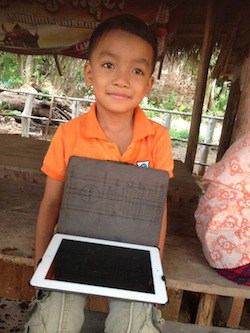
iPad boy
I was convinced of this when, walking through a remote village in Siem Reap, Cambodia, I came across a little boy with an iPad and he was happily flicking his finger across the screen. It made me, a frequent visitor, see Cambodia with new eyes – from a poor, ravaged, war-torn country to a developing nation of people with aspirations, be it for education or entertainment and travel.
With “The Asia Factor”, we want to focus on the broader similarities because only when you connect the dots can you see more clearly the bigger picture and then drill down into the specific areas where you can unearth opportunities for your business.
See you Oct 21-23 in Singapore, Oct 21 being our WIT Bootcamp where we will also unearth local stories that make “The Asia Factor” what it is.