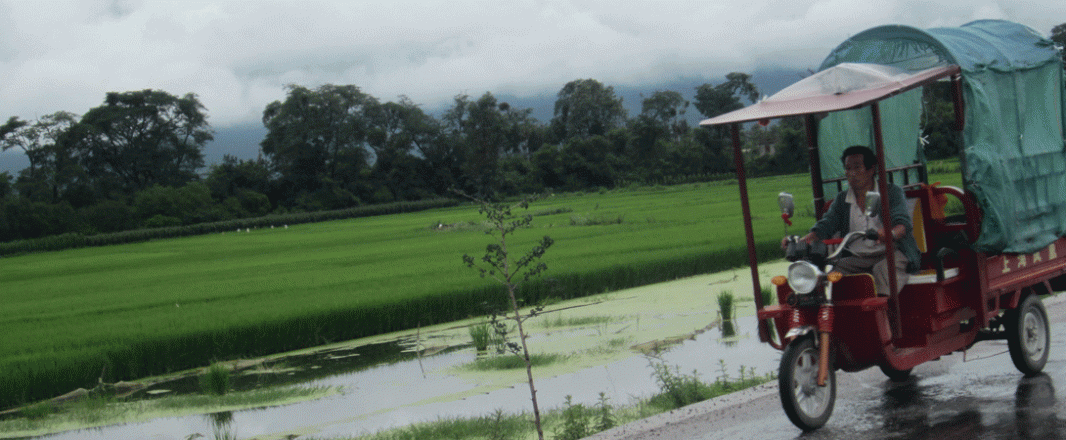
Today is the first day of my tea and horse trail adventure in Yunnan. Over the next seven days, I will cover by four wheel drive the same trail that ancient tea and horse traders traversed on their way from Dali through Lijiang and up to Zhongdian (Shangri-La), on the Tibetan-China border.
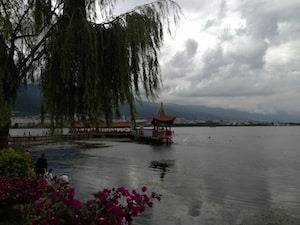
Serene Dali Lake
It’s a trail I’ve long wanted to do ever since my first visit to Lijiang when I visited the Tea and Horse Museum and learnt of this historic trading route and heard stories of merchants stopping in staging post inns along the way with their mules, horses and tea.
Today’s travellers have it far easier of course. I arrived in Kunming today by air and I did something I think would have been impossible in any airport anywhere in the world.
I managed to make my one-hour connection despite the fact that I had to go through immigration, pick up my baggage, run up to Level 3 Departure to check in for my China Eastern connecting flight to Dali.
The girl checking me in at Changi had told me she couldn’t check my bag straight through to Dali, neither could she issue me a boarding pass “because it’s not in the system”.
Because my brain hadn’t checked in for work yet at that time of the morning, plus I hadn’t realized I had such a tight connection – my flight was scheduled to land at 12.20 and the China Eastern flight was 13.20 – I unthinkingly checked in my bag which I could easily have hand carried.
On the flight to Kunming, I played several what-if-I-don’t-make-it scenarios in my head. Well, I needn’t have worried.
Kunming Airport is an impressive facility, similar to the Hong Kong airport in look and layout. There was no queue at immigration. My bag was first off the belt. An airport staff directed me to Level 3 Departure and gave me the check-in counter. And in fact, I even had time to spare before boarding the MU flight.
When I think of the connection I had to make from Canberra to Auckland once via Sydney or from Los Angeles onto Las Vegas, I realise how much the world has changed.
China has leapfrogged most of the Western world in terms of infrastructure and is doing its best to catch up in service standards.
On arrival in Dali we drive through its capital Xiaguan, a major bustling metropolis with 3.4 million population. It’s a small city by China’s standards but it’s big enough for me – in fact, bigger than I had expected.

Chinese family enjoying selfie time
Tonight, I am spending the night at the Landscape Hotel, a charming inn built in the old Dali style. The first thing I saw when I walked in – a Chinese family in which every member including two young boys had a device with which they were taking photographs of each other.
Out in the old town, more Chinese tourists – it is school holidays – and even more devices. I’ve never seen such a high concentration of smartphone activity anywhere. In the Landscape, you don’t even have to ask about wifi – it’s there, it’s free and it’s open.
Welcome to the new China.
Tomorrow though I look forward to discovering the old China. We are off to Weishan, an old Bonnan tea trading town, that was the early centre of the ancient Nazhou kingdom of the Bai people. I am curious as to what world awaits me.