The man of undetermined age swings his leg back and forth, then stamps hard against the dusty ground. The air is hot and still but his energetic dance celebrating the harvest season sends his loincloth flapping. His face may be inscrutable, but his motions are practiced and confident.
I am seated in a semi-circle, with about 60 others, watching a small group of tribes people perform a ritualistic dance. Topless women crouch to the side of the makeshift amphitheatre, striking their drums rhythmically.
In the face of curious tourists wielding large, imposing cameras, a teenage girl lifts her arm gingerly to shield her bare chest, signalling her unease.
Is ‘gawking at natives’ the last taboo in travel? While sustainable tourism has wormed its way into our vernacular, its practical application is still elusive.
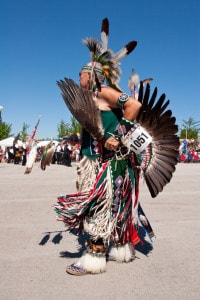
Image of a Native American dancer credited to Kubrak78 via iStock
Ironically, countries that hawk exotic images of local tribes and fetishise their way of life also accentuate the consequence of rampant economic development that pays little regard to native lands and livelihoods.
Had our group trekked inland to the village, it might have felt less like a carnival of human curiosities and more like an opportunity to understand the nuances of tribal life, on their terms and in accordance with their customs.
In an age where these nomadic farmers (population: 300 and shrinking) face an uncertain future thrust upon them by a government ban on shifting cultivation, a replica village and dance performance seems a rather flippant and insensitive way of preserving a disappearing culture.
To my mind there is a clear distinction between celebrating and exploiting a culture. In Malaysian Borneo where I grew up, cultural performances were par for the course at most official events. The hunter’s skill with his blowpipe is demonstrated through dance – a ritual stretching back hundreds if not thousands of years, performed with pride and dignity. In many other places, appreciation from tourists for similar performances has incentivised the preservation of art forms that would otherwise have been lost to modernity.
As more travellers embrace the concept of sustainable tourism – defined by the International Ecotourism Society as “taking care not to alter the integrity of the ecosystem, while producing economic opportunities that make the conservation of natural resources beneficial to local people” – any act that smacks of ‘parading the natives’ may eventually be consigned to history, like the freak shows of the 19th century, now anathema to our modern conscience.
What do you think?
iStock photo image credit: Andrea Calandra