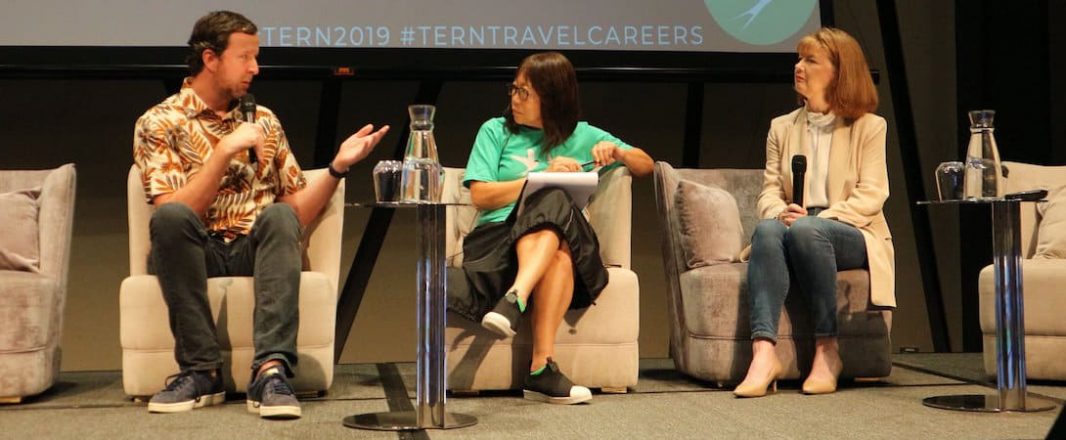
At the fourth edition of Tern Travel Careers, Greg Schulze (Senior Vice President of Commercial Strategy and Services, Expedia Group) and Jennifer Cronin (President, Wharf Hotels, Hong Kong) marked three skills as being fundamental to success.
It was agreed that no matter how much technology changes jobs in travel, critical thinking, empathy and stamina remain the most important skills in your arsenal as a worker.
Said Schulze, “You need to judge your skills in the context of what you’re doing.” As the scope of your job increases as your career progresses, you need to be aware of what new skills you’ll need to arm yourself with. “Read everything you can,” he advised. Cronin concurred, saying it was critical to be “forever learning.”
Schulze explained that while the skills he developed through his background in engineering was fundamental to his early career, communication and empathy are skills have become more essential as time has passed.
“Naturally, everyone has a fear of some form of communication… anything you want to learn to do, you can watch a YouTube video or listen to a podcast but [being able] to talk to and listen to people is so critical.”
Similarly, building skills in problem solving and developing a critical mind can take a variety of different approaches. Schulze said he methodically defines the problem and envisions the result. “Be clear about why you’re doing an analysis and picture the output as something useful.”
Meanwhile, Cronin focuses on “understand[ing] the facts first and then try[ing] to look for the best outcome for [that] point in time.” For example, faced with the current Hong Kong political crisis, Cronin said, “Occupancy rates are plummeting… it’s pointless trying to fix it by advertising Hong Kong as a destination right now.”
Familiar problems will require different solutions. Applying the same logic to every situation won’t always work, so you must be able to adapt to different iterations of the same problem.
Finally, while stamina is perhaps an easy skill to overlook, it is perhaps the most fundamental to how far you can go with your career. Schulze described how stamina is often tested across two realms – “sometimes you work through the night… you need to push through and deliver something of quality” and “longer-term endurance,” particularly in how you handle the ups and downs of your career over time.
He described his time working for American Airlines in 2001 – a knowingly difficult year for the air industry, following the September 11 attacks – as particularly difficult. “It was an awful place to be… people walking out with boxes en masse.”
At the end of the day, he said, “It’s great to have a good job [but] you can’t ever put too much into this… You never know if there’s going to be some disruption that can either be a devastating setback or really push you forward.”
How you handle these ‘disruptions’ can be the key difference to how you progress in the long run.
It must be said building stamina extends beyond just professional life. Being able to endure and bounce back from professional hardship will have as much to do with psychological and physical wellbeing.
In tough times, personal care is paramount, but unfortunately too often overlooked for the sake of reaching the next big milestone.
Finding time for self-care need not be too complicated though. Cronin explained that when times get tough, she chooses to exercise, using it as an opportunity to clear her mind and re-centre herself before taking on her next challenge.