THE International Air Transport Association (IATA) reports that over the past year, re-openings in many economies of the Asia Pacific region allowed for passengers and airlines to return to the skies, greatly accelerating traffic growth in both domestic and international markets. While RPKs in 2022 were 54.4% under the levels of 2019 for this region’s airlines, the recent developments related to the reopening of international travel in China give a positive outlook for the months to come.
We discussed travel recovery and a surge in tourist traffic for the better part of the last year. Now that we’re firmly in 2023, more and more all-year reports are being delivered by industry leaders, analysts, and key players in the market.
It’s safe to say that if there were any doubts about global travel being on the mend, and at times surpassing pre-Covid levels, these numbers by IATA are hard to argue with. IATA represents some 300 airlines comprising 83% of global air traffic.
Earlier this month, the Association announced that the recovery in air travel continued in December 2022 and for the full year:
- Total traffic in 2022 (measured in revenue passenger kilometers or RPKs) rose 64.4% compared to 2021. Globally, full year 2022 traffic was at 68.5% of pre-pandemic (2019) levels. December 2022 total traffic rose 39.7% compared to December 2021 and reached 76.9% of the December 2019 level.
- International traffic in 2022 climbed 152.7% versus 2021 and reached 62.2% of 2019 levels. December 2022 international traffic climbed 80.2% over December 2021, reaching 75.1% of the level in December 2019.
- Domestic traffic for 2022 rose 10.9% compared to the prior year. 2022 domestic traffic was at 79.6% of the full year 2019 level. December 2022 domestic traffic was up 2.6% over the year earlier period and was at 79.9% of December 2019 traffic.
The “wild card” this year is obviously the newly reopened China, which has left many in the industry wondering what it’s impact will be on global tourism.
According to Willie Walsh, IATA’s Director General, “The industry left 2022 in far stronger shape than it entered, as most governments lifted COVID-19 travel restrictions during the year and people took advantage of the restoration of their freedom to travel. This momentum is expected to continue in the New Year, despite some governments’ over-reactions to China’s re-opening.”
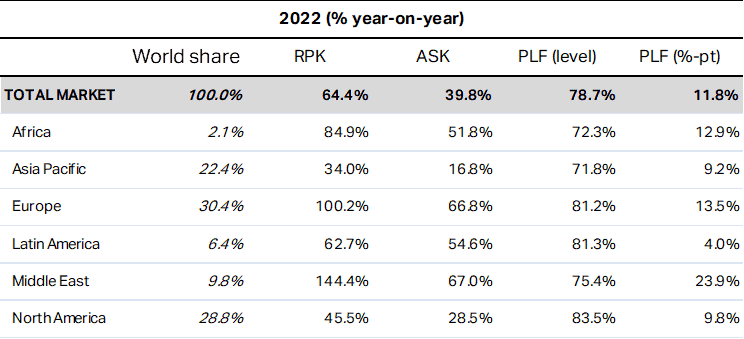
The full IATA report lays out a more complete picture of passenger demand around the world.
Over the course of 2022, global air passenger traffic gained momentum and recovered substantially as travel restrictions were taken down and passengers expressed a very strong willingness to travel:
- Passenger traffic recovered from 41.7% of 2019 volumes in 2021 to 68.5% in 2022.
- At the industry level, passenger demand was met by offered seat capacity in 2022, as available seatkilometers (ASKs) recovered to 71.9% of 2019 levels, while maintaining industry-wide passenger load factors of 78.7%.
- Passenger load factors for 2022 were only 3.9 percentage points (ppts) below the load factors achieved before the pandemic in 2019. Similar observations can also be made at the regional level.
- Globally, domestic operations ramped up quicker than international as domestic travel policies offered more certainty to passengers. Despite the setbacks caused by lingering travel restrictions, international traffic took off significantly in 2022 wherever these restrictions were taken down. As a result, international RPKs surged from 26.8% of 2019 levels in 2021 to 62.2% in 2022.
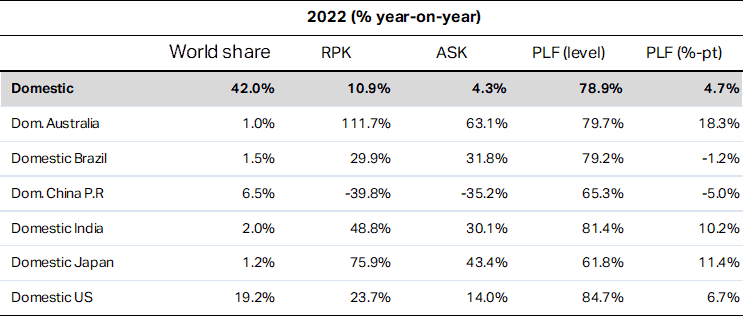
It’s important to note that airlines faced uneven outcomes in 2022. North American carriers led the industry by achieving close to pre-pandemic passenger traffic levels with total RPKs 11.3% under 2019 volumes, followed by Latin American and European carriers at 14.2% and 22.2%, respectively, below 2019 levels.
Elaborating on International Passenger Markets
- Asia-Pacific airlines posted a 363.3% rise in full year international 2022 traffic compared to 2021, maintaining the strongest year-over-year rate among the regions.
- Additionally, capacity rose 129.9% and the load factor climbed 37.3 percentage points to 74.0%. December 2022 traffic rose by 302.7% compared to December 2021.
- European carriers’ full year traffic climbed 132.2% versus 2021. Capacity increased 84.0%, and load factor rose 16.7 percentage points to 80.6%. For December, demand climbed 46.5% compared to the same month in 2021.
- Middle Eastern airlines saw a 157.4% traffic rise in 2022 compared to 2021. Capacity increased 73.8% and load factor climbed 24.6 percentage points to 75.8%. December demand climbed 69.8% compared to the same month in 2021.
- North American carriers reported a 130.2% annual traffic rise in 2022 compared to 2021. Capacity increased 71.3%, and load factor climbed 20.7 percentage points to 80.8%. December 2022 traffic rose 61.3% compared to the year-ago period.
- Latin American airlines posted a 119.2% traffic rise in 2022 over full year 2021. Annual capacity climbed 93.3% and load factor increased 9.7 percentage points to 82.2%, the highest among the regions. December demand climbed 37.0% compared to December 2021.
- African airlines’ annual traffic rose 89.2% in 2022 versus the prior year. Full year 2022 capacity was up 51.0% and load factor climbed 14.5 percentage points to 71.7%, the lowest among regions. December 2022 traffic for African airlines rose 118.8% over the year-earlier period.
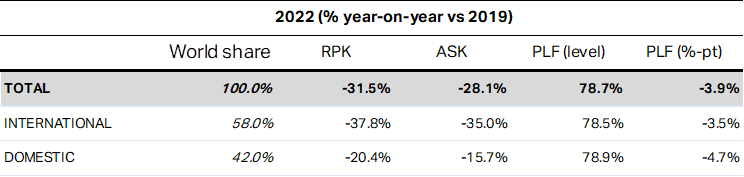
As for domestic markets, IATA emphasises just two countries – India’s full year domestic traffic rose 48.8% versus 2021, reaching 85.7% of the 2019 level.
And Japan’s domestic RPKs rose 75.9% in 2022 and were at 74.1% of the 2019 level.
In closing, Walsh emphatically states, “Let us hope that 2022 becomes known as the year in which governments locked away forever the regulatory shackles that kept their citizens earthbound for so long. It is vital that governments learn the lesson that travel restrictions and border closures have little positive impact in terms of slowing the spread of infectious diseases in our globally inter-connected world. However, they have an enormous negative impact on people’s lives and livelihoods, as well as on the global economy that depends on the unfettered movement of people and goods.”