
With 1,000 people, some 40,000 partners and three global hubs, Booking Holdings’ new Partner Division is taking shape. Its CEO, Omri Morgenshtern, who continues to run Agoda, talks about the complexity of bringing different businesses together, why B2B is not an insurance policy against the decline of OTAs, and his ambition to build the deepest AI travel assistant on the planet.
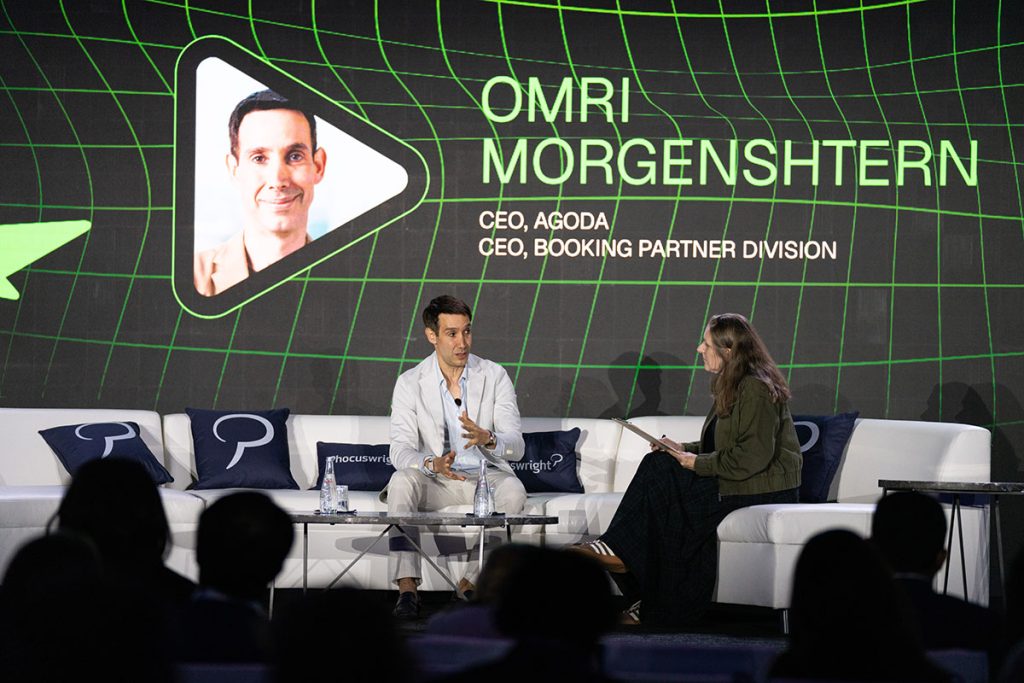
When I met Omri Morgenshtern in San Diego a year ago, he was on his way to Winnipeg, about to embark on a new adventure – building a consolidated B2B business for Booking Holdings while continuing to run Agoda, the online travel giant he has led since 2022.
A year later, we are in Miami, this time with the new Booking Partner Division (BPD) officially launched and his appointment as CEO formalised, and I wanted to know what he had learnt from the experience.
His answer? That he had underestimated the complexity of the task by about 70%. “I think I appreciated 30% of the complexity,” he admitted.
And, for the record, the job is far from finished. “It’s done enough in order for us to live, but we have a lot more issues to solve.”
It turns out that bringing together businesses from different parts of Booking Holdings is not just about combining technology platforms, commercial teams and partner contracts. It’s about defining a thousand things that established companies take for granted.
How do you conduct quarterly business reviews? How do you organise staff parties? Who gets invited? How do you bring people with different systems, salaries, titles and cultures together under one roof?
“Everything is complex and hard,” he said. “It’s the amount of details.”
Perhaps the biggest surprise to him was what proved hardest – it wasn’t migrating partners, renegotiating contracts, or not winning commercial buy-in.
It was building a consolidated financial statement. “I know, it’s boring,” he laughed.
But for a publicly listed company, getting the numbers right is serious business. Bringing together different reporting systems, processes and people, and reaching a point where he could be 99.99% certain of the figures, proved far more difficult than he had imagined.
The other big challenge was people – making sure employees from different organisations felt connected to one culture, one vision and one business.
A thousand people, 40,000 partners and three hubs
The new Booking Partner Division brings together B2B capabilities from across Booking Holdings, including Agoda and Rocket Travel, to create a more unified business serving companies that want to sell travel to their own customers.
It has approximately 1,000 people, some directly employed within the new division and others embedded within Booking Holdings’ consumer brands, particularly in technology.
The division is headquartered in New York, with Amsterdam and Bangkok serving as its other two major hubs. Technology capabilities are concentrated in Amsterdam and Bangkok, while commercial and account management teams are spread across markets.
The partner base? Approximately 40,000, by Morgenshtern’s estimate.
The product portfolio spans APIs, inventory connectivity, white-label solutions, financial institution partnerships and redirect products that take customers into Booking Holdings’ consumer booking experiences.
Think of banks offering travel rewards, loyalty programmes adding travel benefits, or other businesses looking to embed travel into their customer propositions.
Morgenshtern likens the structure to a fast-growing B2B startup “about to explode”, with teams spread across the world but connected through a handful of major hubs. Except this startup is being assembled from the moving parts of one of the world’s largest travel groups.
And he is running it while still serving as CEO of Agoda. How does he find the time, I asked.
By delegating more of Agoda’s day-to-day operations to a leadership team he trusts, including CPO Ittai Chorev who’s been acting as the head in the interim, and surrounding himself with experienced executives. “The quality of the people,” he said, is what makes the dual role possible.
Is B2B an insurance policy against the death of OTAs?
I couldn’t resist asking whether Booking Holdings was doubling down – or tripling down – on B2B because OTAs might be going the way of the dinosaur. Was this an insurance policy?
Morgenshtern wasn’t buying that premise. “I don’t see it as an insurance policy. I see it as uncovering potential.”
His argument is that Booking Holdings has always had significant B2B businesses across its brands, but the market opportunity is now expanding faster than before.
Loyalty programmes are proliferating. Financial institutions are moving deeper into travel. More businesses want to offer travel services without building the underlying inventory, technology and servicing capabilities themselves.
And AI is changing the economics of serving those partners. Previously, customisation was expensive and slow. Every major partner had different requirements, and developing tailored solutions meant significant engineering resources.
Now, AI-assisted development offers the possibility of building customised products much faster.
Partners, he said, are telling Booking two things: they don’t fully understand how the technology landscape is changing, and they need solutions tailored to their businesses.
The opportunity lies in meeting both needs.
For Morgenshtern, the combination of market growth, technology advances and Booking Holdings’ existing capabilities makes this the right moment to consolidate and accelerate its B2B ambitions.
The AI brain: Why all roads could lead to Booking
When I asked what moat the new B2B business could build against disruption from AI, Morgenshtern turned the question around. He sees AI not as a threat to B2B but as an enabler.
First, it allows Booking to customise technology faster and more efficiently for partners. Second, and more strategically, it creates an opportunity to distribute something beyond inventory and booking capabilities.
He calls it an AI travel brain.
Morgenshtern believes every business selling travel will eventually need an AI assistant capable of understanding customer intent, planning journeys, handling bookings and managing disruptions.
And he is convinced Booking Holdings is uniquely positioned to provide it.
Why? Because its consumer businesses have the traffic, data, customer interactions and operational experience to train and continuously improve what he believes will become the deepest vertically specialised travel assistant in the world.
“We will be the deepest verticalised travel assistant on the planet,” he declared.
His vision goes far beyond helping travellers choose a hotel or plan an itinerary. He wants an assistant that can proactively change travel plans when circumstances change, understand the customer’s preferences, respond to disruptions and connect deeply with the operational systems needed to solve problems.
And once that intelligence is developed within Booking’s consumer businesses, it can be customised and distributed to B2B partners.
Imagine a customer planning a trip through a general-purpose AI agent, moving into a Booking experience to complete part of the journey, and later interacting with a bank’s travel assistant to manage another part.
Behind those different interfaces could sit the same Booking intelligence.
Morgenshtern believes the future will not necessarily be about where the customer starts the journey, but which travel intelligence powers the experience.
“I think eventually it’s another form factor,” he said, describing how travellers might interact directly with Booking’s products, through external agents or via white-labelled partner experiences.
I put it to him that what he was really saying was that all roads, whatever route the traveller took, would eventually lead to Booking’s brain.
“Correct,” he replied.
It is an ambitious proposition, particularly in a world where general-purpose AI platforms are racing to own the customer interface.
But Morgenshtern isn’t necessarily interested in fighting those platforms for every consumer interaction. He wants Booking to provide the specialised intelligence underneath.
Why a travel specialist could beat a generalist
I asked Morgenshtern what Booking’s AI assistant could do better than a general-purpose agent.
His answer was the depth of the travel experience. Consider what happens when things go wrong, he said.
A flight is disrupted. A hotel needs to relocate a guest. An itinerary needs to be rebuilt. A customer requires support across multiple components of a journey.
Booking’s advantage, he argued, lies in its ability to connect intelligence with actual travel operations, customer support and real-time information across flights, hotels, attractions and other services.
It can also observe patterns in travel demand and behaviour through the traffic flowing across its platforms.
That gives it the potential to anticipate problems, rather than merely respond to requests. “We can be much, much deeper in the travel use cases,” he said.
In other words, while general-purpose agents may become very good at understanding what travellers want, Morgenshtern believes specialist travel platforms will retain an advantage in knowing what to do when reality refuses to follow the itinerary.
Of course, the industry has yet to prove how this division of labour between generalist agents and specialist travel intelligence will evolve.
But his strategy is clear: build the intelligence once, optimise it through its consumer businesses, and make it available across multiple channels and partners.
Trust, transparency and the rate leakage problem
There is, however, another challenge that has nothing to do with AI, I suggested – that of trust. Agoda has built a formidable consumer business, in part through its pricing capabilities. But its relationship with hotel suppliers has not always been comfortable, particularly when it comes to distribution and rate integrity.
Now, as Booking Partner Division expands its role as a B2B distributor, how does Morgenshtern convince hotel partners that their rates will not end up in places they never intended?
He acknowledged the concern. In B2B distribution, he said, the fastest way to lose trust is through a lack of transparency. Hotels want to know where their rates are going, who is selling them and whether the conditions attached to those rates are being respected.
His answer rests on two principles: transparency and control.
The division’s systems, he said, are designed to show hotel partners which distributors receive their rates and to give them the ability to choose which partners they want to work with.
They can approve certain partners, exclude others and experiment with different distribution arrangements.
For larger hotel chains, Booking also undertakes monitoring, including test bookings, to check whether rates are being sold through the appropriate channels.
He was careful not to promise perfect visibility through every layer of distribution. After all, a rate can pass from one intermediary to another, and then another.
But he said Booking can provide visibility into the first level of distribution and give hotels control over where their inventory is initially sent.
The distinction between B2B wholesale rates and Agoda’s consumer pricing operations is also important.
Morgenshtern said the businesses operate with different rate plans, partners and distribution arrangements. Wholesale rates intended for particular B2B channels are not supposed to be made available to Agoda’s consumer business.
And he knows that this is not an area where partners will tolerate many mistakes. “You gotta fail one time in order to lose the trust,” he said.
The long-term business, he believes, depends on protecting that trust, even when less transparent distribution practices might deliver short-term commercial gains.
What’s in a name? Apparently, not much
With all this talk of building the world’s deepest travel assistant, I had another question. Why hadn’t Agoda given its Personal Travel Assistant a name, like so many others have – from Lola, to Layla, to Penny.
Apparently, the company spent about a month debating the question. The eventual conclusion? It didn’t matter.
A great product would succeed regardless of its name, he said, and a bad product would fail regardless of how cleverly it was branded.
Morgenshtern said he had been in the camp that favoured letting users name their own assistant.
He then volunteered that he calls his ChatGPT “Mark”. “I don’t know why. Mark is a name that I trust.”
And Claude? Claude, apparently, remains Claude.
Meanwhile, he’s in full velocity mode as he continues his task of building BPD.
As he said, there is still plenty of unfinished work, with a clear goal in sight – to move beyond being a distributor of travel inventory to becoming a provider of travel intelligence through an AI brain that travellers, no matter which road they take, will eventually tap into.