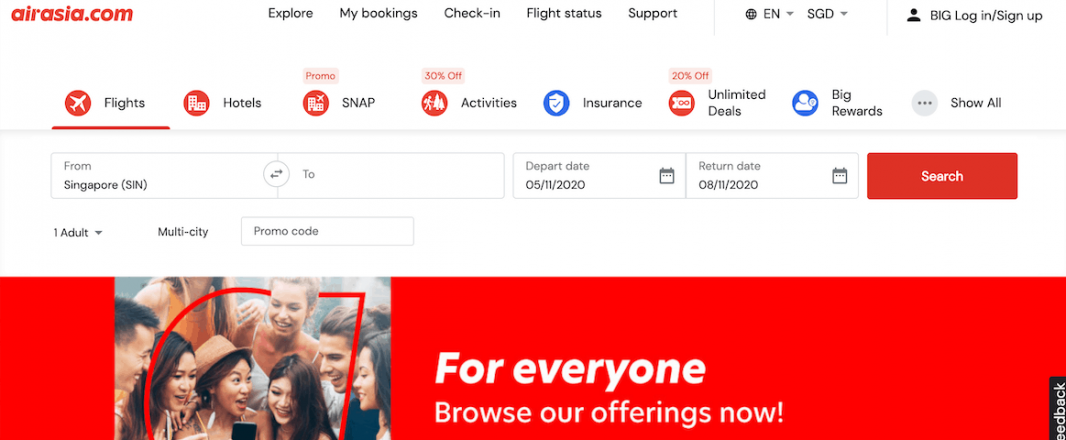
While you are buying an air ticket on AirAsia.com for your next holiday, hop one tab over for some groceries, and then to the next one to pick out a gift for your partner.
When COVID 19 closed all borders, it was an obvious move for AirAsia.com to pivot away from just selling flights and hotels to hawk other products and services to its 75 million plus online customers.
“There are a lot of the reasons why we are very confident in becoming a super app. We have actually been doing it for the past 19 years – we were one of the first carriers to start selling flights online. So in terms of the tech stack, it is actually pretty much there,” said Karen Chan, CEO of AirAsia.com, at the recent virtual Skift Asia Forum.
“As a result of COVID, we have just been accelerating the unification of multiple platforms into one, which is now AirAsia.com, so that we can actually go faster, not just selling flights alone, but also hotels and activities, which are still within the travel vertical, but also moving now into the e-commerce vertical and financial services,” said Chan.
AirAsia.com offers home delivery of duty free products even for non-travelling customers. A 90% sale on its duty free products emptied its shelves in five minutes on day one, she said.

Chan said AirAsia.com’s path to profitability was slightly quicker due to several existing conditions. First, Airasia.com had a huge customer base so its job was not to acquire consumers but to convert them. It also helped that its average revenue per user (ARPU) was high – customers were already accustomed to paying 300 to 600 ringgit for an air ticket, so adding 10 to 15 ringgit to your basket was not difficult.
“The barriers to entry are a lot lower than for a ride-hailing app to sell an air ticket,” said Chan.
Chan also attributed its early successes to being able to shape consumer behaviour through accurate value propositions. The fact that it was the “only OTA that has metal (aircraft)” meant it could control its price lever and that was how it competed with other larger OTAs in selling hotel rooms, said Chan.
She explained that knowing their yield curve on their flights 365 days out, enabled them to sell off distressed inventory on their flights at rock bottom prices. Now being able to bundle that with a hotel allowed them to offer a bundled value proposition with a best price guarantee to customers that no other OTA could. “That’s exactly what we have done and we’ve seen the success,” said Chan.
Using this formula, it held a snap sale of Langkawi hotels before Malaysia had imposed a second lockdown, and managed to sell some 2,000 room nights in four hours. “The hotel was blown away because they had never seen that sort of traffic and that sort of volume and conversion,” said Chan.
Another success factor Chan pointed out is using the right channel for today’s customer. Livestreaming, said Chan, has become the “biggest selling proposition”.
“It is basically a rebirth of TV shopping – ‘you better buy now because we only have five more of this particular product’,” said Chan.
Airasia.com held a livestreaming show recently across all its different products duty free – 40% of its revenue was driven in the 10 minutes that it was on the livestreaming channel.
“When the price is right, when you are actually matching how consumers are now shopping and matching where they are actually looking for deals, looking for products, it works,” said Chan.
Chan also talked about this being a season of collaboration, and not competition.
“So Tony [Fernandez] always says, ‘Karen, go and sleep with everybody. You need to be frenemies in many, many ways’. We have already announced a strategic partnership with Ctrip and we’ve also announced a strategic partnership with Agoda. We need to have a barbell strategy in terms of how we acquire inventory for hotels… I strongly believe in sharing inventory for scalability across ASEAN. There’s no way we can actually go and talk to every single hotel here,” said Chan.
Airasia’s airline business for the next 12 to 24 months will mostly be about cost containment and rationalisation, but the company still wants to be growth-focused, said Chan. AirAsia.com, she said, is “purely about growth” and it will actually likely be subsidising some of the losses it is incurring in the airline business.
“Let me reiterate: we are not spending US$500 million to get new customers; we already have 75 million customers in our base across the entire group. Now, what we are focused on is making sure they come back to our platform with high frequency. Even if the basket size might be a bit smaller than when purchasing an air ticket, we want to keep the stickiness to ensure that they will come back and understand that we have a lot more to offer,” said Chan of its current strategy.
What has she learnt about leading during a crisis?
“First, you have to survive on four hours of sleep a day. Second is that you need to be very transparent and that it is ok to be vulnerable. This is the time to lead with courage. Many organisations talk about learning fast and failing fast, but when you fail, you are out. One thing I admire about Tony is that with him, when you fail, he’ll say ‘you are an idiot – go and pick yourself up, and don’t make the mistake again’.
“It is really important as you begin pivoting, that the leadership team and the board is endorses it, and that has to be cascaded across the entire culture,” she added.