Business events have come a long way, and there’s a long way more to go
I RECALL once having to host a conference in Luang Prabang, the ancient capital of Laos, and when we arrived at the venue – which was a government’s meeting hall – we realised there was no projector screen in sight.
We were apparently the first industry conference to be held at the venue – this was circa early 2000 – and were pretty much left to our own devices to figure it out. So what we did was to borrow white bedsheets from the hotel we were staying at, and we spent a good couple of hours ironing the sheets, stretching them out and fitting them into some sort of frame so they could serve as a makeshift screen.
The event went very well – we did not burn a hole in the sheets – and the Laotian government was appreciative of our efforts to showcase their ancient capital as a meetings destination.
Twenty years on, I found myself at the Grand Sands Ballroom, the grandest and largest of the meeting spaces at Marina Bay Sands, where bedsheets have been replaced by giant drop-down LED panels – 504px (W) x 672px (H) – to “house” virtual speakers.
At first sight they look terrifying, but when deployed effectively and timed well they make a dramatic statement in bridging the physical and virtual world by allowing remote speakers to literally “hang out” next to their physical counterparts.

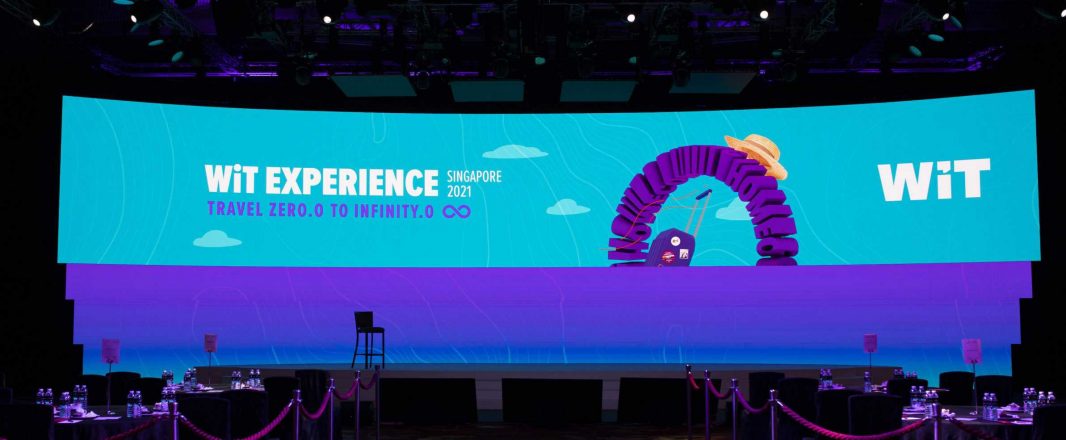
In addition to those giant panels, the ballroom is encircled with more screens than you can count on two hands. Okay, maybe I exaggerate the two hands bit but when you walk into that ballroom which, at 7,672sqm is South-east Asia’s largest ballroom, you do stop to take in the full effect– other than the super massive LED wall on the main stage, there are six other screens which organisers can “play” with.
In normal times that’s what organising events is like – venues are physical spaces for you, as event producers, designers and organisers, to play with and to fill with the content you create for the community you wish to bring together.
They are your canvas on which to paint and create your vision of the experience you want to create for your customers. They can be as rudimentary as in Luang Prabang or as sophisticated as in Marina Bay Sands – it’s what you do with them that matters.
In hybrid times your canvas has been expanded almost to infinity. The physical space now extends to the virtual and that world knows no limitations – other than bandwidth or budget of course.

Frightening and liberating – how to create a unified experience
It is both a frightening and liberating thought. The key is how you balance fear and freedom to create a unified experience for your customers.
And that was what we were up against when we organised WiT Experience Singapore 2021 on October 19-20 this year. To set context, the WiT Conference is a travel technology conference and has been held in Singapore every October since 2005 and in 2019, pre-pandemic, hosted close to 600 delegates at the smaller Heliconia Ballroom at Marina Bay Sands. Delegate attendance is about 70% international, 30% local.
In October 2020, the first year of the pandemic, we were the first pilot travel conference to hold a hybrid event of up to 50 local delegates at Marina Bay Sands’ HybridBroadcast Studio. We kept it fairly simple that year – seven hours of programming, with a blend of physical and virtual speakers, and linking the virtual and physical experience through the GEVME platform.
A year on we knew we had to dial it up; but we didn’t know if we would be allowed to get back into full physical mode. From July this year, we could see the rest of the world in US and Europe returning to full physical events and yet we in Asia remained stuck in the war against Covid, with almost every country facing restrictions on movements and gatherings, and cross-border travel.
So we kept our plans modest. We planned for a physical audience of no more than 250 – it seemed the right number to pluck out of the air, no international delegates would be able to attend and we would have to rely on local industry support – and a virtual footprint, which had become our default for the last 20 months.
Virtual, ya, we can do that in our sleep now, we felt – after all, to “train” ourselves for this summit climb we had organised six “travel roadshows”, a series of three-hour monthly virtual/hybrid events between March and August.
It’s interesting to note that in March 2020 we had to unlearn everything we knew about physical events, and learn everything about virtual, and now come October 2021 we had to relearn physical again but with a twist – how to run physical alongside virtual especially when we wanted to return to full programming mode, and not bite-sized made-for-virtual content. We wanted it to feel like a full conference experience, and not like a series of webinars.
Pre-pandemic, the WiT Conference was a three full day affair. We reduced it to two days – but still it was full on, two full days of programming – 18 hours of content, more than 70 speakers (half virtual, half physical) and more than 900 autocues for the production team.
That’s a lot of content for virtual, but we decided we needed to make the physical gathering count. After all it’d been 20 months since the travel industry in Asia Pacific had come together as one force; so much had happened that we needed to cover as much ground as we could; and for the physical delegates in Singapore, it’d be the first time they would be able to gather with industry friends since the pandemic struck.
We decided to theme the conference as “Homecoming” – a time for our community to come home to WiT and to Singapore, and for travel to come home. This was the video we put together as our clarion call.
The dopamine rush of organising events
Sometime in September we were given the green light that we would be placed under the Singapore Tourism Board pilot scheme – which meant we could go ahead and plan the physical component of the event.
We were given two new spaces to play with – the Sands Grand Ballroom, the biggest space for the smallest audience we’ve ever had, and Marina Bay Sands’ new Virtual Meeting Place, launched five days before our event opened.
Talk about last minute – I swear the events industry’s dopamine rush is not through social media but tight deadlines.
A week before the event, events director Gerry Pang and I sat in the huge, empty ballroom and started strategising and designing the event. How could we maximise the use of the massive LED wall and six giant screens to best bring out the look and feel of “Homecoming”? How could we make delegates feel at “home” despite the strict SMM (Safety Management Measures) in place that would restrict networking? How could we make the experience rise above the limitations of networking, which is one of the key reasons people attend physical events? Those lunch and coffee breaks, where the most networking happened, were not possible anymore – delegates had to be seated at tables and could not mingle without masks on.
We knew that we had to make the content sparkle more than usual. When one leg is taken away, you strengthen the other leg. So we threw everything we had into the content.
Hybrid meant we could reach as far and as wide as possible for speakers – CEOs who’d never have found the time to travel to Singapore for a 20-minute conversation were suddenly available to us. Just had to juggle time zones. In the end, we had speakers from close to 20 countries, including Nate Blecharzyk, co-founder of Airbnb, Peter Kern, CEO of Expedia Group and Greg O’Hara, founder and senior managing director, Certares.

Hybrid meant we could have live entertainment when it wasn’t allowed. We arranged for artistes from Phare, The Cambodia Circus to stage a 20-minute live virtual performance for our audience, as part of our annual WiT For Good initiative to raise funds for Phare Ponleu Selpak. That, and a rapid auction at the closing, helped raise more than US$50,000 for its Visual Applied and Living Scholarship programme.

We arranged for local band, The Souls of Singapore, to start us off with live music on the second day. The band’s song, “Lift Your Eyes”, had been the soundtrack to our Travel Roadshow and it felt right to have them welcome our community home with a live performance, streamed from the Marina Bay Sands’ HybridBroadcast Studio, just down the hall from the ballroom we were in. So near yet so far …

Lessons learnt from behind the scenes
Having the MBS’ new Virtual Meeting Place to play with also meant we could now create a unified experience. The new platform uses the Integrated Resorts’ iconic architecture as the visual interface and the 3D feel makes you feel like you’re actually at the venue. With four days to move in, our team and GEVME’s (our technology partner for the year) worked speedily to upload content and assets. The platform allows full customisation so it’s up to you to decide what you want to place where.

Two team members worked on the virtual platform, a first time for them. Said Koay Yi Ling, “The virtual platform had a content management system (CMS) which the team used to upload content to. As with every new tool, the learning curve for the team managing the content on the virtual platform was ever-present. We were fortunate to have a partner in GEVMR who was ready to jump in and help when the WiT team was at wit’s end, and to resolve technical issues that are part and parcel of the virtual ecosystem.”
Added Dewi Ishak, “I enjoyed working on the 3D virtual platform. Being a gamer myself – I play After Life – I feel very comfortable in the virtual world. It was a tough challenge though to balance virtual and physical. I think the key lesson I learnt is to be able to adapt quickly, challenge myself and not be too hard on myself because things were moving very quickly and needed to be done at fast pace.”
To balance physical and virtual we triggered polls on the Virtual Meeting Place, which both physical and virtual delegates could take part in. For questions we actively encouraged our audience to use a WhatsApp number, which worked wonders.
The idea behind the Virtual Meeting Place is interesting. For organisers holding their events physically at Marina Bay Sands, it means they can create a unified experience as we did so that physical and virtual audiences are “experiencing” a similar sense of place. The Virtual Meeting Place can also become a “forever” home for event organisers to house their content and have year-long engagement with their customers. Think of it as a digital, living library with a marketplace.
Veemal Gungadin, CEO of GEVME, said, “Offering a unified experience for both physical and virtual attendees is at the core of what hybrid events are about. Physical delegates want to see who’s attending live and vice versa. It’s the job of the event planner and the technology provider to enable a seamless experience for them to connect. The unification of experience also applies to the attendee engagement component. You want to get inputs from both the virtual and physical attendees when it comes to polls and Q&A so that everyone feels involved and to make the sessions more dynamic.”

On the key lesson his team learnt from working on the WiT conference, he said, “We realised that it is entirely possible to have speakers present physically, as well as speakers joining remotely on the same panel. It still feels very natural for the speakers and it remains highly engaging for the audience. This will have significant implications in terms of the diversity of voices that we’ll get to hear from for future events.
“However, we realised that it’s not an easy job to keep the online audience engaged. You really need to have dedicated resources and an entirely different approach than you would for a physical audience.”
Events director Gerry Pang cited two key takeaways. “It is an uphill task planning for something during a pandemic when everything is uncertain, and the situation is fluid and ever changing. Staying true to your vision of achieving that unified customer experience helps you break down the planning and execution processes, and ultimately getting to the finishing point.
“It takes a community to make this conference a success. Partnerships with like-minded associates are ever more crucial and valuable in these times.”
The key lesson I took from producing this full hybrid event? Agility, ingenuity and creativity have always mattered in the events world. That means being able to turn bedsheets into projector screens if you have to, or running hybrid if you want to.
This pandemic brought physical events to a standstill and it showed us that we cannot stand still in the face of changing technology, changing desires and changing generations. And if someone gives you the toys, sorry, tools to play with, heck, go for it.
• Related article: Speakers’ share their perspectives on what it’s like to appear physically vs virtually