China’s e-commerce sector continues to shine. According to the Ministry of Commerce People’s Republic of China, the trade volume of China’s e-commerce in the first half year reached 5.66 trillion yuan, up 30.1% year on year. Online retail market reached 1.1 trillion yuan, up 33.4% year on year, accounting for 8.4% of total retail sales of consumer goods of the first half year.
The online travel sector, around 15 years old, is being seen as the biggest opportunity. Min Fan, Vice Chairman and President of Ctrip during the company’s second quarter earnings call, said China has entered a golden era in travel.
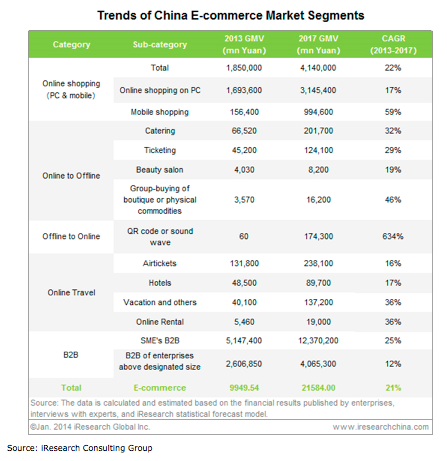
From 2013 to 2017, the compound growth rate of online travel revenue would be 21%, almost equal to the growth of the whole e-commerce market, according to iResearch. (see chart below)
Meta-search brand Qunar’s web user base grew from 110.2 million in 2011 to 234.2 million last year. Its base of mobile users increased from 4.3 million in 2011 to 53.8 million last year.
Investments are being made in travel e-commerce. Intermediaries are refining their offerings and expanding their reach. The giants are adjusting their sources of revenue generation and models are blurring.
“The structural change is that OTAs such as Ctrip are embracing open-platform strategies, and platforms like Qunar are becoming more like OTAs,” said Ming Zhao, founder and chief analyst, 86Research. “We are also seeing big OTAs trying to become one-stop travel service provider. They are investing in segments beyond hotel and air-ticketing. Also, a few small OTAs are focusing on vertical areas, e.g. Tongcheng.”
Ctrip is strengthening its transportation related offerings extending from air to train and bus. The company’s open platform monthly transaction value reached more than RMB100 million in June. As for strategic alliances, Ctrip signed an investment pact worth US$200 million with Tongcheng Network that operates LY.com, and also became a strategic investor in Beijing Mind Education. Ctrip also acquired $15 million of online leisure travel company Tuniu Class A ordinary shares through a private placement concurrent with Tuniu’s IPO. Plus Ctrip led a $60m round of financing announced by car booking service platform Yongche.com late last year.
Next frontier – Online to Offline
“We think that the next big frontier for travel e-commerce in China will be the “weekend DIY tour” and O2O (online to offline, encouraging the online customers to visit the physical store),” said Leo Wang, chief strategy officer, LY,com.
Wang pointed out that currently traditional travel agents are trying their best to get close to online and the OTAs are developing their offline market channel. “OTAs are paying more attention to the tourist attractions ticket, train tickets, coach tickets and weekend DIY tours, and have stepped up their expenditure and strengthened their staff to exploit the weekend DIY tour market,” he said.
As for LY.com, Wang said the company is a one stop travel service provider that caters to travellers’ recreational travel demands.
For Zhao, the next big frontier is outbound leisure travel. “We have seen a surge in this vertical, driven by companies like Tuniu (on organized tour), Shijiebang (self-assisted tour), etc.,” he said.
Start-ups such as Shijiebang are being supported by investors. Shijiebang, an outbound travel service platform, provides customized tourism services to Chinese outbound travelers. The company attracted nearly US$10 million during Series A in November last year.
Product development and investment mode
Intermediaries are currently looking at fulfilling travellers’ overall trip needs. This calls for sustained investment in product development. Most of the intermediaries are incurring expenditure on personnel cost and technology.
Ctrip’s product development expenses for the second quarter of 2014 increased by 55% to RMB479 million (US$77 million) from the same period last year and 9% from the previous quarter, primarily due to an increase in product development personnel related expenses.
Zhao said OTAs are investing aggressively in mobile (hiring engineers) and planning promotions on a regular basis. “Qunar increased 260 headcount in product development during 1Q14, a majority of them for mobile.”
Zhao said, “This kind of investment usually means adding more engineers, for example, engineers for mobile development. Ctrip’s expense on product development in 1Q14 increased RMB100 million compared to 4Q13, mainly due to increase of IT headcount. According to Qunar, they also have engineers working on IT to enhance the level of automation in the booking process.”
He said other than Ctrip.com, which is profitable, most OTAs are in investment mode at this stage. “We don’t expect them (other OTAs) to break even soon. The top priorities for OTAs are to adapt to changing user behaviour, gain market share and grow new initiatives, instead of generating profits.”
He added, “One change in the industry is that Ctrip has tried to invest in and collaborate with some rivals, which will result in less competition and this is good for the profitability of the industry.”
Ming Zhao, founder and chief analyst, 86Research and Any Wu, CEO of LY.com are scheduled to speak at the upcoming China Edge 2014 TravelDaily Conference, scheduled to take place in Shanghai (September 3-4, 2014).