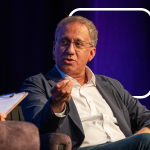
Duetto’s concept of “open pricing” is but the first step in a long journey towards helping hotels extend the trust they’ve already built with “customers who sleep in their beds ” to the booking process.

Bosworth: The customer is full of anxiety and so they search and search until they feel comfortable. This must change, he says.
Said Patrick Bosworth, CEO and co-founder of Duetto, “According to Google and Comscore, people shop 20 websites before they buy a travel product. People say this is because consumers love choice.
“I disagree. I believe the consumer is full of anxiety – they don’t know where to go to get the best deal, they don’t want to be the only one who paid too much. So they search and search until they feel comfortable.
“But if hotels could build trust with their guests who sleep in their beds and hold events in their hotels extend that trust to the booking process, and say, ‘we are always going to offer you peace of mind and that booking direct with us is always your best deal’, then we would have unlocked something real. ”
Unfortunately, he acknowledges that hotels are behind in this regard and it is Duetto’s vision to lead a movement to get hotels up to the point where they can compete with third party intermediaries and move the customer from indirect to direct.
With the recent acquisition of Orbitz by Expedia, effectively creating a duopoly in the US market, executing on this vision has gained more urgency. After the acquisition, Priceline and Expedia combined will control 80% to 90% of hotel bookings across OTAs in US and while this may be good for consumers, it may not be good for hoteliers.
Bosworth told Mashable in this article, “It is increasingly difficult for a hotel company to decide not to work with Priceline or Expedia. The consolidation creates efficiencies and pools even more resources in a small number of behemoths that can dominate marketing spend through online channels. And they have tremendous negotiating leverage with hoteliers.”
For Duetto’s vision to be realised though needs a cultural and philosophical shift in hotel thinking. “This is not just about revenue management or forecasting but a fundamental change in the way hotels approach sales and marketing.”
But as they say, the journey of a 1,000 miles begins with one step and Duetto’s “open pricing” concept promises to revolutionise revenue management by allowing hotels to take pricing beyond the traditional BAR approach and eventually enabling them to offer one-to-one pricing for loyal and valued customers.

Shangri-La Resort & Spa, Boracay: Hotels need to be able to compete in the booking and engagement process.
Credit: Shangri-La Hotels & Resorts
Duetto was started three years ago by Bosworth with co-founders Marco Benvenuti and Craig Weissman. Bosworth and Benvenuti came from hospitality; the latter was deeply involved in revenue management at Wynn Resorts and was Bosworth’s boss when the duo worked at the gaming company. Weissman was the CTO of salesforce.com.
“Many of the ideas we built into Duetto were developed initially at Wynn. We looked at the way casinos were marketing to their guests and saw a big opportunity to pull together the sales and marketing disciplines for revenue management. But we found it needed a philosophical change to achieve that and thought it impossible to do this within a large hotel organisation, so we decided to go out on our own,” said Bosworth.
“What drove our thinking was that hotel revenue management has not really changed much since the mid-1990s but during that time, distribution and online marketing have changed drastically and we believed a better approach was needed, that would allow hotels to be much more strategic in distribution and revenue management.
“We went after owners of hotel real estate to see if we were onto something or just crazy but the response was very strong and that encouraged us to start the business.”
That was when the third co-founder Weissman came into the picture and launched the software business. Today investors include names such as Barry Sternlicht of Starwood and Rich Barton, founder of Expedia. In total, it’s raised US$33.2 million since start-up. Armed with that war chest, it’s expanding into Asia and the Middle East and will officially launch its Singapore headquarters in mid-March when Bosworth will visit the city.
“We’ve put together an unusual grouping of leaders in their own respective industries to help us help hotels create value for guests in the booking process. We’re not just a revenue management company to help hotels build forecasts and make better pricing decisions – pricing is just one component in the engaging and booking process.
“What we have done today is develop a leading revenue strategy system that incorporates our policy of open pricing that depends less on availability but more on demand by price and keeping channels open so that we can offer a price to every customer by every type of room.”
To do this, it’s pulled in important new data sources – from search activity, airline ticket sales information, weather forecasts and social profiles. “The goal is to allow us to better understand the customer.”
The next important step is to integrate digital and loyalty marketing into the revenue process so that forecasting and pricing recommendations are dynamically embedded into the process.
To do this, it is building partnerships with new vendors in loyalty and digital marketing as well as app developers and booking engines. “We are taking a customer-centric approach through the CRS and booking system and with this new CRM, we will move closet and closer to a one-to-one pricing environment,” he said.
He acknowledges the obstacles it faces in getting hoteliers to understand the new approach. “Most of the resistance comes from people who have always played it safe and don’t want to be the first to try it, even though they believe in it.”
The wins it’s had has been with hotels which did not have revenue management systems or with groups who are open to try something new. How it intends to break through is to find champions and with its expansion to Asia and the Middle East, its teams in the field will have the job of convincing hoteliers to join the movement.
In Singapore, Patrick Andres, formerly of Sabre Hospitality Solutions, is leading the effort with a team of five and he told WIT that he was seeing good response from the market. “People are ready for change.”
Andres said he was fortunate that he didn’t come with “20 years of revenue management indoctrination” and thus was able to come at Duetto with an open mind. “As we grow in the region, the skepticism will disappear,” he said, noting that he had seen body language shift in prospects he was meeting from “initial fear to leaning forward to wanting to know more”.
He sees opportunities in markets in Asia, such as Singapore, where markets are strong but somehow results are not falling to the bottomline, as they struggle with rising costs of third party distribution.
Rate parity is also an obstacle but Bosworth said the key is to figure out how to operate within that system. “The opportunity is in yieldable package business and a booking engine that recognises that customer. It doesn’t have to be a formal loyalty programme – as long as you recognise that customer, you are not violating rate parity.
“Even on peak days, you still want to communicate with your loyal customers – they don’t have to go to other channels, you can offer a slight discount or a value proposition.
“The ability to be intimate with your customers, to contextualise what your hotel offers and let them know why you have such a special asset and offer a type of experience no one else can re-create – this is the area hotels can compete.”