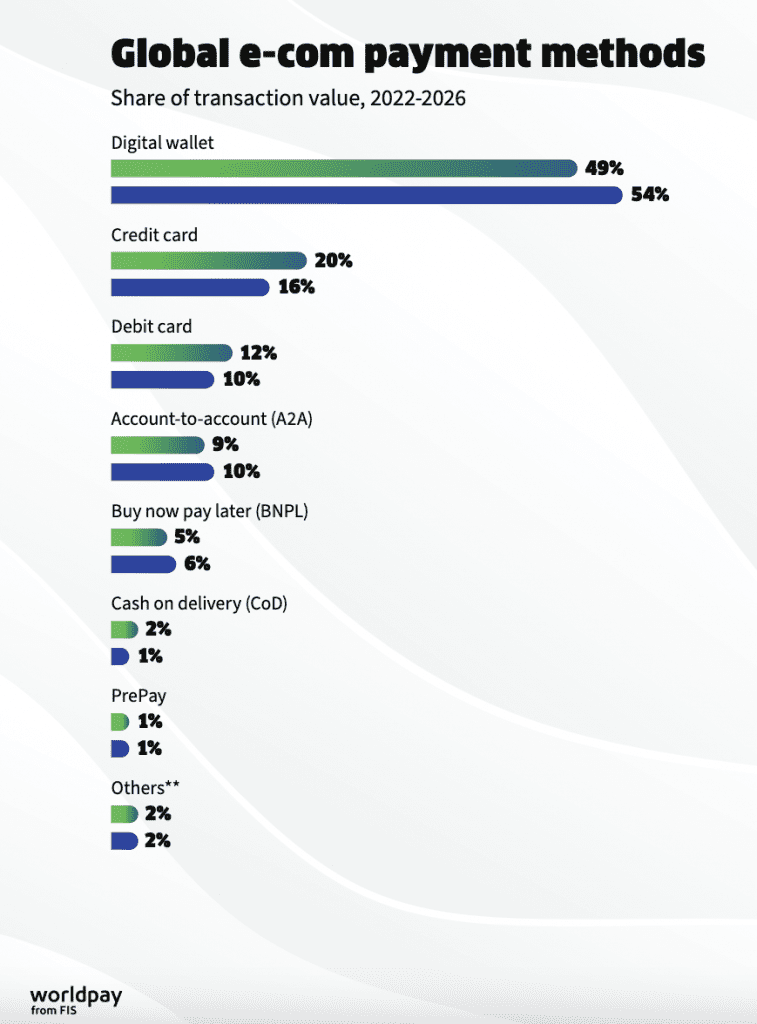
Digital wallets were the leading payment method globally, accounting for 49% of transaction value in e-commerce and 32% at the POS in 2022, and are projected to remain the leading payment method across e-commerce (54%) and POS (43%) in 2026, with fintechs, banks, neobanks, super apps, Big Tech and device manufacturers all competing as wallet providers.
This key trend was highlighted in the latest Worldpay from FIS Global Payments Report 2023 which examines how consumers pay today both in-store and online across 40 global markets.
The report noted that that wallets such as Alipay, PayPal and Apple Pay remain the leading payment method, accounting for ~$18 trillion in consumer spending. Wallets remain among the fastest growing payment methods with 15% CAGR at POS and 12% annual growth in e-com forecast through 2026
While APAC remains an outlier with the overwhelming majority of wallet share, digital wallets are now the leading e-com payment method in Europe (having taken the lead in 2021) and North America (where wallets passed credit cards for leading status in 2022).
In APAC, wallets represented 68.5% of regional e-commerce transaction value in 2021. That amount is now projected to expand to over 72% of transaction value by 2025. “While cards and digital wallets dominate e-commerce payments, a competitive mix of traditional and alternative payment methods make for a diverse regional landscape,” the report said.
Other global payment trends identified in the report include:
• Account-to-account payments soar
In 2022, account-to-account (A2A) payments continued to grow across the globe, with the expansion of real-time payment systems helping to provide faster, safer and more convenient payments for consumers at the checkout. In 2022, there were almost 70 real-time payment (RTP) schemes providing high-speed payment rails that helped drive A2A payments to account for US$525 billion in global e-commerce transaction value, up 13% from US$463 billion in 2021.
Consumer use of credit cards remains strong, while sources of credit are diversifying. Despite our forecast of modest share declines, global credit card transaction value continued to rise both in store and online. Credit card spend exceeded $13 trillion across all channels in 2022. Consumers are increasingly paying via credit card-funded digital wallets, BNPL and POS financing offered by banks, fintechs and merchants.
• King no more but still essential
No longer king, cash remains essential. The decline of cash continues with -6% CAGR projected through 2026, as consumers gravitate to the ease, convenience and safety of digital payments. Yet a “cashless society” isn’t on the immediate horizon. Cash continues to play an essential role in most economies, accounting for over $7.6 trillion in global consumer spending in 2022.
• BNPL enters the next phase of its evolution
Following years of unrestrained growth, buy now pay later (BNPL) is facing increasing headwinds. Regulatory scrutiny, interest rate pressure and intense competition are transforming the sector. Yet BNPL remains popular among consumers and represented 5% of 2022 global e-com spend. BNPL “2.0” is likely to see sustained growth amid market consolidation and mainstreamed regulation.
• Cryptocurrencies are emerging as a viable person-to-business
(P2B) payment option. Cryptocurrencies experienced extreme market volatility in 2022, which served as a headwind against greater acceptance as a P2B payment method. Yet “fringe” still meant over $11 billion in 2022 global transaction value. Consumers are eager to exchange crypto for goods and services, and intermediaries that convert crypto to fiat are making that possible.