Investments against the odds paying off for Hungary-based low-cost airline
Whether you are running an airline, a hotel or a tour operator, doing the right thing in business is now a must-have. “If we don’t do it, we are out of business,” said Jozsef Varadi, CEO of Wizz Air, as he accepted CAPA’s EMEA and Global Sustainable Airline of the Year award in Singapore earlier this month.
“Customers will decide who’s doing the right thing and if we don’t do it, they will leave us behind and make us irrelevant.”
Employees also want to work with companies who are doing the right thing, he said. Speaking at the 2022 CAPA Asia Aviation Summit in Singapore, Varadi said, “We are a young company with young employees who want to do the right thing. That this is recognised, it’s great.”
He also said that if all airlines in Europe adopted the same model as Wizz Air, the European airline industry would reduce emissions by 40% overnight. That means “aircraft choice, the way you operate the aircraft, cut business class which is inefficient use of emissions, how you transfer – hub and spoke is double burning emissions – it’s not an effective model”, said Varadi, whose airline operates a low cost, point-to-point model.
“We are a young company with young employees who want to do the right thing. That this is recognised, it’s great.” ~ Jozsef Varadi, CEO of Wizz Air
The CAPA Environmental Sustainability Awards for Excellence, independently researched by CAPA’s analysts and carbon reduction strategists, Envest Global, recognised Wizz Air for “its progress towards sustainability during the year, acting to reduce greenhouse gas emissions, and to bring itself in line with best industry practices in terms of people, operations and governance, along with its determination to pursue future development opportunities”.
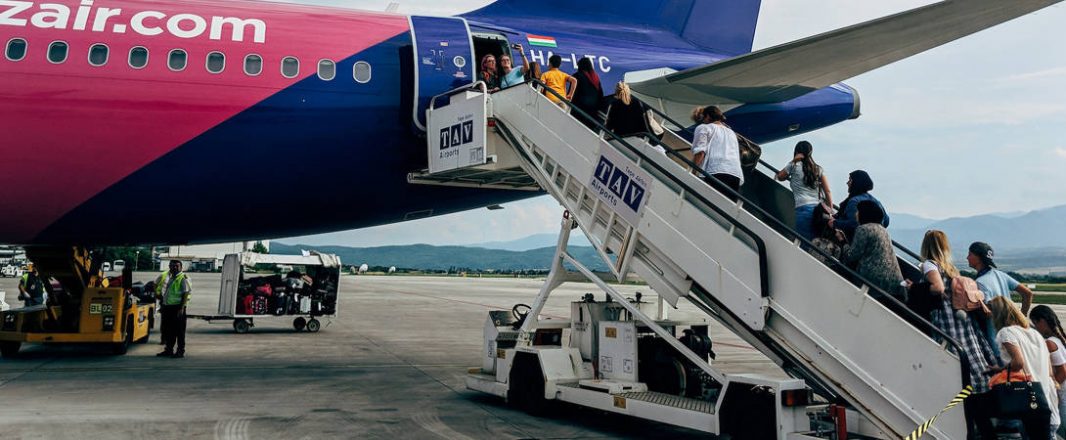
Wizz Air has one of Europe’s most modern fleets, with an average fleet age across its 170+ aircraft of just 4.6 years. The carrier has committed to purchasing more than 300 next generation narrowbodies, including the latest and highest capacity versions of the A321neo, which offers significant reductions in CO2 and nitrogen oxide emissions, along with having much-reduced noise profiles, said CAPA.
Varadi acknowledged the challenges facing airlines in their bid to meet sustainability targets. “It comes down to money, a significant amount of money, it comes down to investing in new aircraft, new technology and innovations. Money was sucked out by Covid and the Ukraine war and not many constituents have the necessary resources to make the investment.
“We were able to do so, and are now the single largest customer of Airbus, with 60 aircraft delivered after Covid, at a cost of $70 billion. There is no other way but to invest in sustainability and make the airline greener than before.”
Virada is a believer in “when everyone is pushing backward, we push forward.”
“Everyone thought we were stupid and crazy. Everyone thought we should have preserved cash, but you don’t know what you don’t know.”
He said Wizz Air is now 40% larger than pre-pandemic, with 180 aircraft compared with 119 going into the pandemic and is carrying 35% higher passenger numbers than pre-Covid – from 40m to 55m this year.
“We made significant investments against the odds, we went into new markets, we bought significant stock in Gatwick (airport), invested in Italy, Albania and set up a joint venture in Abu Dhabi. We are now benefitting from those investments. Our carbon footprint is lower than pre-pandemic. Our fleet age has come down and we have a more efficient operating model.”
One disadvantage, if you could call it that, he said is that while other airlines took state aid, it financed everything itself. “So, you can argue, we didn’t get the helping hand, we had to struggle ourselves but at the same time, we are free to move, free to invest while others got bogged down. It may have cost us more money but on the other hand, we have to consider the future of the company.
“The industry is becoming a commodity, where lowest cost counts. So, we got to be the lowest cost producer, delivering an airline seat lower than anyone else. That’s going back to basics. It’s easy to lose focus, because of Covid and sustainability, then you become a high-cost airline, then you become irrelevant.
“You must make sure you act on the market opportunity. With our Abu Dhabi joint venture, there is huge interest in getting the business model spread out in untapped territories and delivering that extra layer of growth.”
And to deliver that growth, it needs people. “We have 7,000 employees now and by end of the decade, we plan on 20,000 people. We have to become attractive to a new generation of people who have a different view in life. We (our generation) love aviation because of the smell of kerosene, but this new generation, they care about diversity, environment – we need to excite the consumer and our people.”
On Wizz Air’s expansion plans, he said, “We fly from Canary Islands, Spain, up to Maldives in Asia. It’s a huge extended geography and we want to connect the dots within that.”
Its joint venture in Abu Dhabi gives it “an exciting opportunity to extend to Asia”. With its new XLR aircraft, that means it can fly between 7 and 7.5 hours compared with the current 5 to 5.5 hours. “We are excited, but we should not change model. We are point to point. We are good at flying short to medium haul, point to point, we are not good at flying longhaul – we’ve not had a lot of success and that’s not our ambition.”
Its goal is to reduce carbon emissions by 25% by 2030. Currently, it is operating at 57gm per carbon dioxide per seat, and its goal is to get that number to 43gm. The European industry average is 95, “which means we have 85% lower emissions than the average European airlines.”
In his opinion, there are three stages to sustainability from an airline’s perspective. “How do you apply available technology now? At one point in the future, we can decarbonise flying completely but the debate now is electric versus hydrogen. Electric is good for small aircraft but not the solution for larger aircraft, so it needs to be around hydrogen – I don’t know when that will be delivered. Once that happens, we can think about how we can access the technology.”
For now, the bridge is Sustainable Aviation Fuel (SAF). “There are questions around it – economics, availability, the whole financing model, the longer you look at the issue, the bigger the challenge. So we try to get the best out of what we have now. We have feed stock competing with food.
“Food sustainability may become more important, so we don’t want to be in a situation where food competes with fuel.”
He said Wizz Air was supporting between three and five initiatives focused on SAF. It has invested 1.5b Euros in this sector. “We try to put money where it makes sense, have the industry develop the right type of technology, to get supply. It’s all quite intangible right now, economics, availability – and now there are bigger issues than SAF.
‘Maybe this is the opportunity to disrupt the industry. The route we have chosen is to work with established players and prop up newcomers.”
Wizz Air conducted its first ‘green’ demonstration flight in 2022, operating an A321neo partially with sustainable aviation fuel (uplifting 4.5 tonnes of 30:70 blend of sustainable aviation fuel) on a service from Bucharest to Lyon, delivering a 13% reduction in emissions. “That’s not going to solve all the problems,” said Varadi.
Another challenge is how to access SAF when it’s available. “There’s a difference between developed and developing markets. Maybe it might be easier in South Europe, not so in Eastern Europe, the same in Asia.”
Thus, his inclination is to bet on hydrogen. “If that is figured out, that should solve the entire problem,” although he added, “by the time it becomes industrialised and replenished, it may be 2040-2060 and I am not sure how many of us will be around. Between now and then, the industry has to come up with something.”