
If global strategist and author Parag Khanna had his way, there’d be 250 million people who would travel with a global passport, and the world would have its first identification not tied to a nationality.
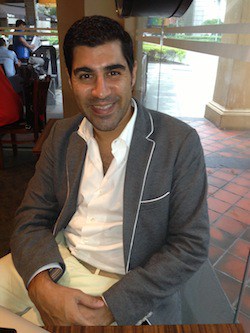
Parag Khanna
In fact, that was the idea he submitted to the US$1 million TED Prize 2013 and it ended up as a finalist, losing out to Sugata Mitra’s School In The Cloud wish to create a learning lab in India.
Explained Khanna, who will be speaking at the WIT 2103 Conference this October, “My idea was for people who are so-called global citizens – who do not live where they were born – to carry a global passport that does not tie them to any nationality.
“There are now more expatriates than ever in human history – one out of 20 people – and a lot are permanent expatriates – and I believe that in my lifetime it will be possible for us to qualify for a document with the right biometric information. The technology is there, it’s the political will that’s needed.”
Khanna obviously based the idea on himself. Born in India, moved to Dubai, studied in Europe, lived in New York and London, and now Singapore, and travelled everywhere – for his book on “The Second World: How Emerging Powers Are Redefining Global Competition in the 21st Century”, he travelled to 50 countries over three years – Khanna calls himself a global citizen.
“If you travel a lot, you have a chameleon identity. You do think of yourself as a global citizen,” he said.
“Dubai for example has the highest foreign-born population of any place – there are many permanent expatriates and it’s not a national place anymore but a global melting pot.”
Singapore, where he lives now, too has a quarter of its population who are not born on its soil.
Khanna, who calls himself a traveller before any other labels such as “global strategist” or “author”, sees travel as an end in itself. For his work, travel is his methodology – it is the process by which he carries out research for his books. Since “Second World”, he’s written “How To Run The World: Charting a Course to the Next Renaissance” and with his wife Ayesha, co-wrote, “Hybrid Reality: Thriving in the Emerging Human-Technology Civilisation.”
Personally, travel has become a habit. “For me, travel is a way of life, it is the experience, I don’t differentiate between journey and destination. I never get bored getting on planes, I still love the flying.”
His move to Singapore from London a year ago was “so obvious”.
“Many people living here take it for granted but even coming from New York or London, there is no contest in terms of quality of life. It is far superior here than anywhere else.
“If we compare our lives with two children between New York and Singapore, it is like the difference between Tokyo and Lagos. Singapore is about Asia, it is the capital of Asia, the governance is good, and we don’t want to deal with incompetent governments, traffic jams, mobile phone breakdowns…”
Beyond quality of life, Khanna also wanted to be at the centre of the new world which he believes is shaping global competition.
“We are Asian, I am Indian and Ayesha’s Pakistani. We know what Asian values are and there is a huge difference in the way one looks at the world. I cannot pretend professionally to really know Asia (even though I am of Asian extraction) ‘because I am the guy in New York or London who knows it better than anyone else‘.
“I don’t have much respect for experts on Asia who live outside Asia.”
In the past year, he’s travelled extensively across Asia and he sees a “hybrid reality” emerging. “Every new city that’s being built in the entire world is between Dubai and Shanghai. It’s fascinating exploring the future of infrastructure in our lives and seeing it being built in front of your very eyes – Tianjin Eco-City, Guangzhou Technology City.”
So back to the global passport idea – does he think the idea is elitist and that only the privileged need apply?
“I think poor people need it more than rich people. If you are rich, you can buy a passport. Only 40 million of the 250 million are rich, the rest are Indians, Filipinos and other nationalities working in countries outside their home.”
He said he is determined to pursue the idea of the global passport. The challenge is not the issue of travel data but customs and border checkpoints. “That’s what needs to be solved.”
Khanna, who will addressing the WIT Conference’s theme, “The Asia Factor” on October 22, said that, to him, “Asia Factor” means many things.
“Most fundamentally, it’s the geopolitical fact of Asia achieving parity with the West in importance. It’s also that Asian capital is rapidly being exported around the world: an estimated $2 trillion in outbound FDI from now until 2020. Then it’s the fact that for most multinationals in the West, selling in Asia makes the difference between success and bankruptcy.”
• Book your early bird rate for the WIT Conference here
• Programme here