Well, the dragons are out in full force as the Chinese community all over the world prepare for their Lunar New Year, the year that will welcome in the Wood Dragon on February 10.
In Singapore, in one week, I saw all shapes and colours of dragons – from the Crystal Dragon that swooped into the Marina Bay Sands’ Lunar New Year celebrations to the neon-lit twin dragons that sailed by boat onto the beach at Sentosa Island and last night, at Suntec Convention Centre, a glowing, shining, weaving dragon which floated over our heads as we ooh-ed and ahh-ed at the pomp and ceremony.
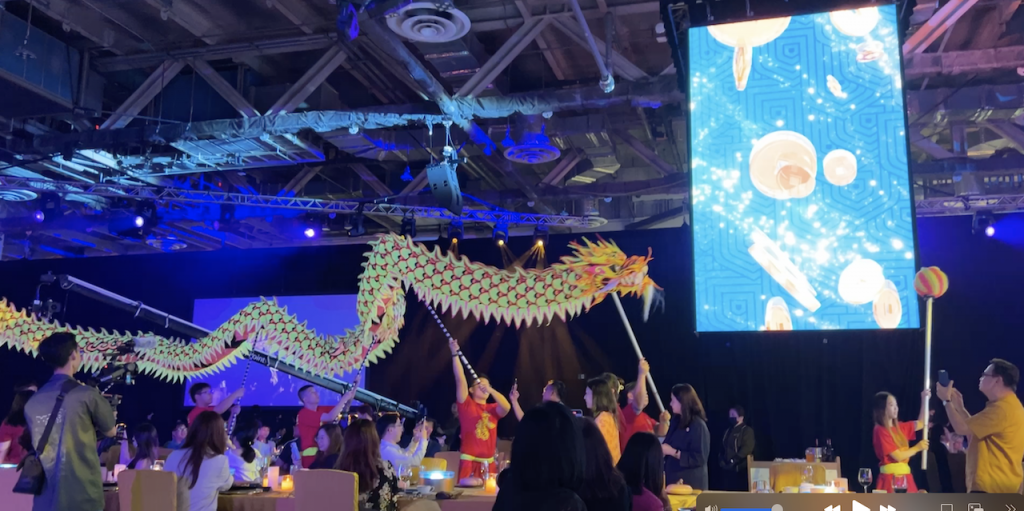
The Crystal Dragon at Marina Bay Sands.

The sailing dragons on Sentosa island at the Lunar New Year party hosted by Sentosa Development Corporation
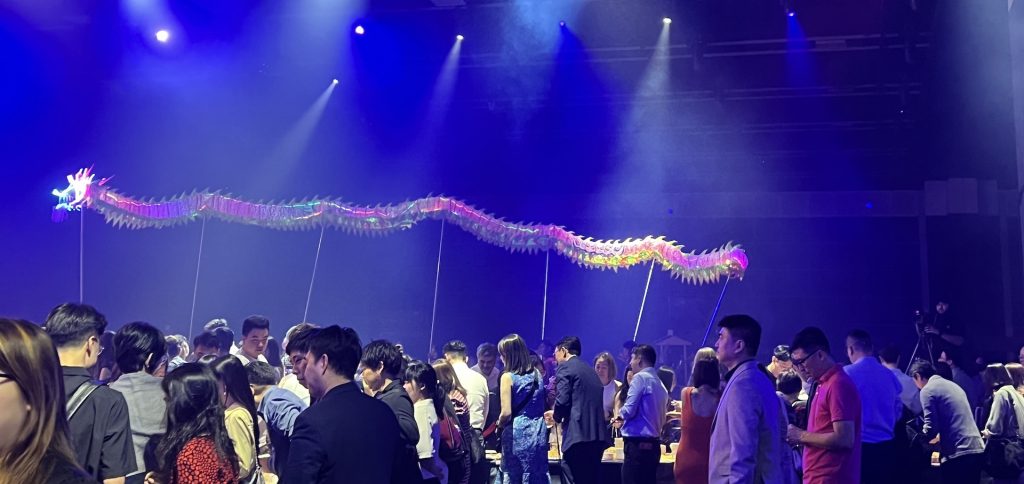
The floating, glowing dragon at Suntec Convention Centre.
Yes, the local travel industry’s going all out to celebrate what was a pretty robust 2023 and never mind, what lies in store, the important thing is to mark the here and now.
Considered the most auspicious of the 12 animals in the Chinese zodiac – it is after all the only mythical creature, the rest being the more humble pig, rat and so forth – the Dragon is the sign when most people want to get married and have babies.
Everyone wants a Dragon baby, after all. I should know. In my immediate family, Dragons easily outnumber the rest – I am not sure what it’s done to the family fortunes but at least, we are still together in one happy horde.
Thus, it is with these hopes of auspiciousness, abundance and excitement that we in Asia Pacific’s travel industry welcome the Year of the Wood Dragon – some are calling it Year Two of Recovery, and it will be the first year that will hopefully mark the return of the full engagement of China with the world, both inbound and outbound.
Let’s face it, the Chinese outbound engine largely sputtered last year and did not deliver as many had anticipated and hoped, and inbound was almost a non-story with so much uncertainty and barriers to entry.
It’s a different story this year. But before we get to that, it’s worth casting back in time to 60 years ago, when the last Wood Dragon swooped in.
Curious about what had happened in 1964, I asked ChatGPT to summarise the key events that happened in the world, in Asia and in travel, specifically.
- The Beatles in America – the start of the “British Invasion” in the music industry in the US.
- Gulf of Tonkin incident – sparking the start of the war in Vietnam.
- China’s first Nuclear Test
- Muhammad Ali beats Sonny Liston
- Nelson Mandela’s imprisonment
- Kenya’s independence
Specifically in travel:
- The Tokyo Summer Olympics – that year, Japan stepped up tourism promotion.
- The introduction of the Boeing 727 – a gamechanger for short to medium haul routes
- Opening of Walt Disney’s “It’s a Small World” Ride at the 1964 New York World’s Fair
So what can we expect in this coming Wood Dragon year? Well, I am no fortune teller, neither is ChatGPT – so that’s one job AI won’t be replacing anytime soon.
But it says, “The Dragon is associated with characteristics such as strength, energy, creativity, and passion. Wood represents growth, flexibility, and expansion. Therefore, the Year of the Wood Dragon is often seen as a time of innovation, progress, and positive change. It can be a time for taking risks and pursuing new opportunities.”
So what are the new opportunities to pursue in Asia in the new year?
- China inbound – the Chinese government is going all-in on inbound. Visa waivers in recent months for countries such as Malaysia, Thailand and Singapore will make it easier for travellers from South-east Asia to visit. It’s certainly been a hurdle for me, holding a Malaysian passport, and travellers, post-2020, are less tolerant of such restrictions. So this year, I will return to China for sure.
- China outbound – yes, everyone’s been keeping their eye on that for years but its return will be interesting, and different. There’s a slowing economy and unemployment is high so those who can afford to travel really want to, and will have very high expectations, especially on the tech front. The levels of tech innovation and customer adoption in China are insane – they’ve had two to three years of living and playing within their own bubble – so engagement has to be digital-first.
- India is the new China – Professor Scott Galloway acknowledged that in his year-end “Pivot” podcast and says he’s planning his first trip there to explore the possibilities. The country has put a spacecraft on the moon and it has aircraft orders upwards of 1,000. “Imagine the impact of that,” said Gaurav Bhatnagar, CEO of TBO.com. “This is inflexion point and it will be massive. A large working population with large purchasing power, and a Gen Z generation that thinks differently in how they travel but they are not decision makers yet. It’s a huge, exciting opportunity for outbound travel.”
- Generational shifts across Asia – Michael Dykes, vice president, market management, Asia Pacific of Expedia Group, is a firm believer in demographics setting longterm trends. Gen Z already forms 25% of the population in Asia and with Millennials, that adds up to 50% – “it’s a huge population of people with potentially a very different set of values and a very different childhood, driving a lot of differences in the way that they will purchase and how they will make brand decisions”.
These are just some of the broad strokes – within each are lots of nuances that baby Dragons would have to burrow deep to discover.
As for taking risks, well, the Wood Dragon, being the most flexible of dragons, will find plenty of things to experiment around – the first of which is AI, being called out as a generational shift in technology.
Bill Gates, in his notes for the new year, said, “The early years of a new age are often marked by lots of changes. If you are old enough to remember, think back to the beginning of the internet. At first, you probably didn’t know many people who were using it. But it became more common over time until, one day, you realized most people had email addresses, bought things online, and used search engines to answer their questions.
“We are just at the beginning of this transition right now. This is an exciting and confusing time, and if you haven’t figured out how to make the best use of AI yet, you are not alone. I thought I would use AI tools for the foundation’s strategy reviews this year, which require reading hundreds of pages of briefing materials that an AI could accurately summarize for me. But old habits are hard to break, and I ended up preparing for them the same way I always do.
“If I had to make a prediction, in high-income countries like the United States, I would guess that we are 18–24 months away from significant levels of AI use by the general population. In African countries, I expect to see a comparable level of use in three years or so. That’s still a gap, but it’s much shorter than the lag times we’ve seen with other innovations.”
I am curious about his comment on Africa given WiT is holding our first event on the continent next March, and while he didn’t mention Asia, I’d stick my skinny neck out here and say there will be countries in Asia that will leapfrog in AI innovation and adoption, the way they did social and mobile.
For starters, the Singapore government has put its weight behind an approximately $50m initiative to develop South-east Asia’s first large language model ecosystem catering to the region’s diverse culture and languages. And let’s not discount countries South Korea and China that will be making their own moves.
Meanwhile, when Singapore unveiled its Lunar New Year Dragon decorations in Chinatown, it lit up social media immediately, with many saying the illuminated creature looked less Dragon, more like Shrek or Japanese comedian Pikotaro. You decide.
Told you, it’s going to be an exciting year ahead. Happy Lunar New Year to all our Chinese friends.
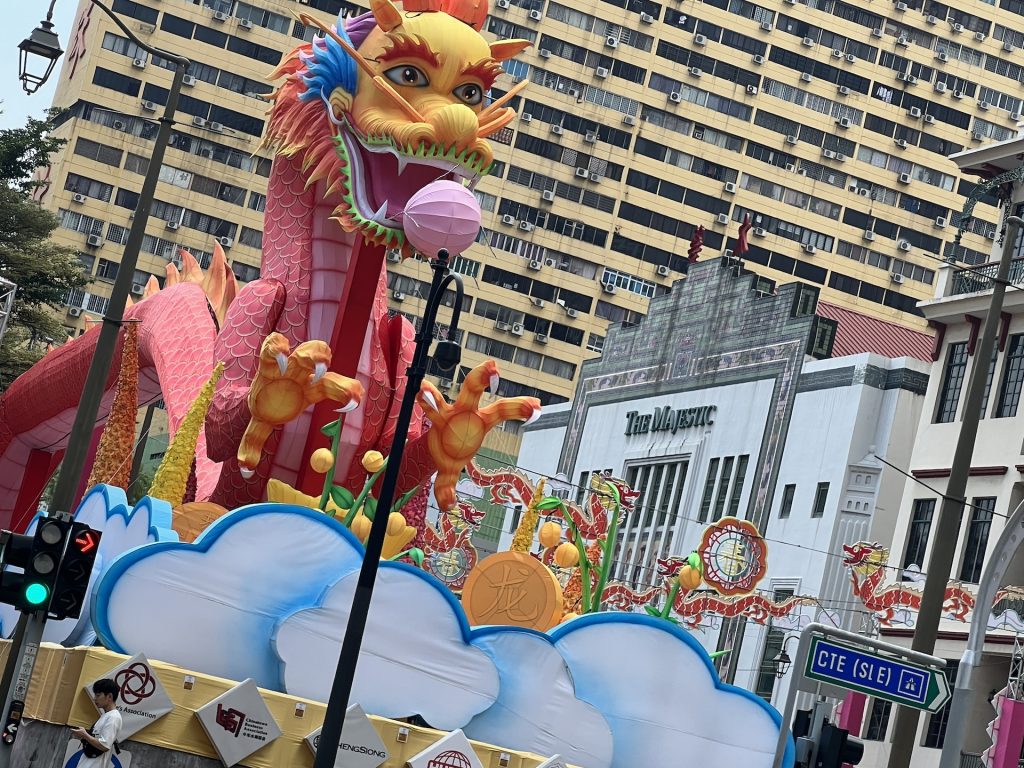
The Dragon at Singapore’s Chinatown – Shrek or Pikotaro?