I don’t know much about farming or gardening. The closest I came to either was listening to my father talk about his time hiding amongst the sweet potatoes during the Japanese invasion of then-Malaya and oh yes, just to name drop, when Prince Charles (soon to be King) took me on a tour of his gardens at Highgrove.
Incidentally, yesterday, when I was in Ipoh yesterday on a road trip from Kuala Lumpur to Penang via Bentong (Pahang) – one does these detours because one can – I “met” the Prince-soon-to-be-King again at the town’s oldest Hainanese restaurant, opened by a Hainanese immigrant in 1906.
A picture of a very young Charles was hanging in the colonial-themed restaurant, which has since been given a new lease of life by local architect Seow Wee Liam, who has quite rightly kept faithful to the restaurant’s heritage. He’s renamed it Durbar at FMS (Federated Malay States, being its old name), and kept its colonial-local feel and flavours.
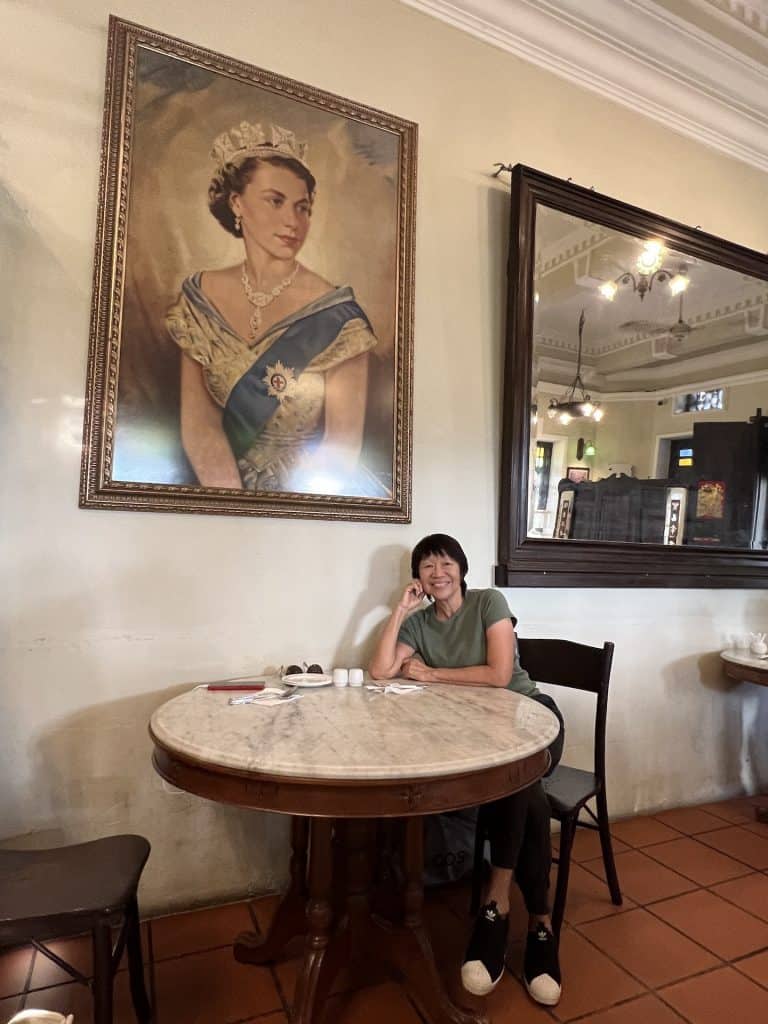
Dining in royal company at colonial-local restaurant in Ipoh, Durbar at FMS (Federated Malay States).
A huge portrait of a young Queen Elizabeth hangs on the walls of the charming restaurant and her eyes look kindly on those who dine on the scrumptious food that ranges from good old fish and chips to Hainanese fare like Hainanese chicken chop and local noodles.
Anyway, I am detouring but that’s what usually happens when I am talking about food – but it’s all connected, as you will decipher as you read on.
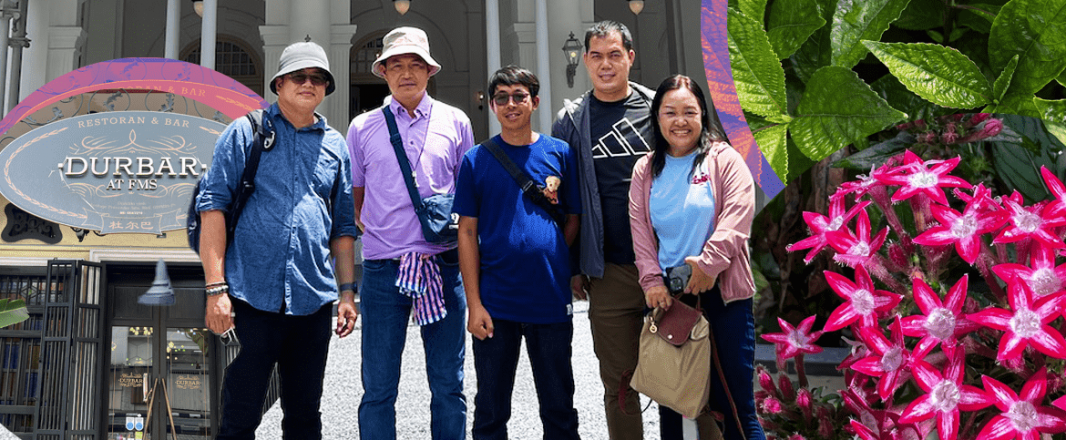
This week, I had the privilege of hosting four gardeners and farmers from Thailand – they work at Suan Sampran, a family-run eco-cultural destination located on a 50 acre plot by the Ta Chine river, Nakhon Pathom province. These gardeners have been working with the family for decades – for three of them, it was their first job and the youngest among them has been there seven years, and I don’t think he’s going anywhere soon from the camaraderie I felt among them.
The most senior, Kop, joined the family as an agricultural studies graduate and today is the right hand of Arrut Navaraj, the founder of the Thailand Organic Consumers Association (TOCA) and its Organic Tourism movement, in which I was told now has more than 1,000 farmers on its platform “with still a long, long way to go,” said Navaraj.
Spending as much time as I do with my head in the clouds (technologically speaking, not metaphorically), it was refreshing to spend time with folks who work with their hands and grow real things that nourish our body. They just seem to be so grounded in the simple pleasures of life, and so contented with their lot, and yet so open to new ideas and experiences.
They were on a study-cum-leisure trip to visit Singapore’s gardens and farms and as one said to me, with a twinkle in his eye, “to have Tiger beer and chilli crabs”. Two among them were first-timers to Singapore and therefore took in everything with big eyes and big appetites.
I was curious what gardeners or farmers from Thailand could possibly learn from tiny Singapore with its land and resource limitations. Thailand is a huge agricultural economy – according to Wikipedia, agricultural production as a whole accounts for an estimated 9-10.5 percent of Thai GDP and 40% of the population work in agriculture-related jobs – while Singapore has a plan in place to meet 30% of its own food needs by 2030.
Speaking through Amazon’s Say Hi app and aided by a human translator to get it to 100% accuracy, I managed to glean some of their learnings from their visits to two places I helped arrange – Edible Garden City, the people behind the food gardens at Marina Bay Sands, Raffles City Rooftop and PARKROYAL COLLECTION Marina Bay, and the Aquaponics Farm at the Fairmont.
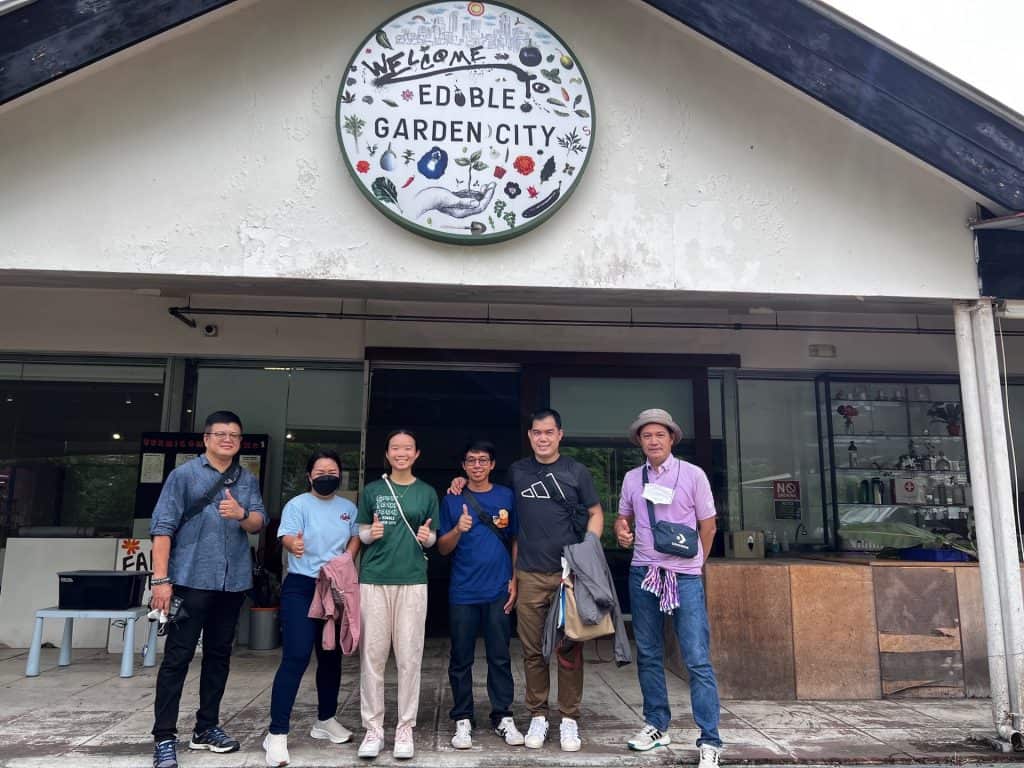
The Thai group at Edible Garden City where they learnt about curating experiences.
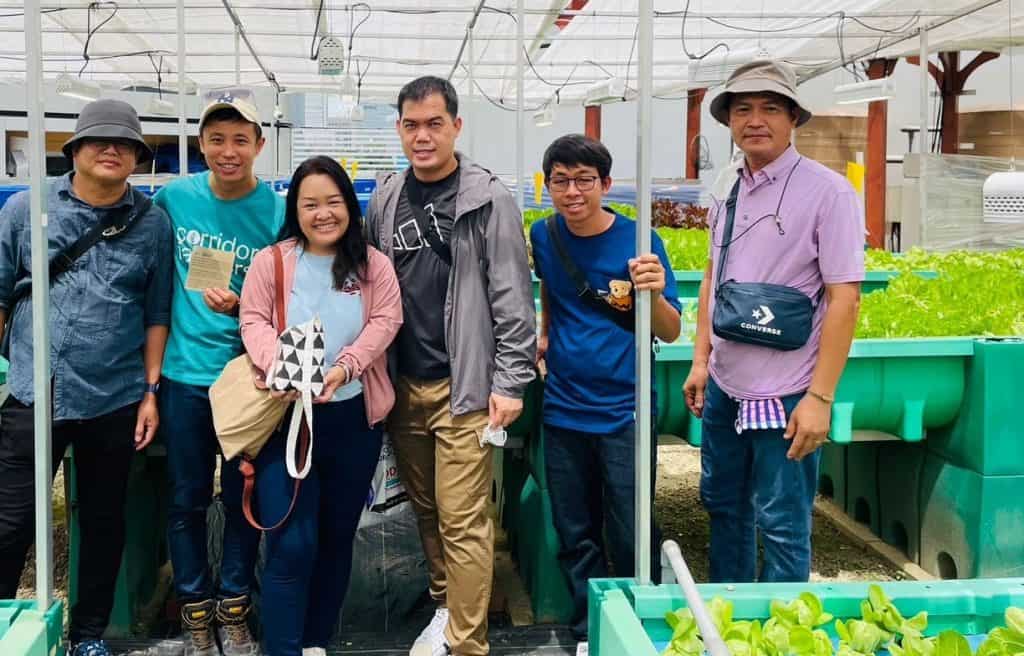
The Thai group at Fairmont’s Aquaponics Farm: “Very tidy” management techniques.
Overall, they are impressed by Singapore’s efficiency in urban landscaping – “I love the big trees at Fort Canning”, said the newbie. “They really know how to make use of trees in urban places,” said another.
They are impressed by Singapore’s “management techniques” which Kop described as “very tidy”.
“What I learned was to manage the farm,” said Kop (through Say Hi). “This is a relatively limited area, a very poor environment, so management, technology and scientific knowledge is very necessary.”
He is most taken by the idea of vertical gardening and farming.
From the tour at Edible Garden City, they learnt about how to create experiences around gardens. “It was interesting that everything grown there could be eaten and it became such an enjoyable experience, to not only learn about the plants and trees, but then to taste them as well,” said Angkana Jimanont, who accompanied the group. “This is very useful to us at Suan Sampran because we also create a lot of
experiences around our gardens.”
Her words stayed with me on my road trip the following day which took me to Bentong, a small town in Pahang state, where I’d been told to visit the Bentong Farm.
First, we got lost and turned up at the Bentong Happy Farm and trust me, there was nothing – human or animal – that looked happy about it. Described as a farm stay, it was deserted and the chalets looked empty and desolate. We spotted a woman cleaner and when we asked about the animals, she said, “Not here,” and pointed us to another hilltop.
Eventually, we found the Bentong Farm, described as a petting zoo and farm and garden. It’s a do-it-yourself tour, buy a ticket, and walk around the place, look at animals (pet them if you want) and then walk through the orchard where the trees and plants are named for your guidance. There are meant to be rangers to enlighten you at different stops but the one we met was so nervous of the giant blue cockatoo we felt it was best to leave him and the bird alone.
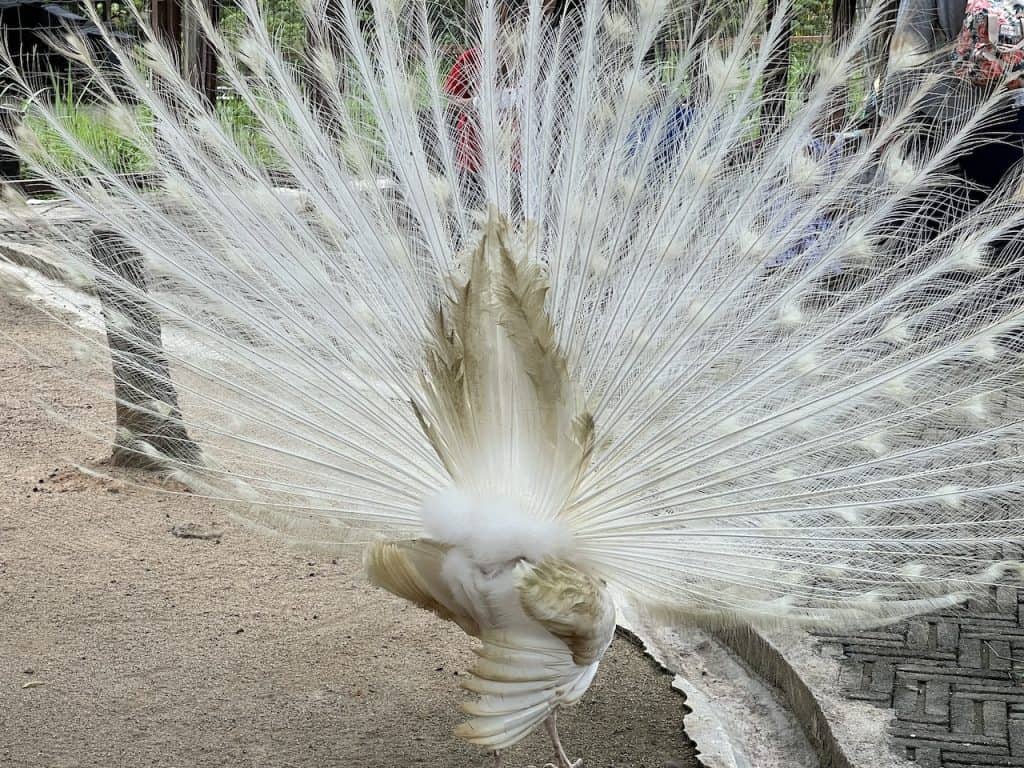
Peacock sighting at Bentong Farm.
The highlight were the peacocks, particularly the white ones, which put on quite a display for us but honestly, I’d rather see them free than confined to this space.
It highlighted to me the contrast between a curated and a non-curated experience. In one, you learn and leave enriched and inspired, as my newly-made Thai friends were after their visit to Singapore, and in the other, you leave, disappointed.
Anyway, all’s well that ends well because when we ended up at Darbur at FMS, we learnt that when it comes to food experiences, local is best – cooked by locals with local ingredients, never mind if the influence or learning comes from colonial, Thailand or Singapore. Local adaptation and interpretation of different cultures makes the global world of travel go round.