There we were at WiT Japan & North Asia speaking of the disruption taking place in travel and the day after we wrap up our two-day event comes the news that LINE, Japan’s main messaging app, is getting into travel.
The news release said that LINE Travel “would be a comprehensive travel service enabling users to search for, compare, and book domestic and overseas trips”, offering first a one-stop service to search for the best deals from more than 250 popular travel sites including JTB. Features to be launched in phases include accommodation reservations, followed by flights and domestic/international package tours later this year.
LINE introduced “LINE Shopping” last year and travel is the latest vertical to fall under this umbrella. It also has LINE Delima for food delivery. LINE has set a FY2019 target of Y100b gross transaction volume for LINE Travel, similar to its target for LINE Shopping.
In the last year, there’s been a massive shift to messaging and messaging apps now account for six of the world’s top 10 apps. At the Facebook Hotel Summit Asia Pacific held in Singapore earlier this month, Nikhilesh Ponde, head of global travel strategy for Facebook, said there were now 8b messages a month between people and businesses, up from 2b just 12 months ago. And that 43% prefer mobile messaging to interact with companies.
LINE coming into travel was just a question of when, not if, and industry players in South Korea are also waiting for the day when Kakao will also enter travel. Between LINE, WeChat and Kakao, there are said to be 1.3b active users. Whatsapp is piloting payments in India, said Ponde, when he spoke of the emerging trend of “conversational commerce” taking place in markets like Thailand with small businesses migrating to messaging platforms.
Beyond messaging becoming the new distribution, here are the key takeaways from WIT Japan & North Asia.
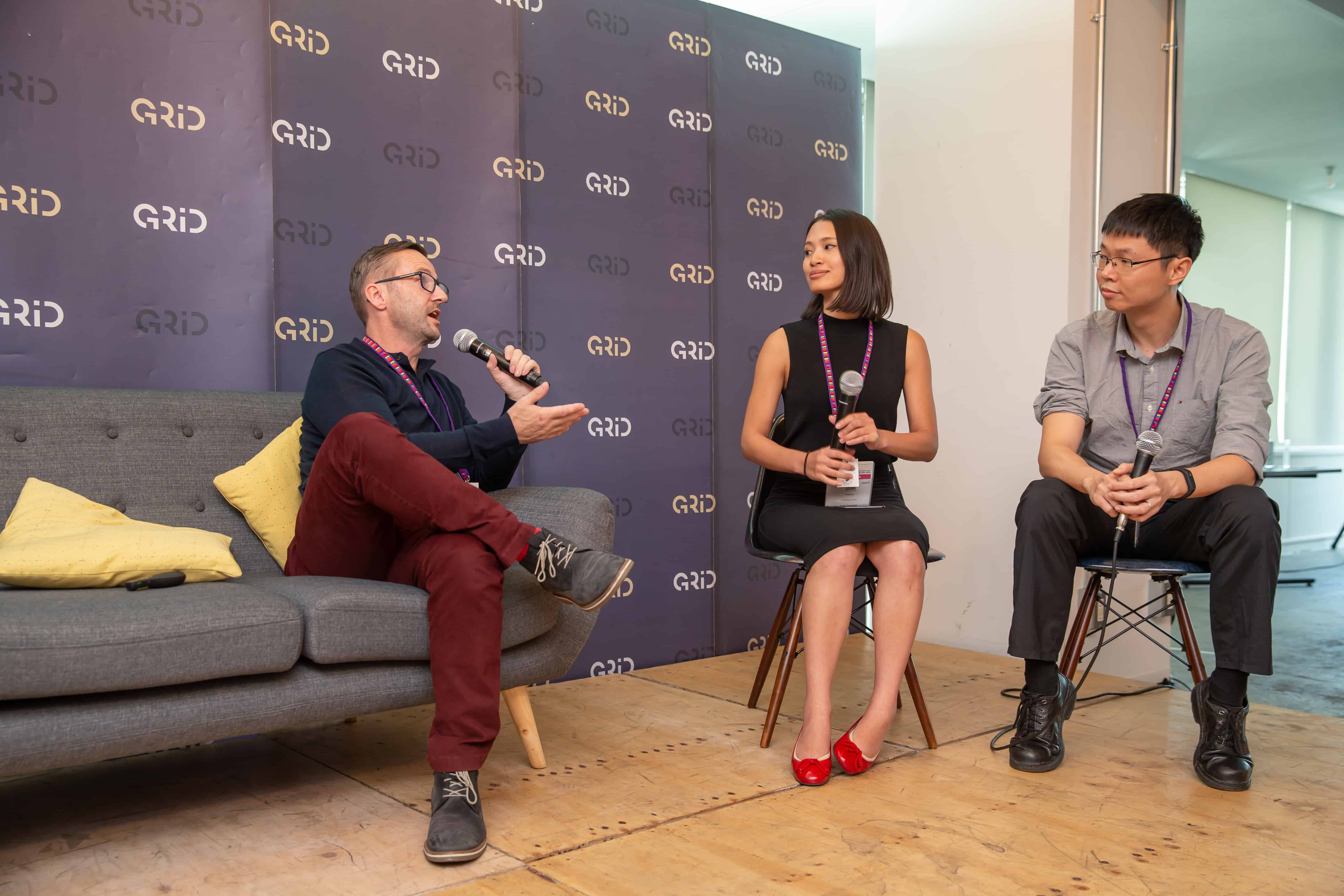
Bobby Healy, CarTrawler, asking Akemi Tsunagawa, Bespoke and Zhu Lei, iGOLA, about their use of chatbot and AI in their businesses.
- Two forces converge – big gets bigger but it’s never been cheaper to build a startup
While investors spoke of the trend of the consolidation of funding and money chasing the big, there’s never been a better and cheaper time to do a startup, tech-wise.
Bobby Healy, CTO, CarTrawler said machine learning and natural language processing technologies were being sold off-the-shelf. “Before it may have cost $7m to do a machine learning startup, now it costs nothing. It’s the perfect point of time with startups and investments pouring into the space.”
His advice was to focus on B2B businesses and in chatbots and machine learning. Citing the example of Arthur, CarTrawler’s chatbot, he said Arthur now handles 40% of the company’s 45m emails a year. He has reduced average email handling time from 210 to 114 seconds, which means removing one third of costs. And Arthur is always rated No 1 agent by customers.
“Any fool can build Arthur, we built it in three months. Two years ago, we wouldn’t have been able to do this,” he said.
- Videos and stories are the new big thing
The mantra “video is the new text”, uttered by Ram Badrinathan, formerly of Phocuswright at a WiT almost a decade ago, is finally coming true. CISCO predicts that video will account for 78% of all mobile data traffic by 2021 but we don’t have to wait till then to see how our own social feeds are reflecting that.
Instagram TV’s been launched and Instagram Stories, in which content disappears after 24 hours, are taking over our feeds. Omi Suzuki, head of e-commerce and travel vertical for Facebook Japan, said 8m videos are processed everyday on Instagram. This Facebook-owned platform is clearly enjoying a boom outside the US – of its 500m daily actives, 80% are beyond the US – and it’s attracting travellers. According to Suzuki, 54% of travellers say they have used Instagram in the past month and they view videos 2.2 times more than other US Instagramers, watch videos in their entirety 2x more, have 1.6x more sessions and spend 1.3x the time per week on Instagram.
The challenge with videos is if you’re a site focused on transaction, they can slow down your download speeds – and these days, if your site takes more than 2 seconds to load, you lose that user.
So how do you balance inspiration with transaction?
- For Japan, inbound’s the gold; for South Korea, outbound’s where it’s at
It’s interesting to contrast the two markets. Japan’s outbound is stagnating while its inbound is booming, close to 29m visitors last year. That inbound rush is benefitting global brands like Expedia and TripAdvisor which are all enjoying double-digit growth in Japan.
Expedia Group’s Michael Dykes cited the figures of 30-50% when speaking about the growth the OTA was enjoying in Japan and interestingly, its growth is not only in inbound where it’s naturally stronger but in outbound as well as domestic.
By contrast, Japanese travel brands such as Recruit, JTB and Rakuten are recording lesser growth because of their lack of brand awareness in offshore markets as well as their already high penetration in their home markets. The three brands are clearly intent on expanding outside Japan.
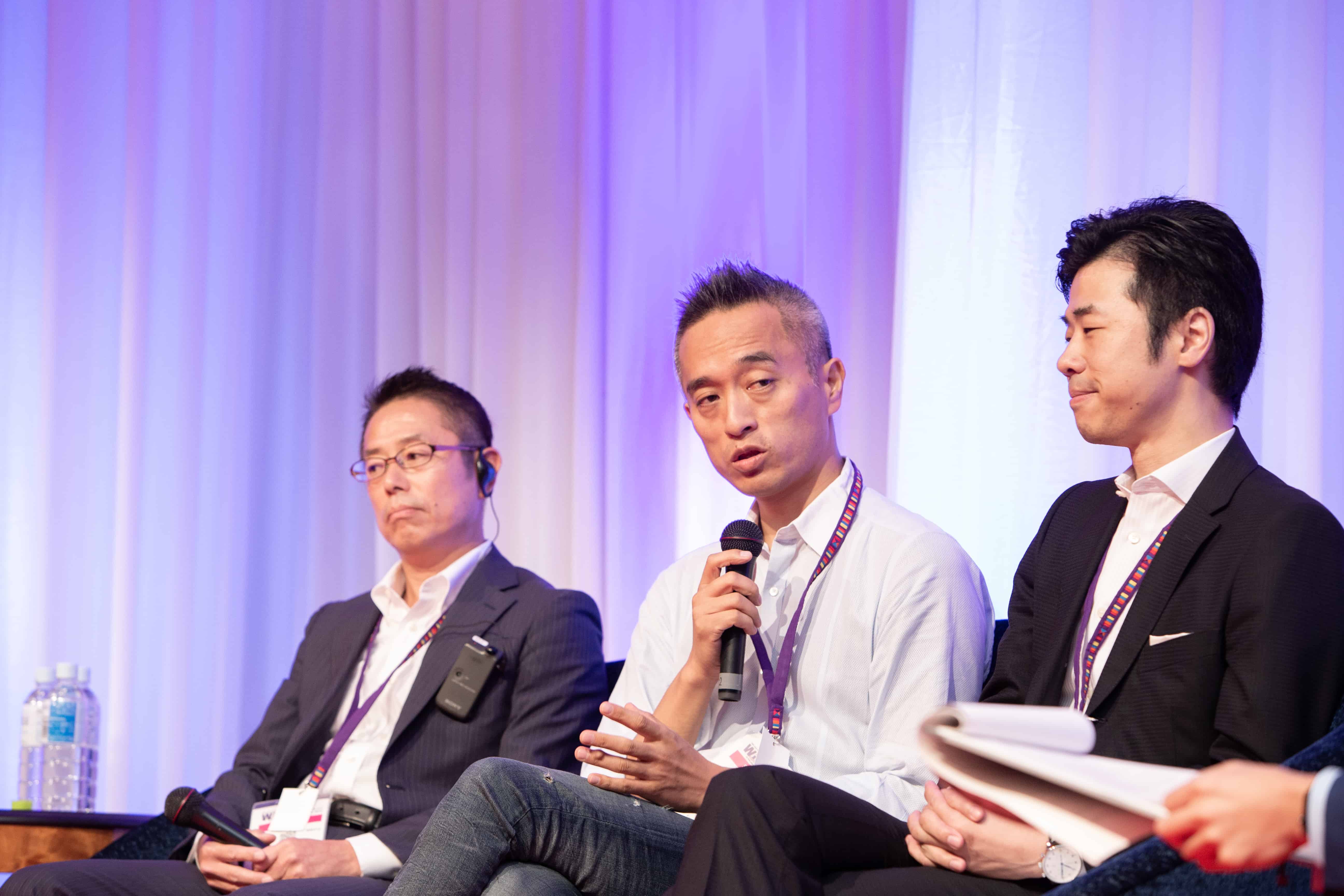
From left, Kenichiro Miyamoto, Recruit Lifestyle, Ken Mishima, JTB and Yoshiyuki Takano, Rakuten – looking for growth in a saturated market and fighting for a slice of the inbound pie
Travelport’s survey on “Simplifying Japan’s Outbound Trends” highlighted that amid a stagnating trend, it was female and the +55 travellers who were more likely to take shorthaul trips and spend more, a fact proven by airlines such as Peach which have made female travellers the cornerstone of their strategy.
Airlines are certainly benefitting from the inbound rush – Japan Airlines’ Takafumi Maruyama said the airline had seen a 250% increase in the sale of its Air Pass. Jetstar Japan, which will have 28 aircraft by 2019 and has flown 25m pax in the six years of its operations, has introduced self-service kiosks and is seeing encouraging adoption, said Kensaku Nagayama, head of marketing, Jetstar Group. On its domestic network, Nagayama said almost 80% of sales was coming direct through its digital channels.
South Korea’s outbound meanwhile grew by 22% to top almost 25 million last year (half of its population) with almost a third (7.1m) travelling to Japan, a 40% increase. Fuelled by low cost airline activity, it’s a number that’s set to grow further with six more low cost airlines pending approval.
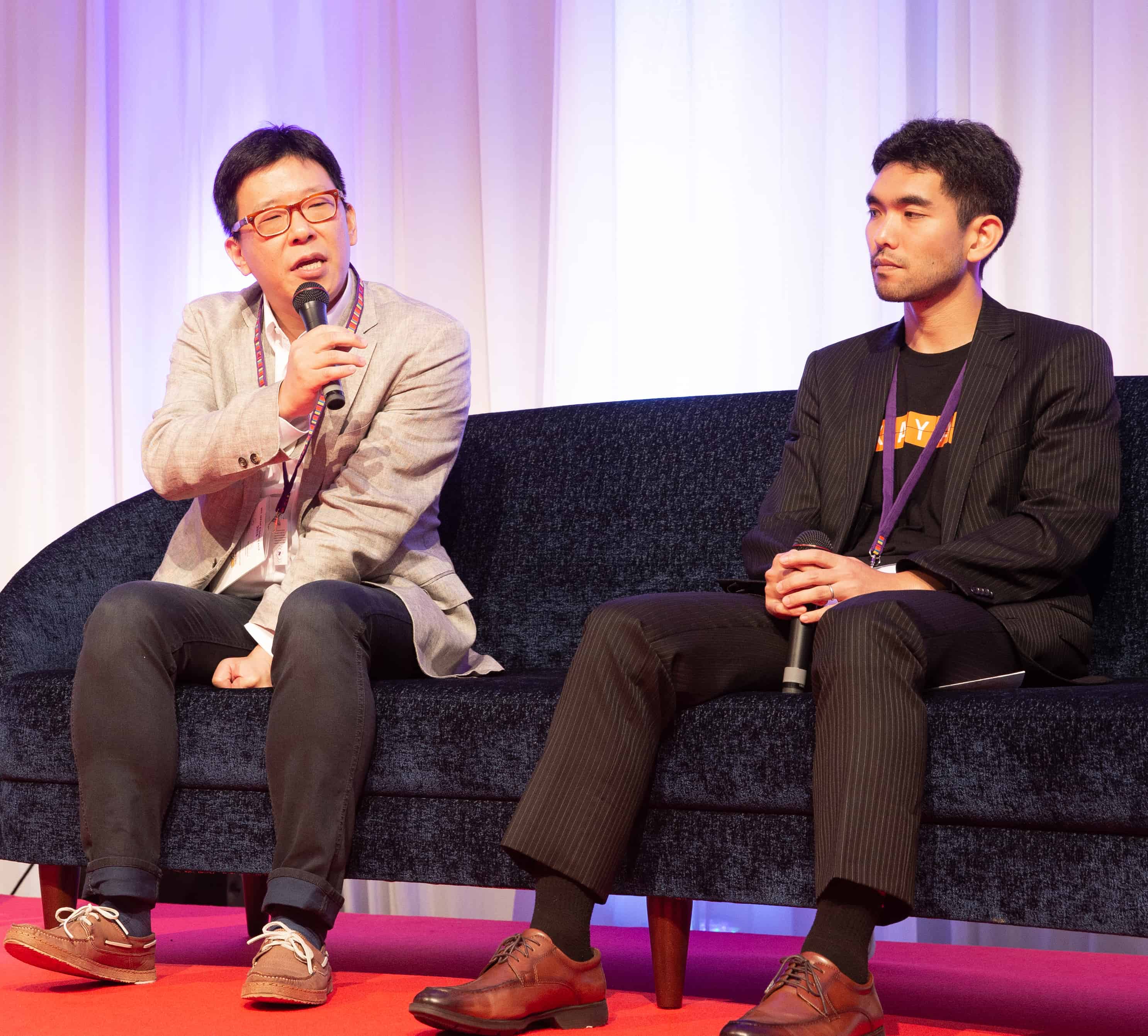
Ryan Lee, Dunamu (left) and Masahiro Yamashita, KAYAK on opportunities in the South Korean market
This has created new opportunities for meta-searches like KAYAK whose head of Northeast Asia, Masahiro Yamashita, said in this market with a 92% smartphone penetration, even among the elderly, consumers were going digital and travel brands had to keep up.
In a flight-led market such as this, Ryan Lee, chief investment officer of Dunamu Inc, a South Korea-based $100m fund focused on blockchain startups said flight OTAs had the advantage since they caught customers at the top of the funnel and had the window and time to sell them other travel products.
4. It’s still new but blockchain could counter fraud and build trust and how about digital humans who can debate?
Given the strength of the Korean outbound market, Dunamu’s Lee also said that if he were doing a startup, he’d build it around tours & activities targeted at the Korean traveller and blockchain had the potential to address this fragmented market, where 80% of bookings remain offline in APAC.
“In situations where suppliers are paying a lot to the middlemen and where there’s an issue of trust because of the fragmented supply, blockchain could work to address these two issues,” said the South Korean e-commerce expert, who used to work at Tmon Travel.
Acknowledging the scepticism around blockchain currently, Lee said, “It’s hard to see it now just as we couldn’t see the future of the Internet 20 years ago but we are clearly invested in it.” His fund has already deployed $19m into blockchain startups in South Korea as well as outside the country.
In his presentation, Masaya Higuchi of IBM Japan talked about how crypto anchors and blockchain could unite against counterfeiters and fight fraud in food and medicine supply. IBM and Walmart are building a fully transparent food system which would be able to pinpoint the source of produce. It is also introducing blockchain to verify the jewellery supply chain, tracing it to its real origin, from manufacturer to retail.
In the area of AI, It is partnering with MIT on a 10-year, $240m investment to create the MIT-IBM Watson AI Lab. And it’s making progress in its moves to create the “digital human” – for example, Sophie, the robot created for Air New Zealand and a “digital debator” who can actually inject humour into her arguments.

Kotaro Chiba’s vision of Tokyo, drone city of the future
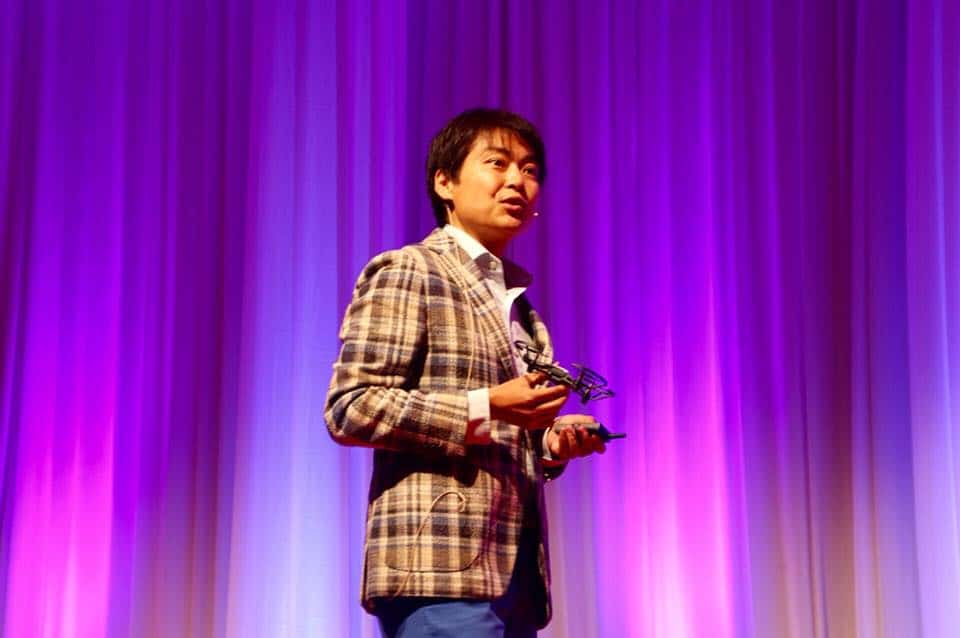
Kotaro Chiba: Wants Japan to take the lead in drone technology
One new tech that Kotaro Chiba has ambitions in is drone technology and his ambition is to see Japan take the lead in this sector. He knows the odds are stacked against Japan of course.
At the event, he flew a drone, priced at US$100, that was made in China by a company that already controls 70% of the drone market. But Chiba, founder of the $16m Drone Fund, is not deterred. He’s invested in 19 drone startups as well as an array of travel startups including RELUX and Trippiece.
He imagines drone tourism where travellers can stream live video images to friends and family back home and drone mobility where hover bikes and hover taxis move us around in the space between land and sky. “That’s the new Internet,” he said.
- Private accommodation – could regulations spoil the party?
The new regulations, which came into effect around “minpaku” accommodation, may have created short term pain for companies in the home sharing space with Airbnb hit the most but the general consensus seems to be that it’s good for the longterm.
Shinichi Tatebayashi, CEO and co-founder of SQUEEZE, which provides tech solutions to home owners, said about 30% of his business was affected but he remains bullish about the future. For him, the interesting question to ask is, what will happen to the 8m empty homes in Japan? Will these homes be put onto the private accommodation market to ease the supply crunch given the strong inbound market and the government’s push to hit 40m visitors by 2020?
However Takaya Shinozuka, CEO & co-founder of RELUX, said he was concerned regulations may be too tough and could be a setback for the sector. One reason he says that the restaurant scene in Japan is so diverse and interesting is that it has minimal regulations.
The new regulations are currently confusing and on top of the national policies, local governments also have the right to introduce their own rules – for example, in Kyoto, in residential areas, only 60 days during January and February are allowed and in Sapporo city, only weekend is allowed in residential areas.
The other interesting factor is that while 15% of foreign travellers use “minpaku”, only 0.3% of Japanese travellers use them and when panelists were asked to predict the domestic share in five years’ time, most pegged it at under 10%. Clearly there’s the gold to be mined with the Japanese domestic market pegged at 641m travellers back in 2016 (Japan Tourism Agency). What’s needed is exposure and familiarity, said the players in this sector, with Aya Aso, CEO of Savvy Collective, observing, “It’s still a new thing for Japanese to stay in other people’s homes.”
However, Tom Nagata, managing officer for home business, Airbnb said the company was seeing an uptake among Japanese in their 20s.
- In protecting disappearing Japan, it will need to look outwards
One common theme was also the disappearance of old Japan. Tabica, a startup which pitched at our competition, said 14,375 villages were in danger of disappearing by 2050 and founder Tessei Hosokawa, a monk, wanted to find a way to help preserve vanishing lifestyles and these villages. Its business matches local villagers who create experiences around their lifestyle, crafts and skills. “Old people full of skills, passions and talents are living alone and forgotten in villages around Japan,” said his pitch.
Founded in 2015, it now has 4,.200 hosts, 27,000 customers and employs more than 20 full-time staff. It’s clearly a hard-to-scale model which was why it did not make it into the semi-finals but one thing I’ve learnt about Japan is that it’s full of individuals like Hosokawa who are passionate about delivering a better Japanese experience to foreign travellers, as well as preserving local heritage and traditions.

Katsumi Sakakura (left) and Yu Aoki passionate about sharing their Japan with travellers.
Yu Aoki, co-founder of Japan travel magazine Matcha, who pitched his startup in 2014, has managed to grow his content business to reach two million users and now covers 10 languages. Yuki Naruse of On My Trip works and lives on a bus, offering multilingual audio guides to foreigners. And it’s not only local Japanese who are passionate about sharing their Japan. A New Zealander who’s lived in Japan for 20 years, Greg Lane of Tokyo Cheapo targets travellers who are not only budget-conscious but fearful of venturing out of their comfort zone.
And there are some things Lane will not write about and promote, like animal cafes. “Tourists don’t know they are part of the problem because without them, there wouldn’t be these cafes,” he said as he told me of owls being imported from South-east Asia.
Katsumi Sakakura, a performer who opened our event last year and closed it this year, is keen to show foreigners his idea of “Cool Japan” through his company Orientarhythm, and speaks of a village where you can meet the last Samurai and how he wants to create experiences around such disappearing traditions.
When Adam Brownstein, managing director, North Asia for Booking.com, who moved to Tokyo from Singapore, was asked what was the biggest difference between the two countries, he said, “Singapore looks outwards, Japan looks inwards.”
When asked which aspect of the Japanese environment needed to be changed to favour startups, Masashi Takahashi, CEO and co-founder of Japanese tours & activities site, Voyagin, said, “A global mindset among investors. It is hard to raise funds here if you have a global idea.”

Masako Wakamiya: “Technology gave me wings.”
Since the first WIT Japan in 2012, we’ve seen a growing interest among Japanese companies in looking outwards. Tomohisa Yamano, founder & CEO of Asoview, spent seven days learning English well enough to take part in his panel to tell us about his startup, which has raised US$14m, and focuses on selling Japanese tours & activities to locals and visitors.
And let’s not forget 83-year-old Masako Wakamiya, the world’s oldest iOS developer who after she quit banking, learnt to code, developed an app for seniors, got invited to Apple’s Worldwide Developers Conference, met Tim Cook and the rest is history. “Technology gave me wings,” she said. She now spends her time travelling – her dream destinations for next year are Estonia and Latvia – and speaking at conferences and inspiring audiences with her spark, smarts and smiles.
So message of the day – look outwards or wither within and fly like Masako.