
Striking a balance between finance and sustainability, and commerce
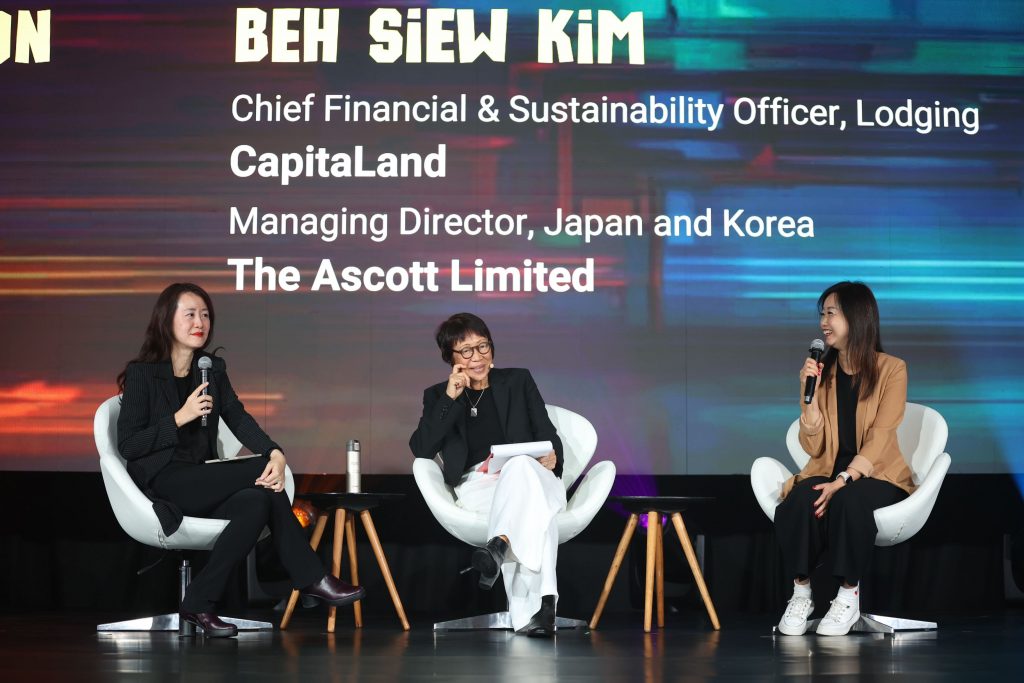
Right, Beh Siew Kim, Chief Financial & Sustainability Officer, Lodging, CapitaLand and Tan Bee Leng, Chief Commercial Officer, two sisters doing the balancing act between innovation and return on investments in tech and marketing.
In the Eurythmics’ song “Sisters Are Doing It For Themselves”, Annie Lennox croons, “Standin’ on their own two feet, And ringin’ on their own bells, we say, Sisters are doin’ it for themselves”.
Well, at Ascott, the hospitality subsidiary of Singapore’s real estate conglomerate, CapitaLand, two sisters are doing it for themselves in the area of finance, sustainability and commercial, and the duo – Beh Siew Kim, Chief Financial & Sustainability Officer, Lodging, CapitaLand and Tan Bee Leng, Chief Commercial Officer – spoke of the balance they bring between innovation and return on investments in tech and marketing, to deliver benefits to the owners of hotels they manage.
Celebrating its 40th anniversary this year, the group has grown from a single property on Singapore’s Scotts Road to over 900 properties in more than 200 cities globally. This has taken a transformative mindset – shifting from a real estate-focused business model to a service-led powerhouse, harnessing technology, sustainability and a unique guest experience.
Today, 90% of total units are under management and franchise contracts. And it has set a goal of achieving more than S$500 million in fee earnings by 2028 – from $331m in 2023.
Said Beh, “We started from a real estate play, but today, our focus is on the guest experience. We wear the lens of an owner, so we know how to own the assets, but we now wear the lens of a manager, focusing on maximising returns for the owners. It’s not just about fees; it’s about returns from the owner’s perspective.”
She said that by blending operational excellence with asset management, Ascott has been able to focus on delivering high-quality service while expanding rapidly.
“What makes this journey so unique is our dual role as both owner and operator,” Beh added. “It gives us a much better perspective, one that aligns us with our owners’ goals and allows us to deliver more than just numbers.”
To deliver on the numbers, Ascott’s marketing team is structured with its own P&L, a rare approach that emphasises accountability and results. “We operate with full financial responsibility, from CapEx to depreciation,” explained Tan. “It’s challenging but rewarding because it makes us think differently about every dollar we spend.”
The use of measurable digital marketing has further strengthened this accountability. “Technology has made conversations with finance a lot easier,” said Tan, who sees the value of technology in tracking ROI.
“Digital marketing is so much more measurable, which means we can show exactly how our efforts are contributing to the company’s bottom line.”

Tan Bee Leng: “It’s not just about loyalty; it’s about building relationships.”
Balancing Act Between Direct Customer Loyalty and OTA Partnerships
To ensure it delivers on the commercial benefits of having the Ascott brand and for that, the group also underwent a digital transformation and put technology front and centre of branding and marketing, as well as in delivery of the guest experience.
One key plank of the strategy is the Ascott loyalty programme, ASR. Launched just five years ago, Tan said it has transformed into a major driver of engagement and growth.
“Our loyalty programme, grew at 40% year-on-year in membership and 30% in revenue. It was always about giving members what they truly want, so we went out there and did things a bit differently – no blackout periods, no minimum spend. We asked ourselves, ‘What would our members want if they were building this program?’ and then we went out and made it happen.”
This approach has paid off, with members spending 80% more than non-members and 60% making repeat bookings.
“We listened to our members,” Tan said, “and we realized they wanted more than just a room – they wanted memories. So, we’re taking them there. It’s not just about loyalty; it’s about building relationships.”
Even as it drills deep into its loyalty programme, Beh stressed the importance of maintaining strong partnerships with OTAs. “It’s a bit of a ‘frenemy’ situation. OTAs are critical to the ecosystem, but we want to keep strengthening our direct relationships. It’s a balancing act.”
The financial-commercial partnership between the two executives also brings a different approach to the type of partnerships they sign. For example, its recent partnership with Chelsea Football Club was more than a traditional sponsorship, it included a hotel management contract, allowing Ascott to rebrand two hotels at Stamford Bridge under its Lyf brand.
Beh recounted that when Tan came to her with the idea, she asked if it could include a management contract or two. “We must always ask for more value,” she laughed.
Said Tan, “This Chelsea deal is more than just putting our logo on a stadium. We’re bringing the Ascott experience to football fans in a way that’s both immersive and personal. This is about creating a lasting relationship, not just a one-time engagement.”
Watch the full session here:
“Small Victories with AI Make Conversations with CFO Easier”
Understanding guest preferences is crucial for Ascott, and data plays a key role. “Our data told us that stay patterns changed post-pandemic,” Beh explained. “Short stays became longer, and long stays got shorter. This was an eye-opener, and it led us to adjust our offerings to cater to this new demand.”
With its hybrid hotel-residence model, Ascott has the flexibility to meet guests’ evolving needs.
AI is also helping Ascott to redefine personalisation. “Cubby, our chatbot, is just the beginning,” said Tan, describing how the AI-powered bot will soon be multilingual and multi-channel.
“The goal is to make Cubby a familiar face in our guests’ journey, a trusted travel companion. We want our guests to feel that Cubby understands them, no matter where they’re from. We’re building a relationship with our guests that feels personalized and consistent.”
In getting there, though, both executives recognise the need to balance investment and innovation – how to achieve an equitable return on innovation especially now when masses of investments are going into AI without immediate returns.
That’s why Tan is an advocate of bite-sized wins. Its AI strategy is broken down into four steps, “Attract, Convert, Close, Deliver”.
“Small victories with AI make conversations with the CFO easier. We start with what we know works, and then we scale up when we’ve proven the value,” said Tan, as Beh smiles and nods approvingly.
Tan acknowledges the challenges though in delivering on the last, fourth step of “Deliver”. “Creating a seamless front-end experience is tough when our back-end systems aren’t always talking to each other. It’s frustrating, but we’re committed to finding solutions, to collaborating with partners, and ultimately, to delivering an experience that feels effortless for our guests.”

Beh Siew Kim: “For us, it’s always about the next step. What’s the next technology that will enhance the guest experience? How can we be better stewards of our environment? It’s a journey, and every part of it matters.”
Supporting Aligned Startups with its Innovation Fund
Separately, Beh said CapitaLand has an innovation fund to support startups that align with its ecosystem. Tan added, “This fund lets us explore ideas that could transform our industry. We’re not just investing in businesses – we’re investing in possibilities, in what our industry could become. It’s about looking ahead and building a future that aligns with our values.”
One of its core values is sustainability, a portfolio that comes directly under Beh. “We’re always looking at how we can do better by the planet. In the last two years, we’ve evaluated green tech in every aspect of our operations, asking ourselves, ‘How can we save energy? How can we reduce our carbon footprint?’”
This commitment extends to waste management, an area where Ascott is exploring the use of robotics and AI to address food waste. “There’s so much potential here,” Beh said with enthusiasm. “If we can use technology to reduce food waste and find ways to repurpose it, we’re not just saving money – we’re doing what’s right.”
She concluded, “For us, it’s always about the next step. What’s the next technology that will enhance the guest experience? How can we be better stewards of our environment? It’s a journey, and every part of it matters.”