Highlights:
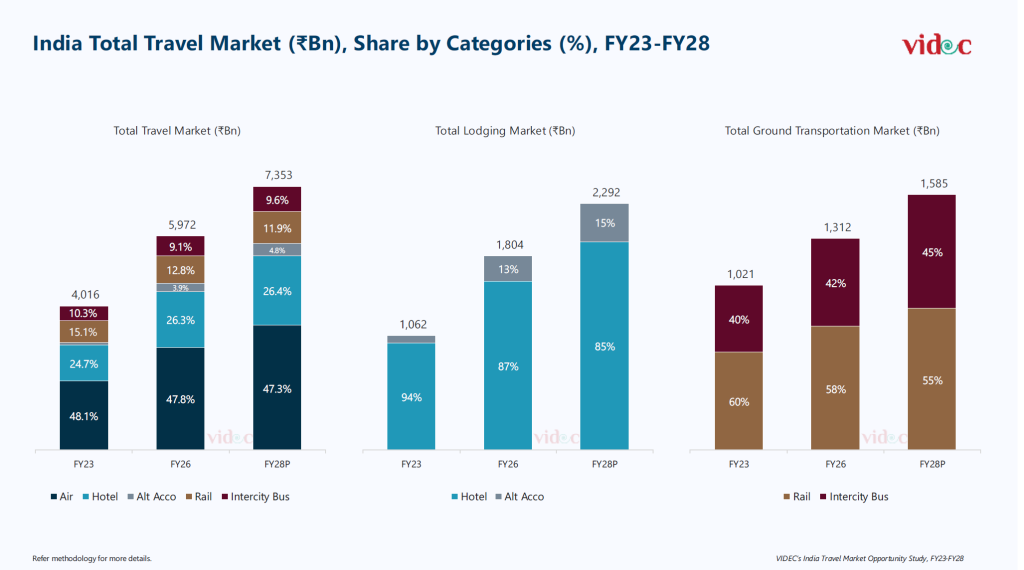
- Total market outlook: Indian travel market was valued at ₹5,972 billion ($67.6 billion) in FY26, up 7.6% y-o-y, after three consecutive years of double-digit
- Engines of growth: Alternative accommodation emerged as the fastest-growing category in FY26, expanding by 30%, followed by intercity bus (15%) and hotels (11%).
- Online market outlook: Online penetration crossed 42% of the total travel market in FY26, with OTAs continuing to lead the online channel with around two-thirds
VIDEC Consultants, a boutique travel research and M&A consultancy firm, shared insights from its latest study, titled “VIDEC’s India Travel Market Opportunity Study, FY23-FY28”. The study provides in-depth insights into the fastest-growing travel segments, market projections, and key distribution trends shaping the Indian travel, tourism and hospitality landscape.
The fundamentals driving India’s post-pandemic travel boom—robust economic growth, massive infra investments and soaring consumer aspirations—supported three consecutive years of double-digit growth. FY26, however, was a year of moderation, with travel market growth slowing to 7.6% amid a series of disruptions through the year, from India-Pakistan conflict (Apr-May’25) to the Air India crash (Jun’25), IndiGo scheduling crisis (Dec’25) and the West Asia war (Mar’26).
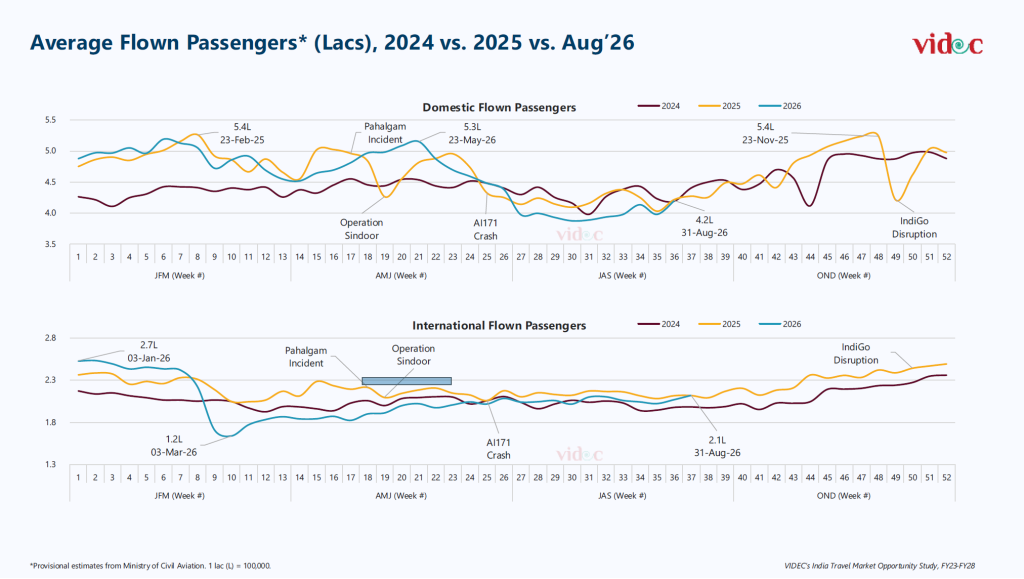
The air category bore the brunt of these disruptions, more than any other travel category. The domestic air market is effectively a duopoly, with IndiGo carrying 64% of flown passengers and the Tata Group, comprising Air India and Air India Express, carrying another 27%. With both players facing operational challenges in FY26, India’s domestic passenger traffic registered virtually no growth, its first such performance since the pandemic. India’s domestic air traffic remained above the 2024 trend through 2025 and was broadly in line with 2025 levels during January–May 2026. Since June, however, traffic has fallen below even 2024 levels, pointing to a moderation in demand amid higher airfares and constrained capacity.
On international routes, foreign airlines account for 55% of passenger traffic from India, even as the share of Indian carriers has increased in recent years. The Middle East remains the most prominent corridor, accounting for around half of India’s international air traffic. Geopolitical challenges, including the closure of Pakistani airspace, the Russia-Ukraine war and the West Asia conflict, along with the oil shock, have disrupted airlines’ network planning for long-haul routes from India to Europe and North America, resulting in longer flight times and higher fares. Also, depreciation of Indian rupee against US dollar raised airline operating costs, as around two‑thirds of those costs—fuel, lease, MRO, insurance—are dollar denominated. Together, these factors have dented the growth of India’s international air segment.
Throughout 2025, India’s international passenger traffic remained well above the 2024 trend line, despite several disruptions. The year 2026 started on a stronger note, with the momentum continuing through February. Since then, traffic has fallen sharply, reaching a two-year low. Through August 2026, international passenger traffic remained below the corresponding 2025 levels.
VIDEC estimates India’s total travel market opportunity at ₹5,972 billion ($67.6 billion) in FY26. Air is the largest travel category, accounting for nearly half of the total travel market. The lodging category—including hotels and alternative accommodations — accounts for over 30%, while the ground transportation categories—rail and intercity bus—contribute the remaining 20%. Alternative accommodation, a nascent yet rapidly expanding category, was valued at ₹233 billion ($2.6 billion) in FY26, registering a stellar 30% year-on-year growth. Intercity bus (15%) and hotels (11%) were the other bright spots, while the two transportation categories, air and rail, weighed on overall market growth.
Over the past decade, India’s digital revolution, driven by affordable data, rising smartphone penetration and the mass adoption of digital payments (read UPI), has been the catalyst for growth of the online travel market. As a result, the share of online channels in total travel market has risen rapidly from 33% in FY20 to 42% in FY26.
Categories with greater supplier-side consolidation tend to have higher online penetration, as seen in reserved rail (89%) and domestic air (62%). International air has relatively lower digital penetration, reflecting the complexity and higher price points of the product, as well as the greater need for personalised service and assistance.
Similarly, online penetration remains relatively low in more fragmented categories such as intercity bus and lodging, pointing to significant headroom for further digital adoption. Intercity bus was the fastest-growing online travel category, with online penetration rising from 15% in FY20 to 35% in FY26. Alternative accommodation also recorded strong online adoption, with online channels accounting for 40% of GBV in FY26, a notable feat for a category still in the early stages of its growth journey.
Online travel agencies (OTAs) have been at the forefront of driving digital adoption in travel bookings. OTAs commanded over 80% of the online market across every travel category, barring rail. In the rail segment, IRCTC, the state-run intermediary authorised to distribute reserved rail tickets online, remains the dominant player. The competitive landscape of the Indian OTA market remains dynamic and diverse, with each brand having unique strengths across travel categories and consumer cohorts.
MakeMyTrip Group is the clear market leader and continued to command over half of the total OTA market in FY26. The Group remains the only full-service OTA in India, with a presence across all travel categories and ancillary services. It continues to benefit from its pole position, as reflected in strong performance in corporate travel, intercity bus and lodging categories. The Group is also on track to list on Indian bourses. ixigo Group is the second-largest OTA and has remained profitable despite its focus on ground transportation. The Group is now diversifying its product offering, with air GBV recording the fastest growth among major OTAs in FY26. Listed in June 2024, the company recently secured a $146 million investment from Prosus to accelerate diversification and international expansion.
Cleartrip, the privately held, air-focused OTA, expanded its market share, driven by B2B expansion and aggressive customer acquisition. Its parent, Flipkart, is also eyeing an India listing by 2028. EaseMyTrip saw a largely stagnant topline in FY26, as growth in non-air segments was offset by a decline in air. Yatra, the corporate travel-focused OTA, maintained its market presence, supported by robust growth across air and hotel categories in the last fiscal year.
In recent years, major OTAs have increasingly focused on the higher-margin non-air segments to boost profitability and offset the slower growth of the broader air market, making the hotel OTA landscape increasingly competitive. Booking.com, the global OTA behemoth, benefits from strong brand recall, underpinned by the depth of its content and first-mover advantage. Agoda has made rapid inroads in India, supported by strong marketing and customer acquisition strategies. Airbnb, the global leader in alternative accommodation, dominates the Indian market in both listings and GBV.
Commenting on the key trends, Virendra Jain, CEO and co-founder of VIDEC, said, “The Indian travel industry has navigated several setbacks over the past year, making 7.6% growth a particularly strong outcome. Indians took over 4 billion domestic trips in 2025, highlighting the strong appetite for and aspiration to travel. This underscores the resilient travel demand and the underlying growth potential. Rising prosperity and a younger demography create a long runway for sustained travel market growth.
The adverse impact of geopolitical and other disruptions was largely constrained to air category, as evident in the double-digit growth in hotels, alternative accommodations and intercity bus categories. The overall travel market is projected to maintain its growth momentum in FY27. While air traffic is trending slightly below last year’s levels, higher ticket prices are expected to support the GBV growth.
On the distribution side, OTAs are increasingly expanding into non-air categories, which should help improve overall margins. The role of AI in travel is still evolving, but its adoption so far has been largely concentrated around travel discovery and product experience. We expect online travel intermediaries to remain central to the transaction layer. At the same time, AI is already enhancing the customer experience, with an increasing number of OTAs integrating AI capabilities into their platforms.”