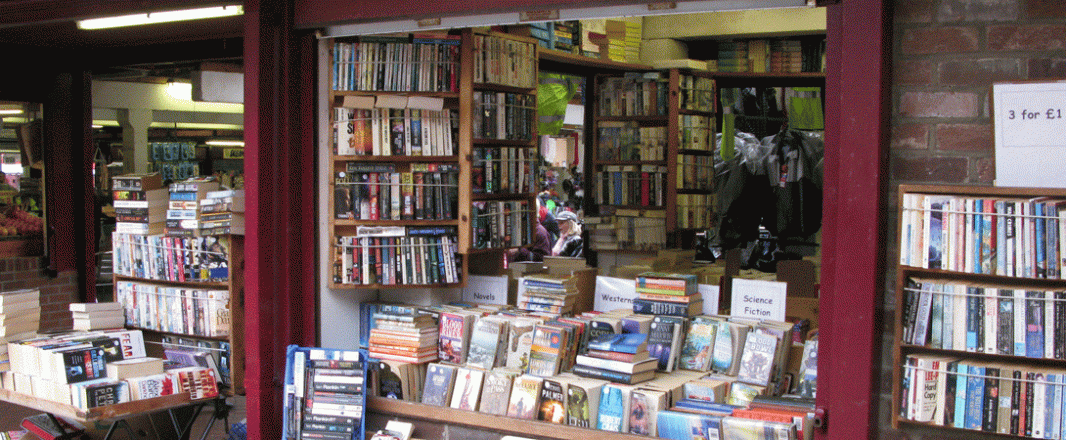
Just completed the book “The Little Bookstore at Big Stone Gap”and I think it should be compulsory reading for every retailer – whether you’re selling travel, books, music or anything that’s been commoditized by the Internet.
 Billed as “a memoir of friendship, community and the uncommon pleasure of a good book”, it’s about a couple who decides to pump their life savings into a dream – you know one of those people you think are crazy but you secretly admire because you wished you had the guts to do it yourself.
So Wendy and Jack have always dreamt of owning a bookstore. And when they found an old rambling house in a struggling Virginian coal mining town and fell in love with it, they took the plunge. A “toxic work environment” also probably helped with the decision.
You know, the point when the pain of not changing outweighs the pain of change … we’ve all been there.
Ignoring the voices in their head – the printed book is dying, bookstores are closing, there’s a recession – they listened to their heart, bought the house, restored it (a great deal of work was needed), opened a book store and six years later, have carved a nice little business and, more importantly, life out of an Appalachian mountain community.
What I found interesting about the book – other than the over-arching narrative of two people who dared to pursue their dream and are now living it – are the little business tips buried within.
Like how they learnt about the book business, how they are sold and distributed, the margins – all their learning was on-the-job, they knew nothing about the business – and how they used the Internet – the very thing that’s eaten away at the book business – to learn, become experts in the trade, build networks and a community and provide an experience Amazon just cannot.
In other words, using technology to reverse technology.
The bookstore is more than just a place that sells books. It’s a place you go to meet friends, get personal recommendations on books, discuss books, take part in events, meet the family cats, have home-made cookies and pies and well, just spend time with good folk with common interests.
This is where retail has to go if it is to compete with virtual stores – you can’t compete on price and range but you can on personality and purpose.
In Auckland recently, I walked into The Women’s Bookshop in Ponsonby Road. Curious, I asked the proprietor why it was called that when it stocked men’s books because I thought the store would only have books written by women.
She told me its history – about how this was started as a feminist movement in the 60s when women authors needed championing and there was a whole chain of them around the world. But now since the movement has lost momentum, only a handful are left and she’s one of them.
“We’ve expanded the selection to include books written by men but books we feel women will like,” she said.
She told me business has been tough but she’s added little touches – such as hand-written reviews and “Staff Recommendations”. “People like these, our recommendations are more personal than those you get on Amazon,” she said.
I’ve noticed of late more bookstores trying to do this – handwritten reviews and recommendations – to create a more curated and personal feel.
But it’s not easy. In Singapore, an “indie” bookstore, Books Actually, had to reach out to its “fans” on Facebook to help it raise a 2-month deposit on its rental which had just been raised – S$16,000. And its fans helped spread the word through blogs such asthese. Fortunately they managed to raise the funds and are still open for business.
They’re not the first “indie” business in Singapore to crowd source for funds – a cute little book and arts café called Pigeonhole also managed to stave off closure by using its social network.
While it was heartening to see how supportive people were – and how many of us do want to keep “indie” businesses alive otherwise the world would be a very bland, boring place – you have to wonder how sustainable they can be in a high-cost, competitive environment like Singapore and that for every success story – like Wendy and Jack – there are of course many failures.
That however shouldn’t stop any of us dreaming because I think if you, like Wendy (who keeps this blog by the way and has done this video tour), know how to use the Internet, it can be every retailer’s best friend, not enemy.