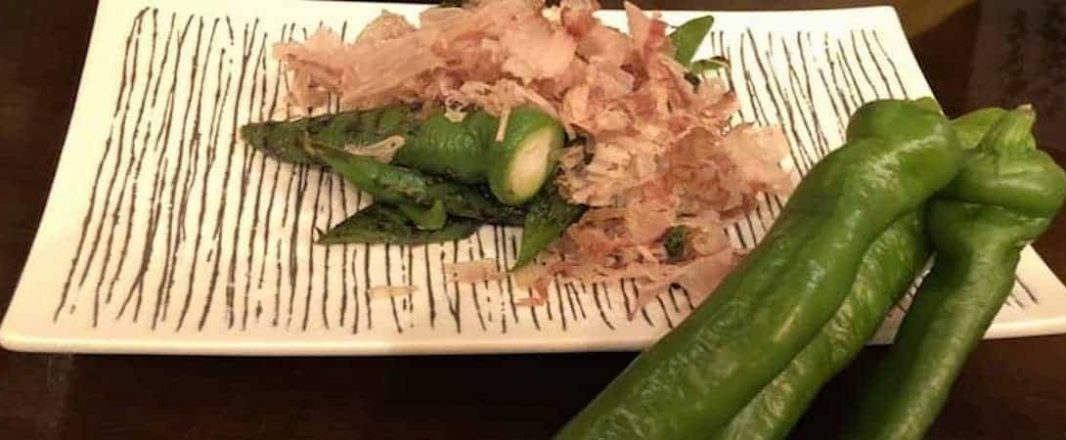
Last night, I was having dinner at one of the many hole-in-the-wall Japanese restaurants in Tokyo that every traveller likes to boast about discovering when I had a culinary epiphany of sorts.
Based on a recommendation from a local (the best kind there is), this one was called Hanawasabi, serving Kyoto seasonal specialities. It took us a while to find it – it’s located on the sixth floor of a nondescript building near Ebisu Station – and after several attempts with Google, we decided to ask actual people who were all very helpful, even if one or two sent us the opposite direction. It didn’t matter, they added up to the local encounters and experiences every traveller thirsts for these days.
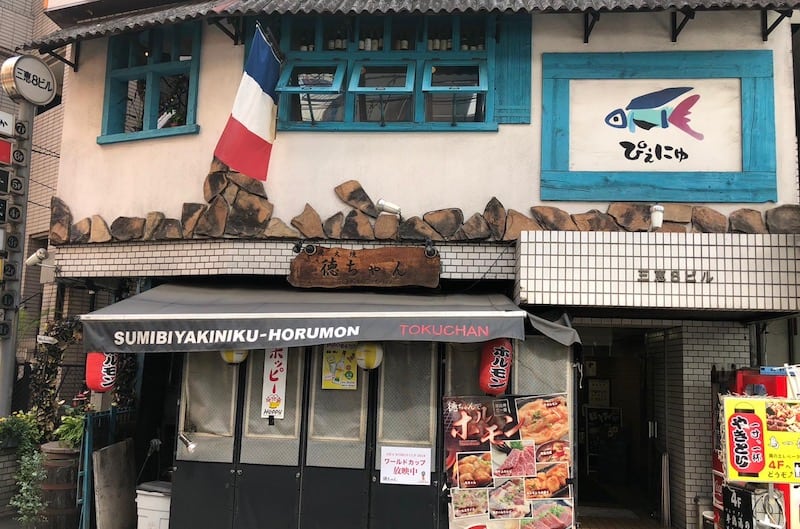
Hanawasabi is on the sixth floor of this nondescript building near Ebisu Station.<.em>
The restaurant is small – maybe six tables – and there was this one woman who ran everything. The menu is handwritten so forget Google Translate. What helped were the pictures – so we just pointed to everything that was hand-drawn – eggplant, green peppers, fish.
It is amazing with a bit of imagination and effort – and a bit of technology – how easily it is to be understood across cultures. We looked up Kyoto cuisine on our phones and pointed to pictures we saw there. She took out her mobile whenever she couldn’t understand us, and pointed to pictures.
In the end, we had the most amazing meal – the freshest of ingredients cooked with utter simplicity.
And that’s when I had my culinary epiphany – surely with such fresh ingredients and simple cooking techniques, even I could be a chef in Japan?
I mean it would take an idiot to mess up the produce we were offered – the sweet corn was sweet, crispy and crunchy, the onions were covered in a very light batter which just crumbled and all you were left with were the juicy real bits, the Ayu sweet fish was lightly grilled with olive oil and you just popped the whole thing in your mouth.
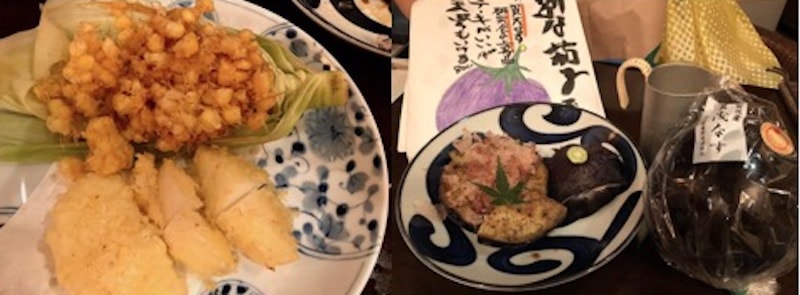
(L):With corn like this, how can you go wrong? (R): Eggplant in three parts – hand-drawn, the real thing and cooked to perfection.
So how could anyone mess it up? That’s when I thought perhaps someone should start a reality cooking competition that’s in reverse – instead of always looking for the best chefs, why not have one that surfaces the worst chefs – the ones that could mess up even if the produce is the freshest and the cooking techniques are the simplest? Call it Disaster Chef, not Masterchef.
It made me think of startups and business leaders and wonder if the same is true. Like could you give someone the best idea and the best company to run and they’d still mess it up? History has proven this to be true of course – it’s littered with stories of successful businesses and ideas that have floundered simply due to human foibles and frailties.
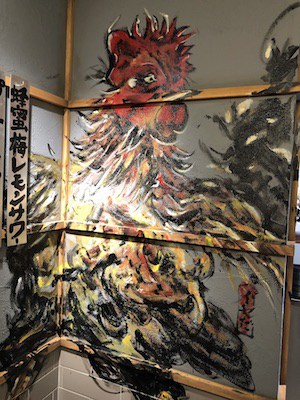
Talking of Super chickens, found one on the wall of another hole-in-the-wall eatery in Tokyo.
Tomorrow, we will kick off our seventh WIT Japan & North Asia in Tokyo and we will have a lot of startups and travel industry leaders gathered over two days – we estimate 500 or more – and we will for sure hear stories of how everyone is adapting and coping with the accelerated world of change that is travel tech.
It’s like a Japanese bullet train these days – things are moving at super speed and it’s getting extremely crowded and super competitive, and everyone has to fight to find their space.
Which brings me back to my culinary epiphany and this story I heard of super chickens and an experiment someone did on measuring productivity – in this case, laying eggs.
They put 12 super chickens in one control group and a mixed batch of chickens – low, medium and high producing – and gave them the same environmental factors. In the end, they found the productivity in the mixed group had risen while the super chickens, there were only three left because they had killed each other.
Back to Hanawasabi and the woman who’s running the front end of the business and clearly her husband who’s the one slaving in the kitchen – they’ve kept to a simple idea, Kyoto specialties; they’ve kept it to a simple business, six to eight tables, hand-written and hand drawn menus; and they’ve adapted to the times. She speaks a smattering of English and wields that smartphone as deftly as her husband does a knife.
They’ve honed their teamwork to perfection and they prove that in business, often there’s only room for one super chicken. The rest just have to cluck along or lay your own egg.
See you in Tokyo.