Multi-currency payments; fraud; how many payment methods should you offer – key headaches addressed
WITH 1.7b unbanked adults in the world, according to Findex Database, Worldbank, the opportunities to address this market with alternative payment methods are immense. The potential is biggest in Sub-Saharan Africa with 80% unbanked, followed by Middle East at 67% and Latin America at 65%.
Within Asia, there’s 59% in East Asia and South-east Asia and 58% in South Asia. In high-income OECD countries, the percentage falls to eight percent, so even in the world of payments, there is huge inequality in the financial tech landscape.
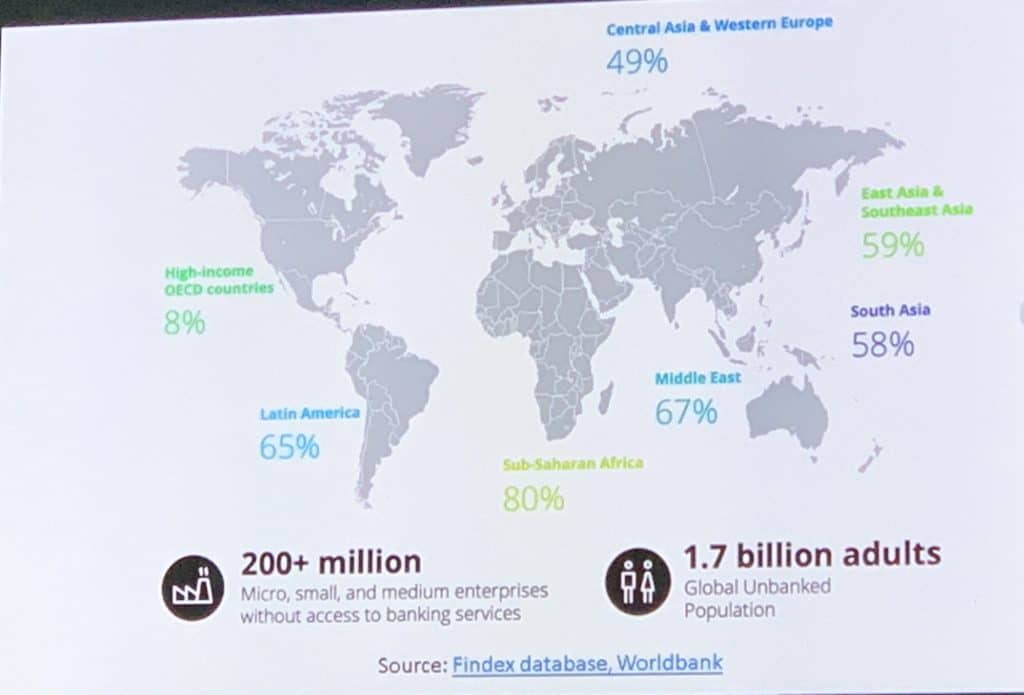
For Ken Ling, vice president, finance of Dusit International, the even more interesting figure is the 200+ million micro, small and medium enterprises without access to banking services, seen in the chart that was shown to the audience during WiT Virtual: Navigating The Complex Payments Ecosystem in South-east Asia: How to localise and digitise.
In the one-hour webinar, held in partnership with NTT DATA, panellists Chan Chee Chong, CEO and co-founder of GlobalTix and Alvin Kumarga, senior vice president, financial services, Traveloka were visibly excited by the numbers in Asia. “This screams opportunity for me,” said Kumarga who joined the Indonesian OTA about three years ago to expand its financial services.
The question is, how do you even begin to address this opportunity especially in the travel space where your customers cross borders (well, at least they used to until now) – but this period seems a good time to start investing in payments and getting your businesses ready for the return of cross-border travel.
“You stand to lose one out of five customers”
Because, yes, it’s a no-brainer, getting payments right is critical to conversions. As Poon Khye Wei, head of payment and chief operating officer of NTT DATA, said, payments is a tiny part of the booking process but a critical component – a study in August 2019 showed that when buying on mobile, 21% of global shoppers abandoned cart due to lack of their preferred payment method. (Source: ystats, Global Online Payment Methods 2020 and Covid-19’s impact, published June 2020)

“This means that you stand to lose one out of five of your customers,” said Poon. Regardless of the reason for abandonment, “getting the consumers to successfully complete their payment is very, very critical to convert a sale, which helps to grow the business and retain customers. Now we not only have to provide a seamless customer payment experience, we also have to take into consideration the customer payment preferences when we want to move our businesses online.”
Again, no-brainer, Covid has accelerated e-commerce and in its wake, digital payments, both on the consumer and merchant side. Poon said 45% of global consumers surveyed in April 2020 increased their usage of digital payments during the pandemic and expected to continue in the next six to nine months.
Poon said traditional sectors from learning centres to gyms moved online the past year and in fact, 82% of global consumers surveyed in April 2020 at the start of the pandemic believed that contactless was a cleaner way to pay. Sharing Deloitte Research, Poon said 78% of consumers increased their use of digital payment services, and the top three reasons were convenience, contactless, and value-added benefits and promotions.

Asia, he said, saw a surge in the use of alternative payment methods (online/offline) for digital transactions such as digital wallets, convenience store payments, bank transfers, real-time payments and BNPL (Buy Now Pay Later) options. Based on data he showed from Statista, e-wallets now make up the biggest percentage of e-commerce transaction value – steadily rising from 52.3% in 2018 to 60.1% in 2020, 63.1% in 2021 and projected 65.7% in 2022.
Poon also noted that “BNPL is increasing popular for consumers to manage cash flow, and for merchants to access new loyalty channels,” saying that, 21% of travellers from APAC used a BNPL payment option for trips in 2020, with Chinese travellers (44%) standing above average.
QR codes, e-wallets, debit cards “as long as they are contactless”
So the trends are clear – digital and alternative payments are the way to go. Dusit’s Ling said in Thailand, there’s been the shift from cash and credit card to QR code, e-wallets, debit cards “as long as they are contactless”, and he welcomes the fintech developments in the past few years as a “good headache” to have for financial controllers like him.
“This means there is a wider range of customers, especially the younger generations, who have more spending power. This generates more revenue for our hotels and resorts. It’s similar to when credit cards were introduced many years ago.”
In tours and activities, Chan said operators “used to be happy with Mastercard and Visa but now they want Grab Pay, Google Pay, Apple Pay, WeChat Pay, you name it, it is all Pay Pay Pay.” With such customer requests, it stands to reason that payments is pretty high priority in his tech stack currently.
Another trend is happening with OTAs (online travel agents). “They used to be happy with just having a base currency – let me give an example, like Traveloka, now they want to pay us for Singapore products in SGD, RM for Malaysia products, Japanese yen for Japanese products in yen – so the margins are so tight, and they don’t use a base currency anymore. They prefer to pay people in the local currencies.” This, he said, creates headaches for operators like himself who have to deal with currency exchange risks.
The reasoning behind Traveloka’s range of financial services
Speaking of Traveloka, which is looking as much like a fintech company as it does travel with services such as Traveloka Pay, Steam Wallet, UANGKU Balance Traveloka, Kumarga said the company’s motivation was not so much to build a financial services business on its own but rather “we looked at what customer’s needs are in the travel and lifestyle space and we went from there”.
The first service it offered was an insurance product in 2015 which was natural to travel. “But then, customers started asking, ‘Hey, I’m traveling, My home is being left alone. Can I have home insurance when we travel?’”
The second service was a BNPL product in 2018. “Again this came out of user needs. We saw user requests, ‘hey, I want to buy travel for my family in instalments, I need to manage my cash flow, can you help me?’”
With credit card penetration at less than five percent in Indonesia, the BNPL model made sense. In fact, Kumarga said it not only solves a customer problem but “this gets us a lot of retention, and increases the lifetime value of customers” by almost double in terms of frequency of transactions and ticket size.
And as Traveloka moves further into the lifestyle space to reinforce its positioning as a lifestyle company, “there are more small, daily ticket size items such as attractions and movies and this requires a very, very specific payment solution, and hence we came up with our wallet”, he said.
Chew Ann Wee, Head of Sales, NTT Data Hong Kong, said because of the big shift of consumers to online, enterprises are now looking at revamping the entire business process – “the end to end digitisation which includes digital payments”.
“How do we put all this together, digitally, on a single platform – reconciliation, reporting, so on and so forth? SMEs that were delaying digitisation – well, they are dealing with it now, and payments is part of that.”
Multi-currency payments, fraud, high cost of implementation
When the audience was asked to identify their biggest headaches, the top three pain points that came up were multi-currency payments, fraud and the high cost of implementation. Chan said the headache of multi-currency payments is compounded in Asia because of the different currencies and he asked Traveloka’s Kumarga how it managed currency exchange risks.
Saying “this is something that we are still learning”, Kumarga explained that it determines its internal FX rate by sourcing the rate from a third party financial data provider and puts a “very thin” markup.
“This thin markup is not for the purpose of seeking extra profit or value but it’s more to hedge the risk rate for absorbing short term volatility during the period from customer booking to settlement. In the future, as we go along, we want to introduce using value and risk methods, which we are still developing, working with our partners.”
Dusit’s Ling posed the question of handling credit card fraud to Kumarga, who said Traveloka used a combination of third party and internal technology, to complement an off-the-shelf solution with internal data, to track what could be suspicious shifts in behaviour. It has also developed its own customer data management database “where we extract customers data in terms of mobile behaviour”.
“When did they purchase, their IP address, all that stuff, and location. We use the GPS also in the mobile app to figure out if a transaction is valid or not. Ultimately, it is a balance between your fraud rate versus your approval rate, reject rate and you try to figure out what makes sense for the business.”
To address the high cost of implementation, Chan said, “We try to work with payment partners that have as many channels as possible. So in every country, what we do is we identify the top three digital wallets that we need to connect to. And then the rest, we use a payment partner, so that’s how we manage our costs.”
For Ling, the cost of implementing domestic payments such as QR codes for hotel services such as food delivery is not that high. However, in terms of room reservations, “we have no choice but to outsource and work with a payment partner who can cater to most of our needs”.
How many payment options to offer? Lesson from Traveloka
The audience was also in agreement with panellists on the importance of accepting e-wallets as a payment option, given their phenomenal rise in Asia. But how many should you offer? Should you work with all, or two or three or just one, wondered Chan. Can customers be turned off by too many payment options, each with different perks and points?
NTT DATA’s Chew said it really depended on individual businesses and which markets. One factor to take into consideration is the marketing that goes with some of these wallets. “The marketing portion of it should not be under-emphasised. There are a lot of wallets that actually package the use of their payment methods together with marketing. And if your business generates revenue out of these marketing programmes, then go for it.”
Or perhaps take a cautionary lesson from Traveloka? Kumarga said, “Before, we kept on adding payment methods. We covered the majority of payment methods, the long tail, and we found that customers were seeing maybe more than 10 payment methods in their payment option page. And it gets confusing.
“People were like, oh there are 10 payment methods, I can pay using all 10, but which one has bigger coupons and all that stuff. And people start browsing, browsing and forget to pay.”
So what it did was streamline and now it offers just one payment method “that’s the most frequently used, I think, in the past five or six transactions. They can change it if they want, but by default it is just that. The main thing is, with that, we see conversions go up and people completing the transactions faster.”

The panellists were a bit more divided over the BNPL model. Kumarga is a definite proponent of it while Chan was more hesitant, saying while the OTAs like it, smaller operators and merchants are not that keen.
NTT DATA’s Chew said he was definitely seeing a rise in enquiries from customers about the model. The hesitation, he said, may come from smaller ticket items as opposed to say, buying a car. There are risks involved but “in general, we are seeing a lot more uptake and more queries on this method of payment”.
As for what investment they would make in the payments sector if money were not an issue, Chan dreamt of exploring “a B2C app where if I Grab Pay, I can convert it into ‘Pay Pay’ and go to Japan and start using it. I think that will be really cool and what consumers really want.”
Dusit’s Ling said, “Whatever that enhances the customer experience in our website – the interaction must be seamless when the customer buys our products, and, of course, it’s reliable. I think we won’t hesitate to spend money in those areas.”
Kumarga said, “One thing that we want to do in Traveloka is invest in the merchants, invest in our hotel partners and travel partners. I think there are a lot of concerns that our partners have with regards to payments, to enabling access to funds, financing, and all that. I think that’s something that we want to work on. We want to help them get more integrated with the ecosystem and bounce back quickly from Covid.”
Watch on-demand here
• Featured image credit: utah778/Getty Images