
Reimagining the very way we conduct ourselves in daily life is no easy feat but travel is inherently an industry built on the notion of ‘doing things differently’. While technology in travel is not a novel topic, acknowledging ‘travel tech’ as its own vertical is still relatively young.
According to Kostadin Kolev, a young entrepreneur and co-founder of Hack Horizon, there is plenty more disruption to be done in the travel technology space, and hackathons are a good way to get things started.
“Travel is one of those industries where the big players really haven’t been disrupted yet… I think that there’s this whole valley in the middle that isn’t bookings and isn’t trip itineraries that is currently under-tapped and is just serviced by these big conglomerates that aren’t really driving innovation.”
That is why Kolev created Hack Horizon – a hackathon that quite literally crosses borders. Set to take place in the first quarter of 2017, Hack Horizon will see 32 of the best entrepreneurs, engineers and designers develop a travel-related prototype over 80 hours, as they travel from Hong Kong to London.
HACK HORIZON – HONG KONG TO LONDON
Hack Horizon is intended to find innovative solutions to five pillars of every customer’s travel experience: booking, insurance, airports, transportation and accommodation – areas that Kolev believes have not sufficiently been disrupted.
Beginning in Hong Kong, the 32 participants will gain a holistic understanding of the travel industry by speaking to industry leaders. They will interact with real-time travellers at Hong Kong international airport prior to their flight, to get insight on consumer needs and desires. They will then develop their prototypes throughout their flight.
Upon arrival at Heathrow airport, participants will be able to validate their newly designed prototypes on real potential customers, before eventually pitching their product to executives at Traveltech Lab – a London co-working space geared towards cultivating tech in travel. The entire hackathon will last 80 hours.
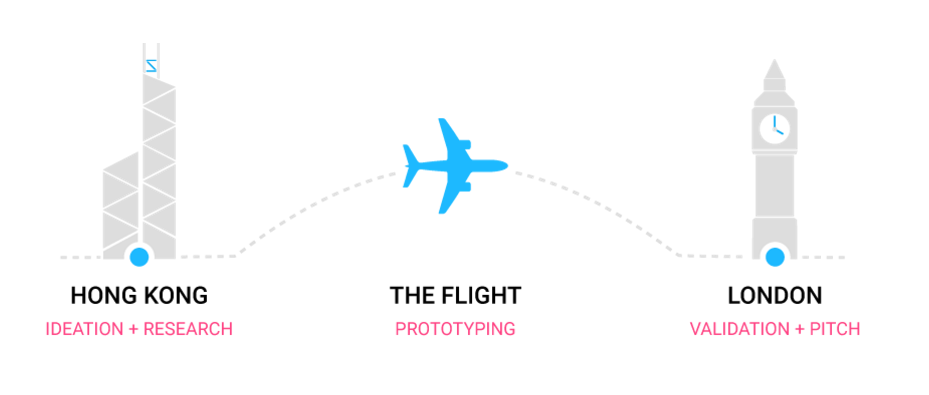 A HACKATHON WITH REAL OUTCOMES
Kolev argues Hack Horizon is a far cry from typical hackathons wherein products are often built in a vacuum, without practical purpose. “You get these really brilliant technological minds that build this awesome solution for no one. They build cool stuff for the sake of building cool stuff but they haven’t really identified the real pain point or the real market opportunity there.”
With that in mind, Hack Horizon seeks to bridge the gap between developers and real-life customers to create something truly useful. “The idea is to give them the opportunity to… understand those real case studies and real user stories,” explained Kolev.

Kostadin Kolev, co-founder of Hack Horizon
This however isn’t his first time at the rodeo. Prior to this, Kolev was co-organiser of StartupBus, combining a startup competition with a road trip, visiting accelerators and incubators through Europe. He also co-founded HackTrain – a railway industry-themed hackathon, conducted on a train journey throughout the UK.
Ultimately, Kolev has used these hackathons not only as an opportunity to bring great minds together for a practical purpose but to also confront the neglected truth that larger companies are simply not doing enough to innovate.
“The [travel] industry isn’t thinking about things in that way and it’s not until you get those prototypes in front of senior executives that they actually wake up… There’s so much potential but you have to think about it in the right way. It has to be framed in the right way.
“To get these big companies to innovate, you need to hit them in the face with some cool stuff to get them to really think about what it is that they’re really doing.” he remarked. “This is exactly what we’re doing; we’re just doing it on a plane.”
INNOVATION AT A STATE LEVEL
Yet, considering every major corporation’s ethos or mission statement typically includes something about always striving to innovate, why is there a hesitation to actually adopt new technologies?
“In all honesty, the real problem with corporates is they want immediate returns… they don’t value the creative. They value the returns and the products… that’s not really how innovation works.”
He notes the general scarcity of ‘innovation labs’ within APAC, arguing that major companies tend to innovate abroad and then push these technologies out to Asia, instead of it being homegrown.
Kolev argues “in Hong Kong… no one is really taking tech seriously because they haven’t felt the pinch of tech. [In Europe] you see market share is being eaten up… you are losing because you’re not being forward thinking in your digital strategy.”
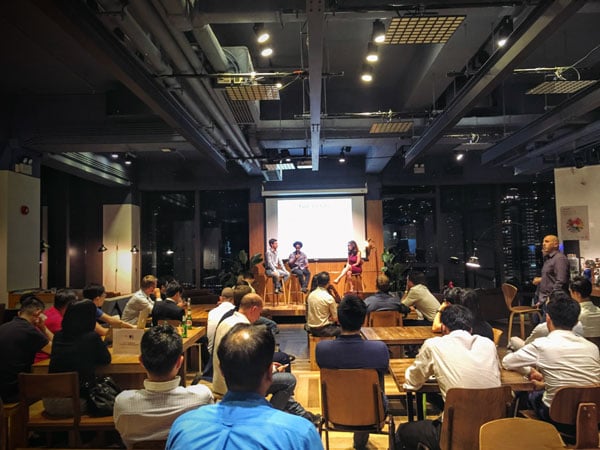
TravelTech Tuesdays, a monthly meet-up to cultivate the travel technology space
However, the solution is unfortunately not as simple as government incentive. That, Kolev predicts, will have the opposite effect on creativity. “The Hong Kong government is trying to put in money to get people to start companies. That is not the role of the government. The role of the government is to make it as simple as possible for you to become an entrepreneur… They shouldn’t be incentivising people to start their own companies. They should provide stability and provide rigor, law, order… if access to funding is easy through governments, that [entrepreneurial] hunger dies.
By contrast, he believes in London, “There’s a greater hunger for [innovation]… that comes with a more mature market… the rules of the game are so much more different there… It’s also a much larger market, so you’ve got to hustle for it.
“The thing is if you decrease the barrier to entry, then the pool just dilutes.”
To help drive greater innovation in Hong Kong, Kolev has helped to organise TravelTech Tuesdays, “a monthly meet-up to connect the rapidly growing TravelTech ecosystem in Hong Kong and encourage new connections, opportunities and collaborations in the space.”
THE SOLUTION TO THE CREATIVITY PROBLEM
He suggests the most effective way to drive greater innovation within the region must start by fundamentally changing the education system.
Two key qualities must be better cultivated throughout any person’s formative years, if we truly want to cultivate a more ‘innovative’ culture – creativity and intuitive thinking.
The capacity to think of creative solutions or to think beyond what is immediately required are crucial in developing a more entrepreneurial mindset. Drawing on his own experience, Kolev explained, “in a startup, there’s no playbook to go by. You’ve got to have a general direction of where you want to go and you need to carve out your own way to get there.”
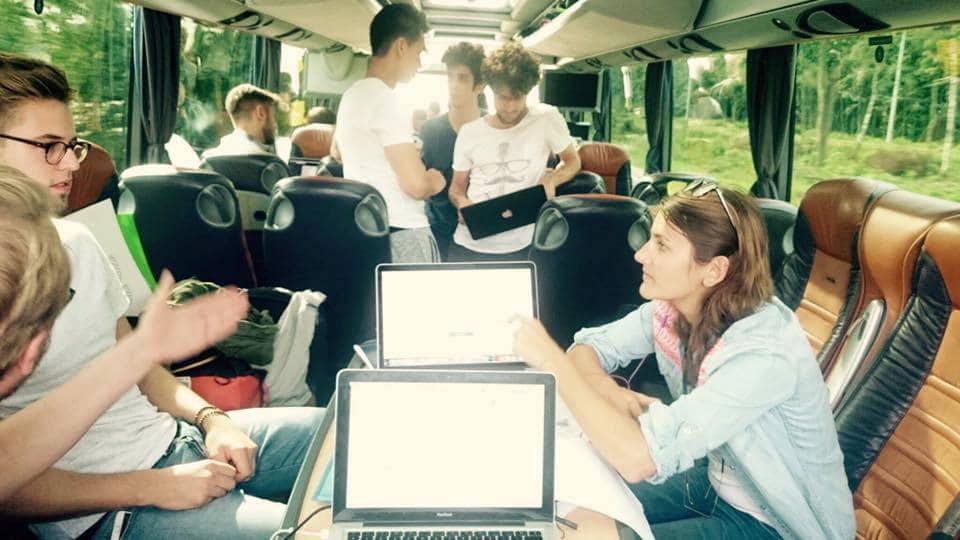
Inside this year’s Startup Bus competition
But how exactly does he propose that this takes place? Kolev views it “much like a dovetail approach. The ‘corporates’ need to change the way they recruit people to stimulate the investors to change, which will in turn stimulate schools, which will in turn change the primary schools… it all needs to start from the top and trickle all the way down.”
By that he suggests that learning needs to shift from a traditionally prescriptive style to a more dynamic one. From that sense, encouraging greater innovation will take far more than greater willingness to take risks and invest in new ideas, in travel tech and beyond. Simply put, traditional education systems will need to be disrupted too.
“Look at Finland. That’s a classic example of [good] education.”