Going to Bali every Christmas was always an annual highlight in my family. We knew exactly what we were in for – which restaurants we needed to visit, how many days we wanted to dedicate to shopping versus beaching ourselves on the sand, and of course, how many fresh mangoes we were shipping home.
When our favourite hotel shut down to make way for renovations, we found ourselves forced to abandon the routine we were accustomed to. Nevertheless, we embraced the opportunity for a ‘change of scene’ and opted for Seminyak, famous for its beach clubs, designer boutiques and countless restaurants.
The area was already familiar to us, but renting a villa there and actually choosing to spend a week there, was new. And from the moment we arrived, I hated it. I have always been aware that I count as being a tourist in Bali. I am under no illusion of how fortunate I am to have been able to experience a grade of holiday with access to a private beach and superb service.
Image credit: cosmin4000/iStock
Yet from the moment I found myself pooled with everyone else like a sardine in a fishing net, it very rapidly dawned on me how much potential we have, as tourists, to ruin a place.
To draw a parallel albeit more geographically distant example – I have always dreamed of visiting Antarctica. I visualise myself all geared up in layers of thermo-wear, standing on the ice, with a Weddell seal basking by the water just a short distance away or watching a penguin dive into and out of the water before being devoured from beneath by a stealthy orca.
Quite easily, I could Google ‘flights to Antarctica’ and with enough money and a solid travel and life insurance plan, be on my way within a matter of days. What I don’t want is to be stuck on a cruise liner with thousands of others with the same travel dream as mine, fighting to get the best view. But unless I am willing to shell out significantly more money than I have, this is the trip I would have to settle for.
Even more unappealing that the sound of that journey, is the degree of damage such a trip would do to the very destination we’re all desperate to see. We very conveniently ignore the impact we have on a place from the moment we arrive. We are desperate to see Antarctica because at the rate of climate change, we cannot guarantee it will be there for us to enjoy much longer. By taking up that opportunity, we’re systematically accelerating the rate at which it disappears. It’s a Catch-22.
Nowadays, if you ask my generation which singular global issue we hold closest to our angry, post-university, revolutionary hearts… we would find it as difficult to answer as a hyperactive five-year-old, aware they can only buy one souvenir from the gift shop after a day at the zoo. Racism? Sexism? Poverty? Education? Could we place them all under a broader term and just call it ‘social inequality’? The list goes on…
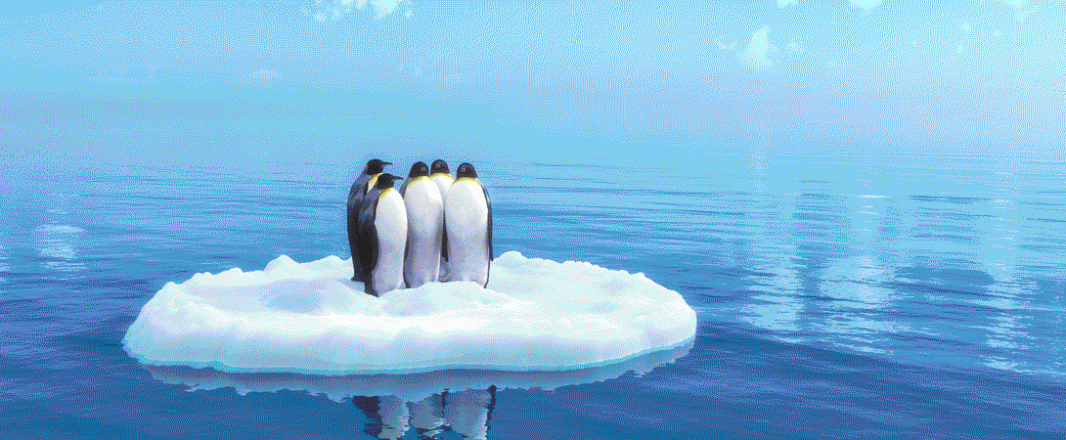
Back in the days of Middle School, if you had asked our thirteen-year-old, wide-eyed former selves the same question, there was no doubt in our minds that global warming was the hot topic (pun intended). Every class project circulated around planting more trees, campaigning to switch off classroom lights and shutting down every machine in the computer lab. All in a grand effort to sustain that slim disk of ice that was keeping that stranded polar bear afloat in the water.
Of course, our intentions were much nobler than our actions at that age (and at this age too). Our gung ho ‘save the world’ attitude extended as far as the next school bell. When term ended, if you asked where we were spending our holidays, many say “Maldives…” to which we would reply, “of course, better visit now…before it sinks!”
Perhaps there is a balance that none of us have managed to (or ever will) strike. Maybe our incessant hunger for ‘discovery’ is doing far more damage than good and we need to come to terms with the idea that if our ‘paradise’ – not yet colonised by the little flags leading the tourist troops – still exists out there, it’s best left unseen.