
In major cities across the world much like Jakarta and Singapore, many of us peer at our smartphones, skimming the news on their way to the office, or scroll through the muted group chat on Whatsapp that we have neglected to open for far too long.
Meanwhile at the peak of a small mountain on an island in Togean, Sulawesi, local Indonesian islanders keep their eyes fixed on a different phone’s screen, hoping with bated breath for at least one meagre bar of signal. It’s like a hunt for a rare Pokémon. Some even scale the tallest coconut tree, gripping with just their feet and one hand with their other arm outstretched in space, waving the phone in the air lest it yield any luck.
Instead of a typically large red and white mobile phone antenna, a stick adorned by a hollowed coconut husk is wedged into the earth, marking the precise point where precious signal might leak through like a crack in the universe… cherished by each phone user in turn, as though it were the final drops of coconut water on a hot day.
It could be seen by some as tragic, that so many residents must wait their turn to make a phone call as if connectivity were being rationed like food, post-war. God forbid, any emergency would spell disaster for most. Even our precautionary satellite phone hardly fared any better than a typical feature phone as if the satellites orbits were also ignoring this patch of paradise.
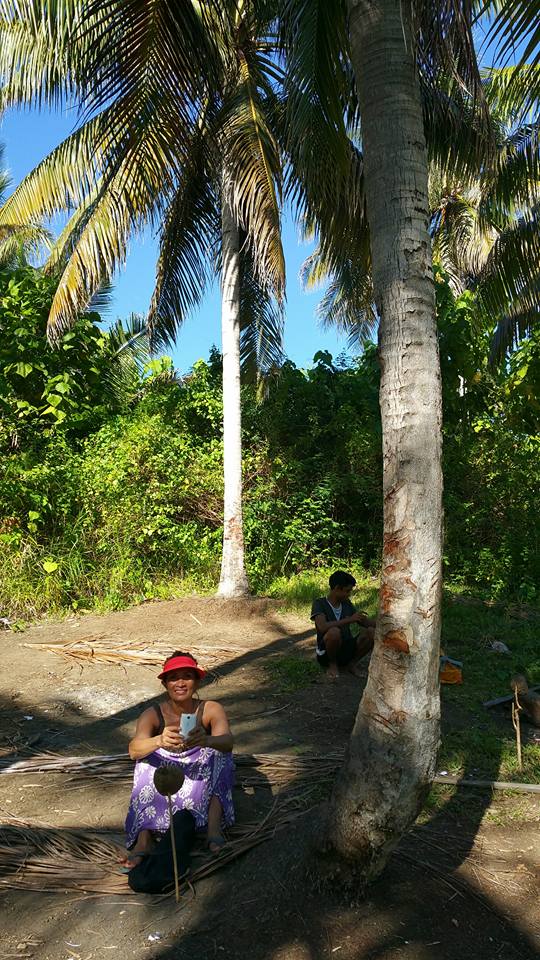
The only spot on the island with relatively reliable mobile signal: under a coconut tree.
Of course, each village faces its own level of hardships that most of us will never have to confront. Yet there was also a natural beauty about it all… like a look back at the way things used to be and still can be, if only we want it. Watching how engaged in the act of just living and how intimate every community in the local part of the archipelago seemed to be was enough to point out how mobile can disconnect us almost as powerfully as it can connect us.
Travelling through the islands, it was an absolute relief to remember what it is like to be ‘off the radar’ in the truest sense of the phrase. Going out for the day meant packing nothing more than a hat and sunblock, while my Samsung Galaxy 6 lay dormant in my hut.
Photographs were taken on an actual SLR camera. With pictures appreciated for themselves rather than as fodder for sending to friends and contacts. There was no sense of urgency to upload something to Instagram and Facebook, or send an envy-inducing Snapchat to friends abroad.
Meeting fellow travellers meant exchanging e-mails and phone numbers on scraps of paper as they too opted to leave their phones at their respective islands. Direct human communication was the primary means of interaction. Here, you wouldn’t book a taxi or Uber so much as arrange a boat by word of mouth, to take you island hopping throughout the week.
Forget restaurant review sites too… breakfast, lunch and dinner were whatever the resort kitchen happened to cook up that day. You either ate what you were served (usually fresh fish and rice), or you went hungry.
At dusk as the sunlight dimmed, electricity hummed through each resort hut precisely from 6pm to 11pm each evening; individual generators powered each island. In local villages, TV satellites were innovatively erected on bamboo poles wedged into the seabed. Children’s cartoons and even English football matches could be heard through each home’s thin walls. Then, the timer would run out and blip – the island went dark.
Of course, once we returned to ‘civilisation’ we were shamelessly quick about sharing experiences online with our photos of crystal blue oceans, powder sand and our bronzed skins. I’ll be the first to admit we fell back into old habits quite hard when we re-entered the modern world of constant connectivity. We may have been reconnected but we lost the peaceful isolation we had come to cherish.
It’s easy to confuse how we often behave when we travel and why we travel to begin with. Simply being stripped of the conveniences of mobile lets you return to travel in its organic form.
It was refreshing to suddenly be reminded what ‘being present’ actually means. There was no impending risk of losing someone’s attention because of the peep of a sudden push notification or the compulsive need to refresh social media feeds.
I’ve said it before and I’ll say it again, slow, real travel instead of tourism, despite its inconveniences, feels like a strange return to the way things should be. I say strange because – as a ‘millennial’ – we don’t notice our state of constant connectivity until we get cut off.
That’s not to say we mind when it’s gone.
Photos: Nellie Trew