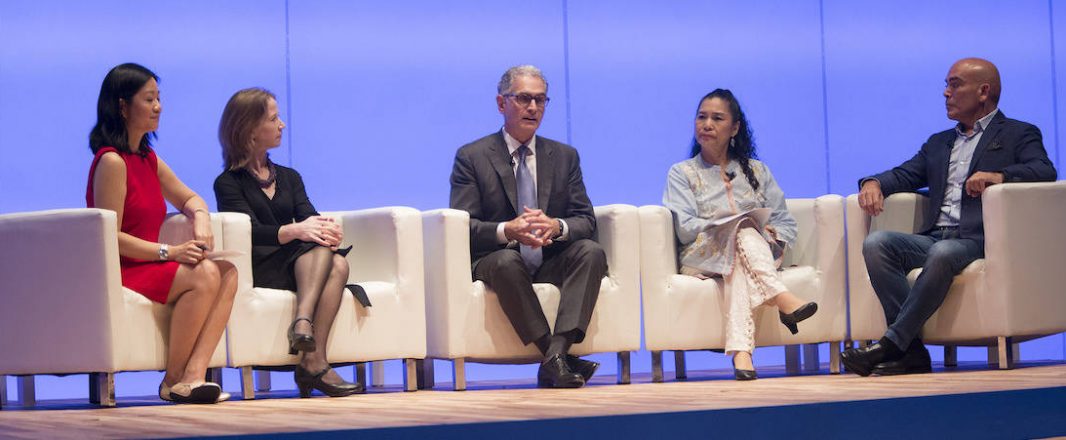
Preparing talent for a new economy is a question that pervades every industry. At the World Travel and Tourism Council Global Summit, held recently in Bangkok, April Rinne (Global Authority on the Gig Economy and Future of Work) named three major developments that will affect the future of work.
Rinne posited that the new economy would mean the end of ‘jobs’ and “lifetime employment”. Many are opting to become self-employed, governing and managing their own working hours.
At the same time, she argued that modern companies are increasingly finding it more expensive to manage full-time employees and therefore also favour hiring self-employed individuals who can offer their services without long-term contractual commitment.
Secondly, the ‘gig economy’ has meant that many no longer need nor want to seek out full-time work. Rather, Rinne said there is a “universe of new opportunities” offered through technology.
She observed the rise of “freelancers”, from 34% in the USA to over 50% by 2030. Europe is leaning the same way. Freelancers report being attracted to flexibility and greater work autonomy, feel more engaged with work and believe they are attaining more skills than they would get in a regular job.
Finally, Rinne said “it has never been easier or cheaper to be your own boss”. She suggested that learning ‘how to be entrepreneurial’ could be achieved through online resources, “if you know how and where to look”. Therefore, she postulates that in the new economy, the only scarcities are “imagination” and an “awareness of resources”.

April Rinne discussing how the future working economy will see a rise in freelancers worldwide
How will travel respond to the modern workforce?
Mark Hoplamazian (President & CEO, Hyatt Hotels Corporation) made a critical yet often overlooked observation. Figuring out how to address and adapt a company’s structure involved far grittier work than adapting to the macro trends identified by Rinne.
It is not simply about granting greater flexibility in work hours or eliminating full-time employment. Hoplamazian reminded the audience that hiring practices even for freelancers involve a high degree of empathy and recognition about each employee’s individual needs. It is unfair and counterproductive for larger companies to force employees to adapt to a company structure when it doesn’t address their primary concerns.
Unfortunately, while the travel and hospitality industry might be quick to adapt and serve to care for each guest, they fall behind when it comes to caring for their own team. Companies must therefore devote the same commitment to their employees, offering a reasonable level of hospitality that would encourage them to stay. The industry needs to improve “practices of empathy and taking action around what you learn from the team” and their needs, he said.
Also, it is naïve to assume that the rise of freelancers infers that more individuals are seeking more flexibility at the sake of job security. Hoplamazian argued that instead, companies should simply offer the tools to grant greater flexibility (e.g. self-scheduling) with the added guarantee of the safety and security of keeping their jobs. In other words, mechanisms for retaining talent are just as crucial if we are to have stable resources (and that applies for freelancers too).
Essentially, the changing needs and priorities in the workforce will alter the dynamic between the employer-employee relationship added Tomoko Nishimoto (Assistant Director-General & Regional Director, Asia and the Pacific, International Labour Organisation).
With that, the industry also needs to anticipate the negative effects of new types of employment. Nishimoto advanced the idea that given that travel is primarily a people-oriented industry. It should lead in devising the 21st century tools to address protection issues (especially within the realms of basic rights, women’s participation etc.) beyond just travel , tourism and hospitality.
The difficult part is figuring out how to provide these tools if, as Rinne suggests, employee rights are more individual-based instead of ‘framework’-based. It is a very different form of collective workforce that is difficult to unify under an old-fashioned labour union.
Rinne suggested that there is in fact already a freelancers union, which exists online. She described it as having less to do with bargaining relationships with employers and more about coming up with a standard template that acts as a fair benchmark for all freelance workers.
Yet, Hoplamazian quickly pointed out that while there is clear focus on the “fracturing of the workforce”, many are responding with the opposite approach by requiring workers to come in and work in the office, like Yahoo and IBM.
What many forget is that while technology enables us to do many things, human-human interaction should never be underestimated. Many tasks are capable of being done online and much of communication can be handled via e-mail or online messaging. Yet, it is difficult to achieve the same sense of common purpose and fulfilment when operating purely through a digital medium.
As Hoplamazian put it, “if you are a purpose-led company, then proximity to your work matters when regarding your own fulfilment.” Thus, there is a grand balancing act to be had. Not all companies can afford to change their structures too drastically and it would risky to over-generalise what changes must be made in response to the ‘future workforce’.
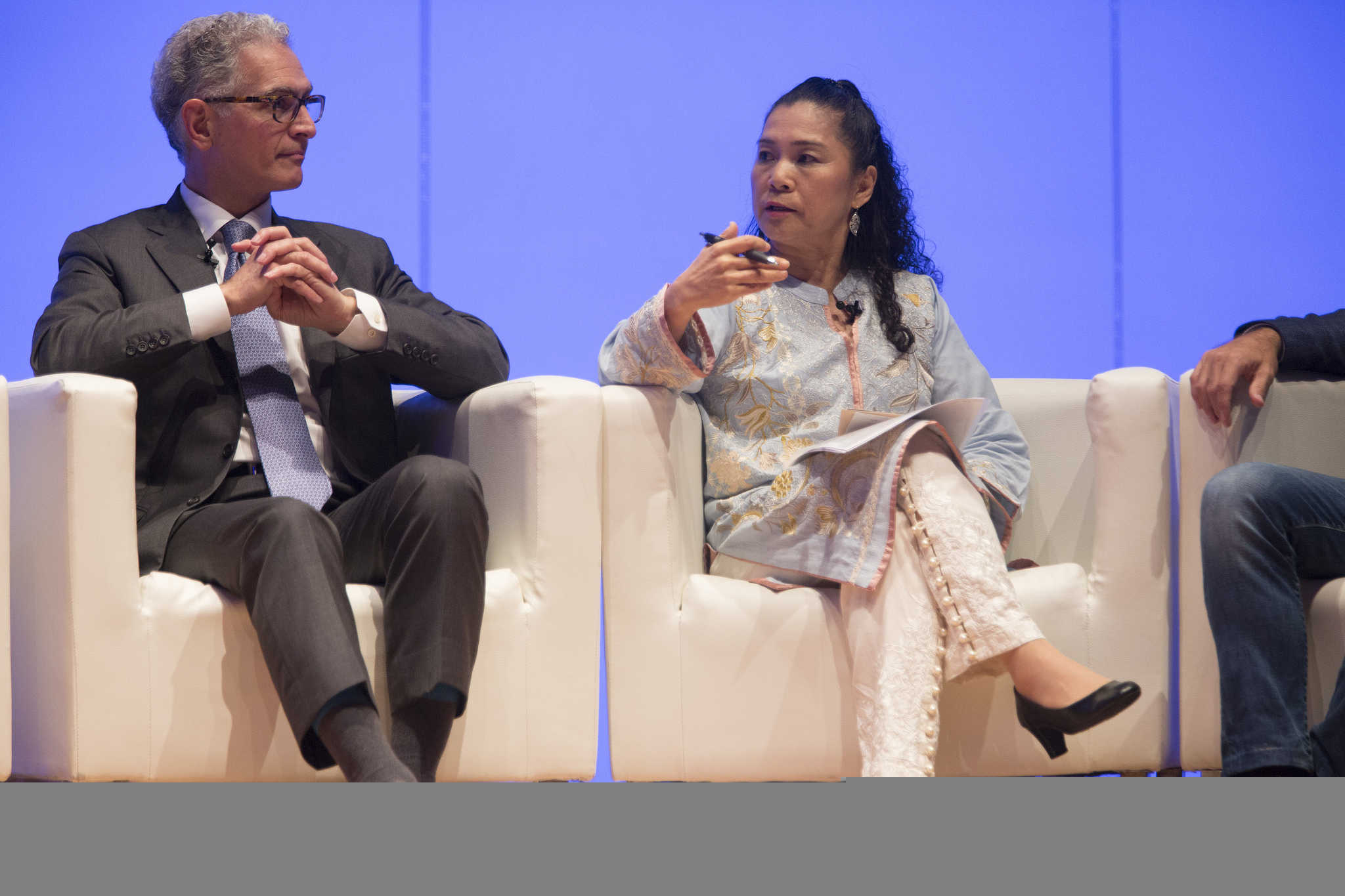
Mark Hoplamazian and Tomoko Nishimoto emphasised the need for the travel industry to set the standards for the future working economy
Kike Sarasola (President and Founder, Room Mate Hotels & BeMate.com) echoed the same point, emphasising how retaining the ‘human touch’ is so crucial within an industry like travel. He argued for the necessity of understanding which roles can be outsourced versus those that are best centrally controlled by the core company.
Of course, there could be no talk of the future workforce without addressing the big “M” in the room – the Millennials. When asked to what degree they have changed the workforce, Hoplamazian was first to admit that the broad age range (17 to 35) is enough to make analysing their specific impact a troublesome process.
He was also quick to emphasise that the generation to follow (Gen-Z) would likely have a radically different perspective/set of priorities when it comes to what they want to do. Thus, preparing a company for the ‘workforce of tomorrow’ should not simply involve mindlessly catering to the wants of every new generation to come.
More crucially, it should involve understanding how these evolving needs can come into play when attracting new talent into the travel industry. Sarasola noted how tourism education is typically quite poor, despite travel being an ever-growing industry. Industry players must therefore strengthen the profile of the industry as a modern, dynamic and fulfilling field of work, by proving what they can offer.
Hoplamazian suggested that the primary appeal in travel rests within its ability to elevate those who enter travel and tourism, providing an opportunity to thrive and develop. Travel has the potential to be a “huge force of addressing economic equality… by welcoming people whose alternative is pretty poor.”
Thus, the travel industry will no doubt feel the impact of the rise of technology and the inevitable effect it has on the new working economy. However, travel, tourism and hospitality must not forget what sets it apart as an industry. It must understand how it can leverage these qualities to not only draw in new talent, but also create a culture of empowerment and fulfilment in the workforce.