
A year is a long time in online travel and that was quite evident when we returned for our second Middle East edition in Dubai last week.
In a region where 60% of the population are under 30 – a generation that can change its habits overnight – and smartphones are nearly as plentiful as sand in the desert, you can bet your bottom dollar that the market will undergo dramatic transformation in the years ahead and I suspect, as usual, travel suppliers will struggle to keep up.
According to emarketeer, UAE has the highest smartphone user penetration – at 73% – and in Dubai, a city of two million people, apparently there are 500 government service apps to allow residents to do everything from paying for your parking and fines, renew passports and eventually use smartphones as passports.
According to Ali Hashmi, Google’s Head of Hotels & Tourism, Middle East & North Africa, travel search queries have risen by 33% year since the last WIT while travel queries via online videos grew 22%. Saudi Arabia and UAE are the biggest markets accounting for 45% and 47% of search and video queries.
Mobile is the fastest growing platform, he said, accounting for 41% of travel search queries in the Middle East and 58% of video travel queries. In Saudi Arabia, the mobile ratio stands at 60%.

WIT’s Yeoh Siew Hoon in conversation with Cleartrip’s Stuart Crighton
Throw into the mix the Millennials which Hashmi also shared data on – and you’ve got a market at inflexion point.
No wonder therefore that Cleartrip is taking a huge bet on mobile, something its CEO and co-founder, Stuart Crighton, said it has been focusing on since 2010, a strategy that it believes will allow it to take the leap to become India’s #1 OTA, and to give it the lead in the Middle East market.
Said Crighton, who was the opening speaker at WIT Middle East, “We have been focusing on our mobile product and strategy for five years now and that’s something we believe at Cleartrip – build a strong product experience and people will come.”
A strong product builds loyalty especially among frequent travellers and allows Cleartrip to rise above the fray of price wars. “There’s always a price war going on,” he said.
Currently, mobile accounts for 51% of searches and 31% of transactions – last year, on the same stage, Cleartrip’s CMO Subramanya Sharma the respective numbers of 32% and 19%, indicating there’s only one way for these numbers to go. It also launched Cleartrip Wallet last year which is gaining traction, said Crighton.
“No one sets out to be the second anything,” said Crighton when asked on stage how it feels to be always number 2. But Cleartrip’s focus on being “the smarter man’s OTA” has allowed it to build up a successful brand in a highly complex and difficult market.
If you read reports in India, you read that Crighton has claimed that Cleartrip has a market share of 23% while Yatra, the third player, has 19-20% in terms of overall gross bookings.
It’s literally “if you can make it in India, you can make it anywhere”. Crighton, who came into travel from a career in energy, set up Cleartrip with his partners after he left Abacus following a short stint in the GDS.
“I still don’t know what a passive segment is,” he admitted. Nevertheless, ignorance has not stopped him and his partners from building an OTA that’s poised for the future, whatever disruption may come its way.
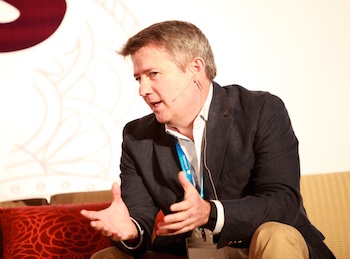
Stuart Crighton: Cleartrip focusing on mobile product and strategy.
It took in a US$40 million investment from Concur and signed a marketing partnership, something Crighton confessed has not yielded much results yet. But it is clear corporate travel – the unmanaged segment which accounts for 70% of the market in India, according to Crighton, is the huge motherlode to mine.
Cleartrip also offers a Cleartrip for Business product and Crighton said at least 50% of its business had a corporate element in it, given the blurring of lines between leisure and corporate.
In July 2014, Concur reported that Airbnb transactions had increased by 27x year-over-year while Uber transactions had climbed 5x. India is Uber’s number 2 market, by the way.
Cleartrip also partnered with Rome2Rio, the multi-modal search engine, and launched Waytogo in India. “Not very original name but rail is huge in India, as you know,” said Crighton. Mobile accounts for up to 90% of rail transactions.
It is also clear it does not want to be known as an Indian OTA in the Middle East. “I rather like ‘the smarter man’s OTA’ tag – the Indian diaspora now accounts for only 40% of our business, so we are not just an Indian OTA anymore,” said Crighton.
Building a brand seems more important in the Middle East than in India, he said, and Cleartrip will invest in building a brand and trust among customers in the region.
Its focus on local content, user experience, mobile and payments should position it well in the Middle East where no clear leader has yet emerged in the OTA space. (Of course, in the hotel space, Booking.com is the clear leader and no one seems able to break that monopoly with no local players really building strong, local content.)
While MakeMyTrip has opted for a public listing, Crighton said there were no plans for an end game for the co-founders except to “keep doing what we love and innovating. There’s still so much to do.”
“Seven to eight years ago, we disrupted traditional travel and now new forces are disrupting us. You realise how vulnerable you are – I mean, we are now seen as a legacy business – and so we have to continue to innovate, to disrupt ourselves.”
One thing’s for sure though. If grit and persistence are what it takes, then Crighton is well-built for the battle ahead.
The road to building Cleartrip has clearly not been easy. A personal law suit in 2009 filed by Sabre/TripGuru made him shy away from the limelight and was a challenging time for him and his family.
It’s not something he likes to talk about still but it’s clearly an experience that has strengthened, not weakened him for the next dawn ahead.
• Featured image credit (mobile in pocket): sb-borg/iStock