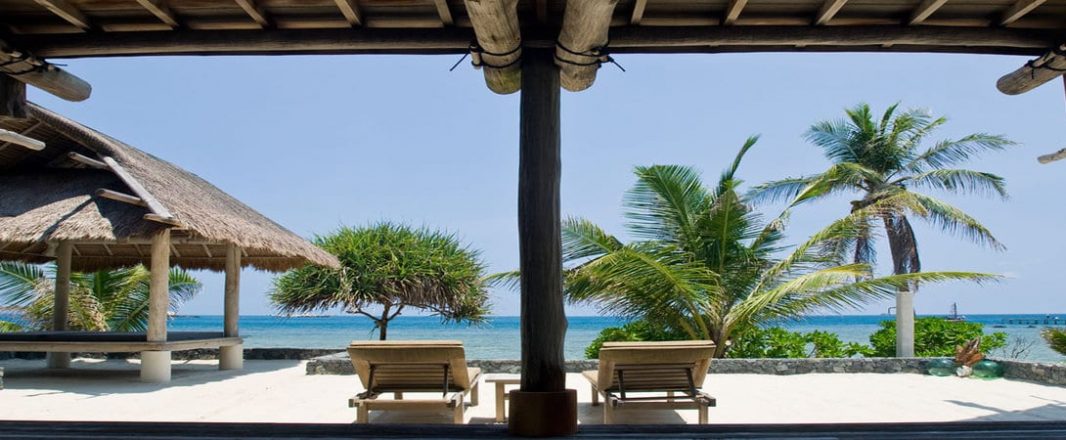

Building and operating a resort in a remote island – access was by ferry from Singapore to Bintan and then another car and boat ride away – wasn’t easy by any stretch of the imagination. But deep down, he knew he was onto a good thing and so he persevered.
A year after opening in 2007, the resort hit its stride and started running full house – first over weekends – and then it began to even out. Today, Nikoi Island runs year-round 90% with average rates of well over S$300. Up to 50% of guests are from outside Singapore, a ratio that surprised Dixon as he had expected a higher percentage from Singapore.
Now five years later, the modern-day Robinson Crusoe is ready for his next island adventure. Ground has broken on a new development on Bawah, part of the Anambas Islands in Indonesia’s Riau province – an area that is being touted as the new Maldives.
Twenty luxury tented camps are being built on a cluster of five islands and are set to open by 2014. It will be open only to couples, no kids allowed. Bawah will be priced around US$400 a night.
While Nikoi does cater to families, one surprise Dixon found was that the highest occupancies were for the one-bedroom houses, and couples are by far the biggest returning customers.
Another island of 17 hectares is also being eyed for development and he’s planning to build an all-bamboo resort, where rooms will come with plunge pools. Again, he’s pitching this as a couple’s retreat.
His idea is to market Bawah as a base for expeditions. “The whole area is very unexplored and during the last expedition a decade ago, they discovered several new species. So we will have a resident marine biologist to help us record discoveries and take guests out on expeditions.” 
For easier access, he’s working on seaplane flights out of Singapore, either from Seletar air base or who knows, maybe even in Marina Bay.
“This is Singapore’s Maldives,” he said. “Imagine having seaplanes land and take off in Marina Bay?”
He is aware that he wouldn’t have been able to do all this without the Internet. “This is why there’s such an explosion of small, boutique hotels – we wouldn’t be able to market and sell without the Internet.”
Almost 100% of bookings are website-direct. The only OTA he works with is i-escape. His booking engine is provided by Asia Travel. Last year, he spent S$2,000 on Facebook ads – that’s the extent of his marketing budget. His Facebook page is managed by him personally and he posts once or twice a week.
His site is optimized of course and he is also clever at optimizing media coverage. A write-up in the New York Times in 2009 continues to give him business today, he said. “In the old days, we wouldn’t be able to refer to this article but today it’s archived on our site.”
He works with four or five traditional travel agents who sell Nikoi as part of an overall package but he finds this process a tad complicated and often, he has to manage expectations of customers. “We prefer to under-sell.”
Sixty percent of his business is through word of mouth, and 20% comes from TripAdvisor where he pays US$500 for a business listing. “We take reviews very seriously,” he said. He had a tough time initially being listed on TripAdvisor as a hotel as the resort didn’t tick all the boxes – but eventually it got past that. Today, it’s ranked number one in Bintan.
Asked if Nikoi’s success is due to brilliant marketing, Dixon said, “No. We hit a sweet spot. People were looking for new places, travel became more experiental and people became bored with an air-con room and television. It’s not much fun fighting for a seat by the pool. To me, the real luxury of Nikoi is the space – 15 hectares for 50 people at any one time.”